Transformer component manufacturing is gaining importance as India expands its electricity transmission infrastructure and demand for high-voltage equipment grows.
Transformers and Rectifiers (India) Limited (TARIL) has announced an investment of Rs 1,250 crore to establish three greenfield manufacturing plants at its Chiyada manufacturing complex in Gujarat.
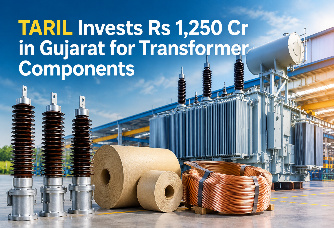
The facilities will produce transformer bushings, pressboard and insulation materials, and continuously transposed conductors (CTC).
They are expected to generate annual revenue potential of Rs 2,000 crore and create more than 1,000 direct jobs once fully operational.
Beyond the investment, the expansion highlights how component availability can influence India's power-equipment manufacturing capabilities.
According to the company, the bushing facility will manufacture oil-impregnated paper (OIP), resin-impregnated paper (RIP) and resin-impregnated fibre (RIF) bushings rated up to 800 kV.
The second facility will manufacture pressboard and insulation materials, which help maintain electrical insulation within transformers.
The third will produce continuously transposed conductors, which are used in transformer windings to manage electrical losses and support performance.
Construction began in December 2025, with commercial operations expected to start in the first quarter of FY2027–28, covering April to June 2027. The plants will operate under a wholly owned consolidated ancillary subsidiary.
The investment also supports the company's vertical integration strategy. By bringing more production processes in-house, TARIL aims to improve component availability, manage manufacturing lead times and reduce its dependence on external suppliers.
Also Read: Commercial EV Charging Hub Installation Guide in India 2026
Transformer component manufacturing is an important part of the wider power equipment supply chain.
Even when manufacturers have sufficient assembly capacity, shortages of specialized components can affect production schedules and equipment deliveries.
Bushings designed for extra-high-voltage applications require specialized materials, engineering and quality testing. Similarly, insulation products and CTC require controlled manufacturing processes to meet the performance requirements.
India's transmission network needs equipment to connect generating capacity, strengthen grid reliability and accommodate electricity demand from industrial expansion and renewable energy projects.
However, additional manufacturing capacity does not automatically eliminate supply constraints. The impact will depend on commissioning schedules, product qualification, and production yields.
TARIL expects the three facilities to generate approximately Rs 2,000 crore in annual revenue and more than 1,000 direct jobs across engineering, manufacturing, operations, quality assurance and research and development when fully operational.
Producing critical inputs domestically can give manufacturers greater visibility over material availability and reduce exposure to external supply disruptions. The development highlights the role of backward integration in strengthening supply-chain resilience.
Consistent quality, competitive costs and reliable deliveries will remain essential for serving transformer manufacturers and infrastructure customers.
TARIL's investment illustrates how expanding production beyond finished equipment to specialized components can support a more integrated manufacturing ecosystem.
As India's power network develops, the availability of these inputs will remain an important consideration for the capacity and reliability of the domestic transformer industry.






We use cookies to ensure you get the best experience on our website. Read more...