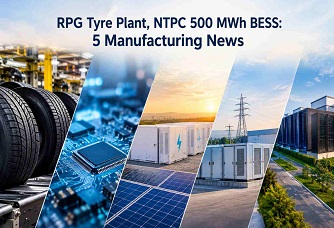
The Indian manufacturing industry is seeing new developments across automotive production, AI infrastructure and energy systems, with implications for domestic supply chains and industrial investment.
RPG Group is exploring a greenfield tyre plant in Madhya Pradesh, while the Ministry of Electronics and Information Technology (MeitY) is preparing an AI regulation consultation paper alongside plans to expand India's computing infrastructure.
Meanwhile, AmpereHour Energy and Ampt are targeting more efficient battery storage systems, NTPC's subsidiary NVVN is preparing to operationalize 500 MWh of storage capacity, and ReNew has signed an MoU for a Rs 70,000 crore green data center park in Maharashtra.
These developments highlight opportunities in manufacturing localization, equipment supply and infrastructure readiness.
RPG Group is exploring the possibility of establishing a greenfield tyre manufacturing plant in Madhya Pradesh, where it already operates a facility in Jabalpur.
Chairman Harsh Goenka discussed the expansion possibility following a meeting with Chief Minister Mohan Yadav. However, the investment amount and production capacity remain undecided.
Beyond the potential investment, the proposal raises questions about the state's ability to attract supporting automotive suppliers.
A new facility could create opportunities for tyre-component manufacturers, rubber processors, logistics providers and industrial service companies if the project proceeds.
The scale of these benefits will depend on the final investment, capacity and sourcing strategy. The proposal also puts the spotlight on Madhya Pradesh's potential to deepen its automotive manufacturing base beyond existing industrial clusters.
Also Read: Indian Air Force at 94: From Four Aircraft to Modern Air Power
The Ministry of Electronics and Information Technology plans to release an AI regulation consultation paper within a month, according to Electronics and IT Minister Ashwini Vaishnaw.
The government estimates a requirement for 10,000 GPUs, with the first tender expected to cover 5,000 units. Vaishnaw also highlighted progress towards indigenous GPU development, particularly for AI inference.
For India's manufacturing ecosystem, the opportunity extends beyond chip design to semiconductor packaging, server assembly, power systems and cooling equipment.
However, domestic GPU development will require technical capabilities and a supporting electronics supply chain. The procurement plan could improve demand visibility, but it does not by itself confirm that the GPUs will be manufactured locally.
AmpereHour Energy has partnered with US-based Ampt to distribute and service its direct-to-battery technology and DC power-management products across India, South Asia, West Asia and Africa.
The companies are targeting solar-plus-storage projects, data centers, EV charging infrastructure and other applications.
Ampt's architecture connects solar photovoltaic arrays directly to a battery's DC bus, potentially eliminating the need for a dedicated battery converter.
This configuration could reduce equipment costs and improve energy efficiency, depending on project design. The commercial opportunity will depend on how effectively developers can translate these potential benefits into lower installation costs and better system performance.
NTPC subsidiary NVVN is preparing to begin commercial operations for 500 MWh of battery energy storage capacity.
It also aims to commission another 500 MWh during the current financial year under a government-backed 3,000 MWh scheme. The milestone shifts attention from announced projects to commissioning and operational readiness.
Utility-scale storage can help manage peak demand and integrate renewable electricity, but deployment also requires reliable battery systems, power-conversion equipment, controls and grid integration.
Progress in these areas could create opportunities for domestic equipment suppliers and system integrators as India's battery storage market expands.
ReNew's subsidiary has signed an MoU with the Maharashtra government for a proposed 750 MW green data center park in the Mumbai Metropolitan Region. The Rs 70,000 crore project is expected to begin operations in phases from 2028 and is planned to use 51 percent green power.
Dedicated infrastructure, including two incoming feeders from independent sources, is also envisaged. For manufacturers, the project could generate demand for transformers, switchgear, cooling systems, backup power equipment and electrical components.
Local suppliers may benefit if they meet the project's technical and reliability requirements. However, the MoU represents a proposed development, and actual procurement opportunities will depend on execution, investment phasing and vendor selection.







We use cookies to ensure you get the best experience on our website. Read more...