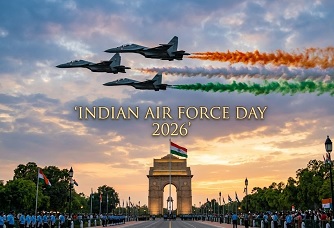
Four aircraft marked the beginning of India's air power. Today, the Indian Air Force operates fighters, helicopters, transport aircraft, air-defense systems and unmanned platforms built around increasingly networked warfare.
The journey from those four Westland Wapitis to Tejas, Rafale and drone-enabled operations has taken 94 years. Along the way, wars exposed operational gaps, new aircraft changed the nature of combat, and advances in technology expanded the role of air power beyond conventional fighter operations.
The force has also evolved alongside India's own aerospace ambitions, moving gradually from dependence on foreign aircraft toward indigenous development, local manufacturing and increasingly complex defense systems. From the airlift of troops into Srinagar in 1947 to precision operations during Kargil and the growing use of unmanned systems today, the Indian Air Force has repeatedly adapted to changing battlefields and national security requirements.
The Indian Air Force was established on October 8, 1932, under the Indian Air Force Act. Its first operational flight took place on April 1, 1933, from Drigh Road in Karachi, then part of British India. No. 1 Squadron began with four Westland Wapiti IIA aircraft, six RAF-trained officers and 19 Havai Sepoys. Its initial role centered on army cooperation and reconnaissance.
World War II became the first major test. The force expanded and Indian personnel took part in operations in the Burma theater, gaining experience in reconnaissance, ground support and other missions. Its contribution during the war also led to the force receiving the prefix "Royal" in 1945.
Independence brought a completely different challenge. During the 1947–48 Jammu and Kashmir conflict, air transport became critical to India's military response. On October 27, 1947, Indian troops were airlifted to Srinagar, demonstrating how quickly aircraft could move forces and supplies into a difficult battlefield.
India became a republic in 1950, and the "Royal" prefix was dropped. The following decades would transform the force from a relatively small air arm into a major component of India's defense structure.
The IAF's evolution cannot be understood without looking at the conflicts that forced it to adapt. The 1962 India-China war highlighted the difficulties of operating across the Himalayas and reinforced the importance of air transport and logistics. The experience also exposed gaps in India's preparedness for high-altitude operations.
The 1965 India-Pakistan war brought extensive air combat experience. Aircraft such as the Gnat, Hunter, Mystère and Canberra played important roles. The conflict showed that controlling the skies could directly influence operations on the ground. Six years later, the 1971 war demonstrated the value of air superiority on a much larger scale. The IAF conducted strikes against military targets, supported ground operations and helped establish air superiority in the eastern theater. The campaign ended with the creation of Bangladesh.
The challenges then moved beyond conventional battlefields. In 1984, the IAF supported Operation Meghdoot in the Siachen region, using helicopters and transport aircraft to sustain troops in one of the world's highest and most difficult military environments. Its role also expanded outside India's borders. In 1987, Operation Poomalai involved the air-dropping of relief supplies over Jaffna in Sri Lanka. The IAF later provided transport and operational support during Operation Pawan, India's peacekeeping mission in Sri Lanka.
Then came Kargil.
Also Read: How 2025 Reshaped the Drone Sector and What 2026 Will Bring
During the 1999 Kargil War, the IAF launched Operation Safed Sagar against Pakistani positions in high-altitude terrain.
The operation presented a very different challenge from conventional air warfare. Aircraft had to operate around steep mountains while striking targets located at extreme elevations. Mirage 2000 aircraft became particularly important for precision attacks.
Kargil showed that modern air power was no longer simply about sending large numbers of aircraft into the sky. Accuracy, sensors, weapons, intelligence and the ability to operate in difficult terrain were becoming equally important.
Aircraft tell another version of the Indian Air Force story. The MiG-21 became one of the defining fighters of the force after its induction in the 1960s. It remained in service for more than six decades and became closely associated with several generations of Indian military aviation. Its final flight in IAF service took place on September 26, 2025, marking the end of one of the longest chapters in India's fighter history.
The aircraft that followed reflected a growing range of requirements. The Jaguar strengthened India's strike capability. The Mirage 2000 became closely associated with precision operations. The Su-30MKI brought heavy multirole fighter capability. The Rafale added advanced sensors, weapons and electronic warfare capabilities.
But perhaps the most significant shift is represented by Tejas. Tejas is not simply another fighter entering the IAF's fleet. It represents India's effort to develop an indigenous combat aircraft and build capabilities across the country's aerospace manufacturing ecosystem. Its development has involved a long chain of Indian organizations, suppliers, engineers and manufacturers. That makes the aircraft important beyond the battlefield.
The modern Indian Air Force is moving beyond a fighter-centric view of air power. Today's battlefield is increasingly connected. Aircraft need to work with radars, air-defense systems, satellites, command networks, electronic warfare systems and unmanned platforms. The ability to collect, process and share information can be as important as the aircraft carrying the weapon.
This shift was visible during Vayushakti-26, conducted in February 2026. More than 130 aircraft participated in day and night operations involving fighters, transport aircraft, helicopters and remotely piloted aircraft. The exercise also included precision-guided weapons, air-defense systems and counter-unmanned aerial systems.
Drones are becoming particularly important. They can perform surveillance, carry weapons and operate in situations where sending a conventional aircraft may be more expensive or risky. Counter-drone systems are therefore becoming an equally important part of air defense.
Operation Sindoor in 2025 also added a recent chapter to India's experience with integrated air operations and precision strikes. The operation has further sharpened attention on long-range weapons, air-defense networks, indigenous systems and the ability to combine different capabilities during military operations.
This is perhaps the biggest change in the IAF's 94-year journey. In its early years, India depended heavily on foreign aircraft and technology. Over time, the focus moved toward local maintenance, licensed production, technology development and eventually indigenous design.
Tejas is part of that transition. So are India's growing efforts in unmanned systems, helicopters, radar, electronic warfare and other defense technologies. The objective is no longer simply to acquire a better aircraft. It is to develop an ecosystem capable of designing, manufacturing, upgrading and supporting complex military systems within India.
That makes the future of the force closely linked with India's aerospace and defense manufacturing ambitions.
At 94, the Indian Air Force stands at another turning point. The force that started with four biplanes now has to prepare for a battlefield where fighter jets will operate alongside drones, sensors, precision weapons, electronic warfare systems and increasingly autonomous technologies.
The next transformation may therefore not be defined by one aircraft in the way the MiG-21 or Rafale has been. It could be defined by how effectively different platforms communicate, share information and operate as one system.
From four Wapitis in 1933 to an increasingly connected force in 2026, the history of the Indian Air Force is ultimately a story of adaptation. Every war exposed a new requirement. Every technological shift created a new capability. And every generation of aircraft moved India a step closer to building air power on its own terms.






We use cookies to ensure you get the best experience on our website. Read more...