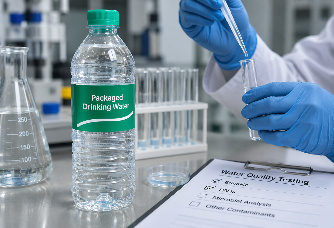
Packaged drinking water safety has come under scrutiny after the Food Safety and Standards Authority of India (FSSAI) declared a Bisleri water sample unsafe and sanctioned prosecution against the company.
The sample, collected from its Goa manufacturing facility in September 2025, reportedly failed laboratory tests involving bromate and polynuclear aromatic hydrocarbons (PAHs).
Following the findings, the government plans to expand testing of packaged drinking water brands across India.
The development has renewed questions about quality control, chemical contamination and regulatory oversight in the country's bottled water industry.
Also Read: How India's Government Policies Support Chemical Manufacturing (2026 Strategy Guide)
According to Bisleri, FSSAI collected six samples from its Goa facility on September 30, 2025. Five initially met the applicable standards, while one recorded bromate at 12 micrograms per liter, exceeding the prescribed limit of 10 micrograms per liter.
Following the company's appeal, a referral laboratory found bromate within the prescribed limit but separately detected PAHs. The regulator declared the sample unsafe and sanctioned prosecution under the Food Safety and Standards Act, 2006.
Bisleri subsequently commissioned independent testing at an FSSAI-approved laboratory, which it said found bromate within the permissible limit. The company also said it submitted the results to FSSAI in February 2026 and maintained that its products were safe.
Bromate can form during certain water disinfection processes, particularly ozonation. The World Health Organization identifies it as possibly carcinogenic to humans and sets a provisional drinking-water guideline of 10 micrograms per liter.
PAHs are a group of chemical compounds that can enter the environment through processes such as incomplete combustion. Some PAHs are known carcinogens, while others have different toxicity profiles.
Prolonged exposure to certain PAHs has been associated with increased cancer risk and other health effects.
The government plans to test packaged drinking water brands across India following the Bisleri case. The exercise could bring greater attention to manufacturing practices, laboratory testing and compliance across the industry.
FSSAI introduced a mandatory testing scheme for packaged drinking water and mineral water from January 1, 2026, following the removal of mandatory BIS certification.
The scheme requires food business operators to comply with prescribed testing requirements to ensure product safety.
The latest action highlights the importance of independent quality checks beyond brand reputation. However, the Bisleri findings concern a specific sample and should not be treated as evidence that all products or batches from the company are unsafe.
The outcome of the regulatory proceedings and nationwide testing will be important in determining the wider implications for India's packaged water industry.
Strengthening quality monitoring and regulatory compliance will be essential to maintaining packaged drinking water safety and rebuilding consumer confidence in the industry.







We use cookies to ensure you get the best experience on our website. Read more...