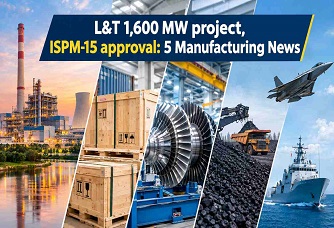
The Indian manufacturing industry is seeing fresh activity across power infrastructure, export supply chains, industrial equipment and defense production.
Keralam has sought a dedicated power plant from NTPC while also advancing battery storage projects.
Jay Wood Industry has secured ISPM-15 approvals for its Kosamba facility, and L&T has received an initial go-ahead for a 1,600 MW ultra-supercritical project in Jharkhand.
NTPC is also considering buying more coal from private commercial miners. Separately, HAL delivered its 2,000th aero-engine while Hindustan Shipyard launched the first Fleet Support Ship, Surya.
Together, these developments highlight how manufacturing capacity increasingly depends on reliable power, compliant supply chains and domestic production capabilities.
Keralam's request for a dedicated NTPC power plant comes as the state looks to address growing electricity requirements.
The plan is being pursued alongside a 2,000 MWh battery energy storage system at Kayamkulam, two 80 MWh projects and up to 300 MW from NTPC's Sinnar plant.
For manufacturers, the significance extends beyond additional generation. Reliable electricity is essential for continuous-process industries, engineering units and other energy-intensive operations.
Keralam's combination of additional generation, storage and grid management could therefore become part of its strategy to strengthen industrial power security as manufacturing demand expands.
Also Read: Ethanol Epidemic in India: Factory Pollution, Vehicle Problems & More
Jay Wood Industry's ISPM-15 approvals for its Kosamba facility allow it to supply heat-treated wooden pallets, crates and dunnage for international shipments.
The facility is positioned to serve industrial clusters across Gujarat and Maharashtra, as well as export corridors including Mundra, Hazira and Nhava Sheva.
The development highlights a less visible part of India's manufacturing supply chain. Exporters in pharmaceuticals, chemicals, FMCG, auto components and heavy engineering also depend on compliant packaging to move products internationally.
Expanding local ISPM-15 infrastructure can therefore reduce a logistical constraint for manufacturers seeking reliable export-ready packaging.
L&T's Limited Notice to Proceed for the 1,600 MW Chandrapura project covers two 800 MW ultra-supercritical units. Its scope includes the design, manufacturing, supply, installation and commissioning of boilers, steam turbines, generators and electrostatic precipitators.
The project therefore represents more than new generation capacity. It creates demand across India's thermal power equipment ecosystem, including engineering, fabrication and component suppliers.
The continued deployment of ultra-supercritical technology also indicates that higher-efficiency thermal equipment remains relevant even as India's overall power system adds substantial renewable capacity.
NTPC's potential purchase of up to 10 million tons of coal from commercial mines points to a broader shift in fuel procurement. According to credible sources, NTPC is considering greater purchases from private miners as electricity demand rises and coal stocks at its plants have fallen sharply.
The development could strengthen the role of commercial coal producers in India's thermal power supply chain.
For the manufacturing sector, dependable fuel availability matters because coal shortages can constrain generation and, in turn, affect industrial electricity supply.
NTPC's procurement strategy could therefore influence both private mining investment and the reliability of thermal power.
HAL's Koraput division has delivered its 2,000th aero-engine, while the government announced a second Shakti engine production line with Rs 218 crore investment and an increase in AL-31FP production capacity from 30 to 50 engines annually.
At Hindustan Shipyard Limited, the first indigenous Fleet Support Ship, Surya, was launched alongside the keel laying of the fifth ship and upgrades to shipyard infrastructure. The five vessels have more than 82 percent indigenous content.
Together, the developments point toward a broader expansion of Indian defense manufacturing.
The focus is increasingly shifting from assembling platforms to building propulsion, shipbuilding infrastructure, specialized components, and supplier ecosystems domestically.





We use cookies to ensure you get the best experience on our website. Read more...