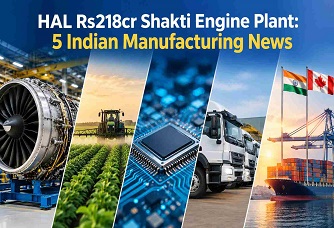
Indian manufacturing is seeing new capacity, technology and supply-chain opportunities across defense, agriculture, mobility and semiconductors.
HAL is set to add a second Shakti engine production line at Koraput with a Rs 218 crore investment, while marking delivery of its 2,000th aero-engine.
Aries Agro has expanded annual manufacturing capacity to 101,400 MT after commissioning a 6,000-MT facility in Gujarat.
Hinduja Group is scaling its Uttar Pradesh footprint, including doubling Ashok Leyland’s Lucknow production capacity.
Meanwhile, BigEndian has secured Rs 130 crore from the Technology Development Board for an indigenous AI Vision SoC, and India-Canada CEPA talks are focusing on critical minerals, energy, aerospace and AI. The common thread is deeper domestic industrial capability.
Hinduja Group’s Uttar Pradesh expansion extends beyond a single investment announcement.
The group plans to double Ashok Leyland’s Lucknow plant capacity from 2,500 to 5,000 vehicles a year, while also pursuing a pumped-storage project estimated at more than Rs 1,000 crore and expanding digital connectivity through Project GANGA.
The manufacturing opportunity is whether these projects can create stronger industrial linkages within Uttar Pradesh. For mobility, higher vehicle output can support demand for local components, logistics and engineering services.
The bigger question is whether capacity expansion can translate into a wider supplier ecosystem rather than remaining an individual plant-level investment.
Also Read: Green Logistics: The Next Frontier in the Oil & Gas Sector
Aries Agro’s new 6,000-MT Sayakha facility has taken its annual manufacturing capacity to 101,400 MT, alongside a 30-location depot network and greater automation at its Vijayawada and Nashik facilities.
The company has also identified backward integration and climate-resilient agricultural solutions as future priorities. That makes the development more significant than a straightforward capacity addition.
Backward integration could give agricultural-input manufacturers greater control over production inputs, quality and supply reliability.
Aries’ expansion also shows how manufacturing growth is increasingly being combined with digital traceability, product development and agricultural equipment, creating a more integrated agri-input ecosystem.
HAL’s second Shakti engine production line at Koraput, backed by Rs 218 crore, will support the growing requirements of Dhruv and Prachand helicopters.
The facility’s 2,000th aero-engine milestone also highlights Koraput’s long-standing role in India’s engine manufacturing and overhaul capabilities. The larger manufacturing story is propulsion localization.
The Shakti program is an Indo-French initiative between HAL and Safran Helicopter Engines, making the next challenge not merely higher output but deeper domestic capability around aero-engine components, precision manufacturing, maintenance and supply chains.
Increasing production could therefore strengthen the industrial base supporting India’s indigenous helicopter programs.
The fifth round of India-Canada CEPA negotiations is taking place with energy, critical minerals, aerospace and AI among the priority areas.
Bilateral goods and services trade reached USD 30.4 billion in 2025, while both countries are targeting USD 70 billion in annual trade by 2030.
For Indian manufacturing, the critical-minerals component could prove more consequential than the headline trade target.
Canada could become a source of minerals and upstream inputs needed for India’s automotive, EV and battery sectors, helping manufacturers diversify supply chains.
The opportunity will depend on whether cooperation progresses beyond raw-material trade into processing, technology and value-added manufacturing.
Also Read: PM Surya Ghar Muft Bijli Yojana 2026: Rooftop Solar Subsidy, Installation & Online Application
BigEndian has received Rs 130 crore from the Technology Development Board for Project VeerAI, a Rs 260 crore program intended to take its indigenous AI Vision SoC from Technology Readiness Level 5 to TRL-9.
The chip initially targets CCTV and surveillance, with potential applications in defense, automotive, industrial and medical sectors.
The key manufacturing gap is commercialization. India has been strengthening semiconductor design capabilities, but the industrial value comes when domestic designs move through validation, testing, integration, and scale-up into deployable products.
BigEndian’s project therefore illustrates the next stage of India's semiconductor push: converting indigenous chip design into commercially viable, application-specific hardware.




We use cookies to ensure you get the best experience on our website. Read more...