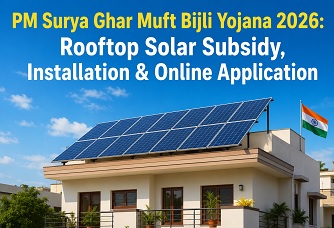
Electricity bills keep rising for most Indian households. The government's answer is the PM Surya Ghar Muft Bijli Yojana.
It was launched in February 2024 with a central outlay of nearly INR 75,000 crore. The scheme lets households generate their own power. It also promises up to 300 units of free electricity every month. As of mid-2026, more than 40 lakh homes have already gone solar. The pace is accelerating fast.
This article covers everything a homeowner needs to know before applying for PM Surya Ghar Muft Bijli Yojana. You'll find the latest subsidy slabs for 2026, and who qualifies. We explain the exact online application steps on the national portal.
The PM Surya Ghar Muft Bijli Yojana is the Government of India's flagship rooftop solar program. The Union Cabinet approved it on February 29, 2024. Its budget outlay is approximately INR 75,021 crore. The scheme's target is bold: solar panels on 1 crore rooftops by FY 2026-27. That's 10 million homes.
The core objectives are simple:
India's rooftop solar market grew 125 percent year-over-year in early 2026, according to Mercom India Research. Residential installations alone made up 82 percent of all new capacity added. Cumulative grid-connected rooftop capacity crossed 30 GW by May 2026. That's up from 27.88 GW just months earlier. Maharashtra, Uttar Pradesh, and Gujarat led state-wise installations.
Raj Prabhu, CEO of Mercom Capital Group, has credited this growth to strong residential demand under the scheme. He has also cautioned that faster DISCOM approvals will matter more going forward. Financing access will also decide how quickly the segment scales. The daily numbers back this up too. Rooftop additions rose from around 5,000 systems a day in October 2025. By July 2026, that number crossed 16,000 a day.
The subsidy is calculated per kilowatt (kW) of installed capacity. It gets capped once a system crosses 3 kW. Here's the exact 2026 breakup:
Also Read: Why These 7 CleanTech Founders Are the Face of Green Transition
Group Housing Societies and Resident Welfare Associations get a separate slab. They receive INR 18,000 per kW for shared facilities, including EV charging points. This applies up to 500 kW total capacity. Each individual home within the society is capped at 3 kW.
State Top-Ups
Several states add their own incentive on top of the central subsidy. Gujarat, Maharashtra, Uttar Pradesh, Tamil Nadu, and Rajasthan currently offer extra support. This ranges from INR 10,000 to INR 40,000 per household. A Gujarat household could realistically cross INR 1,00,000 in combined subsidy for a 3 kW system.
Not every household qualifies automatically. The scheme's eligibility checklist includes:
For Group Housing Societies, the RWA or society management applies on behalf of common areas. Per-unit capacity within the society stays capped at 3 kW for subsidy purposes.
The entire process runs throughone official website: pmsuryaghar.gov.in. This is the national portal for rooftop solar. Keep your electricity consumer number ready. You'll also need your Aadhaar-linked mobile number and bank details.
 Sign up with your state, DISCOM name, and electricity consumer account number. Verify via OTP on your Aadhaar-linked mobile
Picking the right installer matters as much as picking the right panel brand. A vendor must be empaneled with both the national portal and your state DISCOM. Empanelment in one DISCOM zone doesn't automatically carry over to another.
Before finalising a vendor, check for:
Shreya Mishra, Co-founder and CEO of solar company SolarSquare, has spoken about this gap. Around 11,000–12,000 vendors are registered nationally under the scheme. But only 7,000–8,000 are actively operating. This uneven vendor quality is exactly why homeowners should verify empanelment status directly on the portal. Don't just take a salesperson's word for it.
Net metering lets a home draw power from the grid at night. It also lets you export surplus daytime solar power back to the grid. Here's how the last mile works:
.jpg) After installation, the DISCOM schedules a physical inspection of wiring and safety compliance
After installation, the DISCOM schedules a physical inspection of wiring and safety complianceDelays at this stage usually trace back to incomplete documentation. A mismatch between applied and installed capacity is another common cause. Double-checking the commissioning report before submission saves weeks of back-and-forth. According to figures shared with the Rajya Sabha, over INR 14,771 crore in subsidies had already been disbursed by early 2026. More than 26 lakh households have benefited so far.
Not every household wants to pay the full amount upfront. Twelve Public Sector Banks, including SBI, Canara Bank, Union Bank, and Bank of Baroda, offer dedicated solar loans under the Surya Ghar Muft Bijli Yojana. These are routed through the JanSamarth portal.
For systems above 3 kW, loans up to INR 6 lakh are available. Amounts beyond INR 2 lakh may require the solar asset to be hypothecated to the bank. Several banks also offer combined home-loan-plus-solar packages. These finance up to 90 percent of the total project cost. Meanwhile, the World Bank approved an USD 890 million financing package in July 2026 to back the scheme. This move is expected to unlock roughly USD 4.2 billion in additional private-sector solar financing over the coming years.
The single most common reason is using a non-ALMM-listed inverter or panel. Equipment must match the MNRE's approved list exactly. Even a correct-looking model number can forfeit the entire subsidy if it isn't officially listed.
Check the application status on the portal first. If the commissioning report shows "accepted" but payment hasn't arrived after 30–45 days, contact the PM Surya Ghar helpline directly. Don't rely only on following up with the vendor.
No. The central subsidy is capped at INR 78,000 no matter how big the system is. Only state-level top-ups, where applicable, add extra value beyond that cap.

.jpg "AR Enterprises: Building The Supply Networks Behind India's Construction Growth")
.jpg "Industrial Packers: Engineering Industrial Packaging for India's Manufacturing Future")




We use cookies to ensure you get the best experience on our website. Read more...