Indian manufacturing sector is increasingly shifting from capacity announcements to the deeper question of how much value India can retain within its industrial ecosystem.
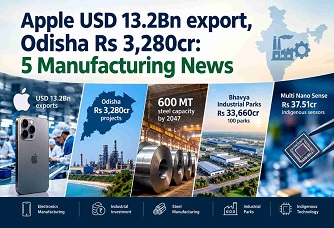
Apple’s USD 13.2 billion iPhone exports, Odisha’s Rs 3,280.58 crore project approvals and the Centre’s Rs 33,660 crore Bhavya industrial park program point to expanding manufacturing activity.
At the same time, the proposed 600 MT steel capacity target and a Rs 37.51 crore technology support program for Multi Nano Sense highlight gaps around technology, localization and industrial supply chains.
These developments indicate that India’s next manufacturing phase will depend not only on creating factories, but also on strengthening components, technology, infrastructure and domestic supplier networks.
Apple’s iPhone exports from India reached USD 13.2 billion in the first five months of the current fiscal year, a 47 percent year-on-year increase. The figure underlines the rapid expansion of electronics manufacturing and India's growing role in Apple’s global production network.
However, the larger manufacturing question is how much of this export value is generated domestically. India has already built significant final-assembly capacity, but the next opportunity lies in components, sub-assemblies, tooling and other production inputs.
The recently completed smartphone PLI program generated Rs 11.62 lakh crore in output, while newer schemes are shifting attention toward domestic sourcing and component manufacturing.
Also Read: Green Factories: How ESG-Driven Manufacturing Attracts Investors
The government has extended applications for the second phase of the Bharat Audyogik Vikas Yojana (Bhavya) industrial parks program until October 31.
The Rs 33,660 crore initiative aims to establish 100 investment-ready, plug-and-play industrial parks, with the first round attracting 87 proposals. The manufacturing gap is whether these parks can develop into complete industrial ecosystems rather than simply providing serviced land.
Manufacturers also require reliable power and water, logistics, testing facilities, warehousing and nearby component suppliers. For MSMEs, proximity to anchor manufacturers and shared infrastructure could determine whether these parks actually reduce the cost and complexity of setting up production.
Odisha has approved 19 projects worth Rs 3,280.58 crore across sectors including technical textiles, steel downstream manufacturing, chemicals, plastics, compressed biogas and food processing. The projects could generate 10,661 jobs across 10 districts.
The more significant development is the spread of value-added manufacturing. Three approved steel downstream projects alone represent more than Rs 350 crore, while Shri Dakshineshwari Maa Polyfabs plans a Rs 401.63 crore PP woven and non-woven manufacturing facility.
This creates an opportunity for Odisha to strengthen local supplier networks around its traditional resource base, moving further from primary production toward fabrication, processing and specialized manufacturing.
The proposed National Steel Policy targets more than 600 MT of steelmaking capacity, over 500 MT of consumption and around 45 MT for direct or indirect export by 2047.
It also identifies AI, machine learning, technology upgrading and decarbonization as priorities. India currently has around 220 MT of crude steel capacity, while 175 specialty-steel projects involving Rs 55,000 crore are underway.
Yet Steel Secretary Sandeep Poundrik has highlighted India’s continuing dependence on foreign steelmaking technologies. That makes indigenous process technology, automation and energy-efficient production an important part of the capacity expansion story.
The proposed Rs 5,000 crore scheme for smaller producers also links incentives to production and carbon reduction.
The Technology Development Board has committed Rs 37.51 crore to Nagpur-based Multi Nano Sense Technologies for a MEMS-based multi-gas sensor and AFE SoC platform. The Rs 75.02 crore project aims to take the technology from TRL-4 (Laboratory Validation) to TRL-9 (Real-World Mission Proven).
The manufacturing challenge begins after technology development: fabrication, packaging, calibration, testing, validation and volume production.
The platform is intended for applications spanning refineries, petrochemicals, power, batteries, hydrogen and industrial safety.
Its progress could therefore provide a useful test of India’s ability to convert deep-tech research into scalable industrial manufacturing and reduce dependence on imported sensing technologies.



We use cookies to ensure you get the best experience on our website. Read more...