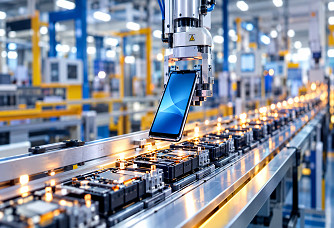
India’s electronics boom gathers strong momentum as firms secure Rs 19,091 crore in PLI incentives and draw investments exceeding Rs 20,580 crore.
Large-scale electronics manufacturers lead all 14 sectors under the production-linked incentive scheme and turn the country into a major mobile phone production hub.
Smartphone exports surge from USD 5.5 billion in 2021-22 to about USD 30 billion in 2025-26.
The scheme builds impressive assembly scale and export volumes, yet the real test now lies in deepening the value chain.
India must move beyond final assembly and push domestic component manufacturing to lock in higher local content and long-term competitiveness.
The government launched the PLI scheme for large-scale electronics manufacturing in 2020 with a clear focus on domestic mobile-phone production. Officials approve 32 companies as beneficiaries.
The original five-year tenure runs from 2020-21 to 2024-25, and authorities later extend it by one year through 2025-26. Companies receive fiscal incentives linked to incremental sales over a base year.
Key outcomes stand out clearly:
These numbers confirm that the scheme successfully creates large-scale assembly capacity and drives rapid export growth.
Also Read: How BESS Can Accelerate India’s Clean Energy Shift
Electronics outpaces every other sector in incentive receipts. The pharmaceutical sector follows with Rs 6,662 crore. Food products receive Rs 3,271.44 crore, while automobiles and auto components secure Rs 3,174.15 crore.
The overall PLI program carries an approved outlay of Rs 1.91 lakh crore across 14 sectors. The government designs the scheme to strengthen manufacturing capabilities, attract investment, promote exports, generate employment and reduce import dependence.
The PLI scheme builds volume and export muscle, yet the electronics sector still needs a stronger push into component and sub-assembly production. Higher domestic value addition remains the critical next step if India wants to convert assembly success into true manufacturing depth.
The sharp rise in smartphone exports shows that global buyers accept Indian-made devices, but sustained competitiveness requires local production of higher-value parts.
The government continues to support the sector through the extended PLI window, giving companies additional time to expand capacity. Manufacturers that invest further in local supply chains will strengthen India’s position and reduce reliance on imported components.
The current incentive and investment numbers prove that policy support works at scale. The same focus must now shift toward building a robust component ecosystem so that the electronics boom delivers lasting industrial strength rather than remaining concentrated in final assembly.
India’s electronics story has already rewritten the export numbers. The next chapter depends on how effectively the industry and policy move beyond volume into genuine component manufacturing.
.jpg "Saksham Enterprises: Optimizing Mission- Critical HVAC Infrastructure For The High Precision Sector")

.jpg "JDS Group of Companies: Innovating Smart Solutions For Modern Power Transmission & Distribution Infrastructure")




We use cookies to ensure you get the best experience on our website. Read more...