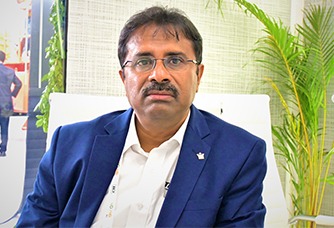
In an interview with Thiruamuthan, Assistant Editor at Industry Outlook, Pinaki Niyogy, CTO & COO of TIL India Limited, shares how advanced, indigenous, and AI-enabled material handling technologies are improving crane safety, uptime, and performance in India. He also highlights efforts to address skill shortages, enable predictive maintenance, enhance intelligent design, and translate customer-driven engineering innovations into long-term leadership. With over 31 years of experience in heavy equipment, Pinaki specializes in product development, operations, indigenous engineering, safety-focused innovation, and technology-led execution.
How significantly is advanced material handling technology redefining safety-led crane performance standards across Indian job sites experiencing rapid automation and infrastructure expansion?
India’s construction sector is growing rapidly as part of the Vision 2047 plan to become a developed country. With so many new projects taking place, the demand for cranes and material handling machines has spiked drastically. However, the shortage of trained operators remains especially for smaller cranes and creates huge safety challenges. Many operators lack in handling loads safely, which can lead to major accidents on job sites.
In order to address this gap, advanced material handling technology comes into play by making cranes inherently safer to operate in every circumstance. These intelligent machines can prevent unsafe movements, which means that if an operator makes the slightest error, the machine can detect and prevent accidents from occurring. Through thoughtful design improvements, such as four-wheel steering and truck-style turning, cranes are now much more stable and easier to operate, unlike traditional articulating cranes that can tip over easily. These innovations ensure that construction can move faster without compromising safety and allowing projects to stay on track even when skilled operators are in short supply.
AI-enabled machines will offer infinite load chart options, automatically determining safe operating conditions for any configuration, whether symmetric or asymmetric outriggers.
Which operational challenges are Indian crane manufacturers encountering when implementing predictive telematics for uptime optimisation across high-load, multi-industry deployments?
Predictive telematics is a tool that captures information from a machine through sensors and transmits it to a server. From there, data can be visualized and analyzed to predict machine performance. For uptime optimization, this means predicting when certain components need replacement. For simple cases like clogged filters, sensor data clearly indicates contamination levels, allowing timely replacement.
The challenge arises when predicting failures of components like bearings, which depend on multiple factors: load lifted, duration, and load cycles. Predictive analysis requires historical data showing how and when failures occur under specific conditions. Currently, telemetry mostly captures fuel consumption, distance traveled, GPS location, and safe operation compliance. Without large volumes of historical data, predicting failures remains difficult, as the concept is fairly new for material handling machines.
Over time, as more mature data is collected, predictive maintenance will improve. Companies like Caterpillar have successfully implemented this for earthmoving equipment using intensive data research, but for material handling machines, limited volumes mean such mature datasets are not yet available.
How is indigenous heavy-equipment engineering improving safety integrity levels in mission-critical pick-and-carry applications across ports, logistics and industrial segments?
In pick-and-carry applications across ports, logistics, and industry, many operators of these cranes are not fully trained in proper rigging. For small pick-and-carry cranes, we have a component called an outrigger or stabilizer. When deployed, the outriggers lift the front tyres and support the machine with cylinders, allowing a higher duty lifting cycle than when on tyres. If an operator tries to lift a load on tyres but selects the wrong outrigger duty, the machine itself now detects whether it is on outriggers or tyres. This makes the machine more intelligent, assisting operators who may not be fully trained.
Sensors continuously monitor the position of the outriggers to ensure correct operation. This combination of untrained operators and intelligent machines creates a safer work environment. These advanced features are offered specifically in smaller pick-and-carry cranes, ensuring very high safety levels. Safety is an integral part of the machine’s design and operation.
Also Read: Why the Demand for Pre-Owned Equipment Is Rising Globally
Looking ahead, how do you see AI-enabled equipment intelligence reshaping the material handling and crane ecosystem in India, especially for safety-critical infrastructure deployments?
AI-enabled machines bring intelligence to cranes by integrating powerful computation directly into the controller. For example, machines track outrigger or stabilizer positions, which are either fully open or closed. Often, due to space constraints, operators cannot extend outriggers fully in all directions. In the future, machines will automatically sense the position of outriggers and calculate safe lifting capacity in real time.
Currently, machines have discrete load charts as part of the safe load indicator system. Operators select from these predefined charts to lift loads safely. AI-enabled machines will offer infinite load chart options, automatically determining safe operating conditions for any configuration, whether symmetric or asymmetric outriggers. This is possible due to advances in hardware, which allow high computing power in compact systems, similar to mobile devices, unlike earlier supercomputers.
While such technology is more common in the Western market, TIL plans to bring it to India. The AI-enabled system will enhance safety, particularly for safety-critical infrastructure deployments. Adoption will depend on customer acceptance and cost, but these machines will also be suitable for international markets, providing cutting-edge safety and performance.
From an engineering standpoint, how does TIL plan to translate its Excon 2025 innovations into long-term leadership in India's smart, safe and fully indigenous AV equipment landscape?
This year at Excon 2025, TIL is launching three machines simultaneously, all completely developed by our engineers in India using as many Indian components as possible. The triggering point for these projects is the voice of the customer. As part of the product development team, I participated in meeting with customers to understand their pain points and where we could add value.
For the first product, Pick-and-Carry, customers requested a flat deck and front steering instead of rear steering, which posed safety risks to nearby vehicles. For the Rough Terrain Ridge Tagger, customers wanted a machine capable of moving empty containers over rough or marshy terrain, leading to the development of a four-wheel drive, four-wheel steer solution—the first in the world. The third machine had performance approval, but customers suggested aesthetic improvements and increasing the lifting capacity from 80 to 85 tonnes.
All these machines are the result of customer input, which continues to guide TIL’s product development. Customers highlight operational challenges, and it is our responsibility as engineers to find solutions. This process ensures TIL’s innovations translate into long-term leadership in India’s smart, safe, and indigenous AV equipment landscape.
.jpg "Saksham Enterprises: Optimizing Mission- Critical HVAC Infrastructure For The High Precision Sector")

.jpg "JDS Group of Companies: Innovating Smart Solutions For Modern Power Transmission & Distribution Infrastructure")




We use cookies to ensure you get the best experience on our website. Read more...