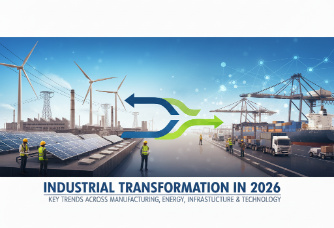
In 2026, industrial transformation will no longer be driven by short-term cycles or separated technology adoption. It will reflect a deeper structural shift across manufacturing, energy, infrastructure, logistics, and industrial services. It is clearly visible that Industries are entering a phase where competitiveness is defined less by scale alone and more by how intelligently capacity, capital and capability are aligned.
What does India’s manufacturing outlook look like for 2026? The 2025 empirical data from IBEF shows manufacturing contributes 16–17% of GDP, with exports and FDI rising, laying the foundation for a stronger, trillion-dollar industry by 2026.
Debjani Ghosh, Distinguished Fellow, NITI Aayog, reinforces this strategic necessity: “If we have to get to a $30 trillion economy by 2047, we need to be in the $12 trillion range by the next 10 years and a boost in the manufacturing sector is essential to achieve that.”
This transition is being shaped by three realities: the push for industrial self-reliance, sustained investment in core sectors, and the growing need to modernize operations without disrupting output. According to Deloitte’s 2026 manufacturing insights, the combination of smart operations and supply chain resilience is now a critical determinant of industrial competitiveness. Let’s take a closer look at the transformations!
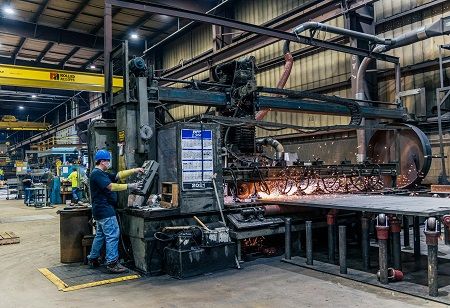
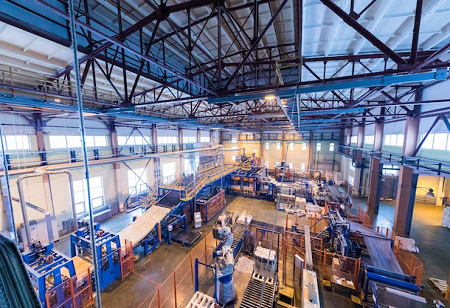
Manufacturing remains at the centre of industrial transformation, but the roadmap for 2026 looks markedly different from earlier growth phases. The focus is shifting from aggressive capacity addition to precision-led manufacturing, where productivity, quality, and flexibility matter as much as volume.
Automation, smart manufacturing systems, and data-driven production planning are becoming embedded across mid-sized and large manufacturers. This is less about adopting Industry 4.0 as a concept and more about solving real operational challenges such as downtime, yield loss, and cost volatility. Deepak Shetty, CEO & MD of JCB India, captures this focus: “Indian manufacturing is no longer just about volume; it’s about precision, efficiency, and integrating technology into everyday operations to meet global standards.”
How Manufacturing Can Get There:
By 2026, success will be measured by how effectively digital tools are integrated across the supply chain while maintaining speed, quality, and reliability—even under operational stress.
Energy is emerging as a critical enabler of industrial growth in 2026. Transformation in sectors from steel to chemicals is increasingly tied to how energy is sourced, consumed, and managed.
Industries are moving toward cleaner and more efficient energy models, integrating renewables and decentralized systems to meet sustainability goals and reduce operational risk. The energy roadmap for 2026 emphasizes stability, resilience, and predictable costs, influencing industrial location strategies, investment decisions, and compliance with environmental norms.
2026 Milestones for Energy:
Infrastructure and logistics are now central to industrial growth. In 2026, industrial corridors, modern warehousing, and integrated transport networks will determine speed-to-market, cost competitiveness, and resilience.
A critical lens in 2026 is supply chain resilience. Input volatility, sourcing diversification, and trade alignment are shaping how industries approach infrastructure investment. Companies are balancing local manufacturing with global integration, ensuring continuity despite geopolitical or supply shocks.
S. Padmanabhan, MD & CEO of Larsen & Toubro Infotech, says, “India’s industrial infrastructure is evolving rapidly, enabling seamless integration into global supply chains. Smart logistics and digitalisation will define the next decade.” And Arun Misra, CEO of Hindustan Zinc Ltd., shares, “Efficient infrastructure and logistics are not just cost drivers; they are the backbone of resilient and globally competitive industrial operations.”
From Vision to Practice:
Technology adoption in 2026 will reach a point where it is no longer a differentiator but an operational necessity. Across sectors, digital transformation in industry is moving beyond experimentation into standard operating practice.
Artificial intelligence, industrial IoT, and advanced analytics are increasingly used to improve forecasting, maintenance planning, and resource utilisation. What sets leaders apart is not access to technology, but the discipline to deploy it where it delivers measurable value.
2026 Milestones for Technology:
The industrial transformation trends for 2026 indicate a shift toward technology that is quieter, embedded, and outcome-driven rather than high-profile or experimental. Sanjiv Mehta, Ex-Chairman & MD, Hindustan Unilever Ltd., reinforces digital transformation importance: “Technology is no longer optional—it’s embedded into every decision, every process, and every competitive advantage in India’s industries.”
Investment in 2026 reflects a cautious yet confident approach. Capital is allocated to sectors demonstrating long-term stability rather than short-term spikes. Risk-adjusted growth, scalability, and execution capability are key criteria.
Sajjan Jindal, Chairman, JSW Group, emphasizes, “We can’t be conservative, we have to be aggressive and that’s what India requires. India needs aggressive companies, India needs growth.”
Investment decisions are increasingly intertwined with supply chain resilience and infrastructure readiness, reflecting the fragility of transformation under geopolitical and operational pressures.
2026 Investment Highlights:
Workforce readiness remains a critical constraint on industrial transformation in 2026. As industries modernise operations, the demand for digitally capable, adaptable talent is increasing. The challenge lies not only in hiring new skills but in upgrading existing workforces to operate in technology-enabled environments.
Leadership capability, change management, and continuous reskilling will play a decisive role in how effectively industries translate transformation plans into operational outcomes. Anant Goenka, President, FICCI, underscores this: “Skilled, adaptable talent is the engine that drives industrial transformation. Without it, even the best technology and infrastructure cannot deliver growth.”
Workforce Roadmap:
By 2026, industrial transformation in India will be closely shaped by government policies and regulatory clarity. Initiatives like Make in India, Production Linked Incentive (PLI) schemes, Atmanirbhar Bharat, and the National Infrastructure Pipeline have strengthened manufacturing, boosted investment, and enhanced global competitiveness.
Sectors that align early with sustainability, safety, and reporting standards will gain a competitive edge. While policies alone cannot drive transformation, they create the ecosystem for industries to invest confidently, integrate innovation, and achieve sustainable growth, making India a global industrial leader by 2026. Going forward, the government should focus on digital infrastructure, renewable energy adoption, skill development through Skill India, and simplified approvals to foster resilient growth.
Industrial transformation in 2026 is not defined by disruption alone. It will be defined by balance — between growth and resilience, automation and human capability, sustainability and profitability. What separates progress from noise is not ambition, but alignment. Industries that connect strategy with shop-floor realities will gain momentum.
Across sectors, the shift is already visible — from expansion to efficiency, from experimentation to integration, from growth at any cost to growth that holds. The industries that succeed will be those that view transformation as a continuous strategic process rather than a series of isolated initiatives. As the industrial sector moves deeper into 2026, the real competitive edge will indeed lie in execution, alignment, and long-term thinking.






We use cookies to ensure you get the best experience on our website. Read more...