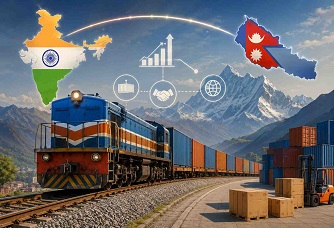
India-Nepal rail trade gains momentum as the first direct commercial container train reached Nepal, strengthening cross-border logistics and regional connectivity.
This India-Nepal rail trade milestone links Indian ports and industrial hubs directly to Nepal through an efficient rail trade network. This reduces transit time and logistics costs.
The train operated under a streamlined customs framework that enables seamless cargo movement across borders.
Officials confirmed that this rail trade initiative will improve supply chain efficiency, boost bilateral commerce, and support landlocked Nepal’s trade access. The development signals a shift toward faster, cost-effective, and scalable rail trade infrastructure in South Asia.
India-Nepal rail trade achieved a breakthrough as the container freight train completed its journey directly into Nepal without cargo transshipment at the border. The train originated from Indian logistics hubs and moved containers via rail corridors to Nepal’s inland terminal.
This direct rail trade model eliminates unloading and reloading delays, ensuring faster delivery timelines. Officials confirmed that the new system cuts transit time significantly compared to road transport. The rail trade route also lowers logistics costs by reducing handling charges and fuel dependency. This improvement strengthens India-Nepal rail trade by making cross-border cargo movement more predictable and efficient.
Also Read: Why India's Mobility Future Depends on Leadership and Innovation
India-Nepal rail trade benefits from a synchronized customs mechanism that allows containers to move with minimal procedural delays. Authorities implemented electronic documentation and pre-clearance systems to support seamless rail trade operations.
The integrated customs framework enables cargo clearance at inland terminals instead of congested border points. This process reduces dwell time and enhances cargo security. Rail trade stakeholders highlighted that this system improves transparency and reduces paperwork inefficiencies. Government officials emphasized that such policy alignment will strengthen India-Nepal rail trade and encourage higher cargo volumes through rail corridors.
India-Nepal rail trade expansion relies on continuous infrastructure upgrades across rail networks and inland container depots. The corridor connects key Indian ports and industrial centers with Nepal’s Birgunj Inland Container Depot, which serves as a major trade gateway.
Rail trade infrastructure investments include track modernization, terminal capacity expansion, and improved cargo handling systems. These upgrades support higher container volumes and ensure smoother operations.
Data indicates that rail trade can handle larger cargo loads compared to road transport, making it a more scalable solution for bilateral trade growth. The new corridor enhances India-Nepal rail trade by enabling consistent and high-capacity cargo movement.
India-Nepal rail trade plays a critical role in strengthening economic ties between the two countries. India remains Nepal’s largest trading partner, and efficient rail trade connectivity directly impacts import-export volumes.
The direct freight service supports Nepal’s access to global markets by linking it with Indian ports. Exporters benefit from faster turnaround times, while importers gain cost advantages through optimized logistics.
Trade experts stated that rail trade expansion will increase cargo volumes, reduce dependency on road transport, and improve overall supply chain resilience. India-Nepal rail trade continues to evolve as a strategic driver of regional economic integration.
India-Nepal rail trade will expand further as authorities plan to increase freight frequency and add new routes. Rail trade stakeholders aim to integrate more industrial clusters and logistics hubs into the network.
Policy support, infrastructure investment, and digital systems will drive the next phase of growth. Experts believe that India-Nepal rail trade will set a benchmark for regional rail trade connectivity in South Asia.
The successful execution of this corridor demonstrates how coordinated logistics, policy alignment, and infrastructure investment can transform cross-border rail trade into a high-efficiency trade channel.
.jpg "AR Enterprises: Building The Supply Networks Behind India's Construction Growth")
.jpg "Industrial Packers: Engineering Industrial Packaging for India's Manufacturing Future")





We use cookies to ensure you get the best experience on our website. Read more...