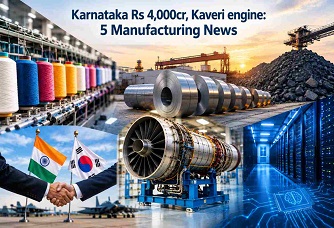
Manufacturing News today points to a broader shift in India's industrial strategy, from adding capacity to strengthening the inputs, technology and infrastructure behind it.
Karnataka has approved a Rs 4,000 crore textile policy targeting Rs 20,000 crore of investment, while SAIL is testing Mongolian coking coal to diversify supplies.
Separately, India's Kaveri engine has cleared trials in Russia, India and South Korea are expanding defense-industrial cooperation, and Adani Group is preparing new data-center capacity while deploying AI across businesses.
Taken together, these developments highlight how manufacturing competitiveness increasingly depends on deeper supply chains, indigenous technology and supporting infrastructure.
Karnataka's Textile & Apparel Policy 4.0 for 2026-31 targets Rs 20,000 crore in investment and five lakh jobs, with Rs 4,000 crore allocated to support the sector.
The policy also identifies 34 focus taluks for additional incentives and brings silk yarn production, including reeling and spinning, within its scope.
The less-emphasized manufacturing implication is value-chain depth. Rather than focusing only on attracting factories, Karnataka is attempting to expand activity across fiber-to-fashion manufacturing, technical textiles and silk.
Incentives for the PM MITRA Park in Kalaburagi could also help move textile investment beyond established industrial centers.
The key manufacturing question is therefore whether the policy can translate investment commitments into integrated supplier networks, processing capacity and downstream value addition.
Also Read: Karnataka Manufacturing Industry 2026: Policy & Key Sectors
SAIL has airlifted a one-metric-ton sample of Mongolian coking coal to evaluate it as an alternative supply source. India imports about 95 percent of its coking-coal requirement, with Australia accounting for more than half of supplies, making diversification strategically relevant to steelmakers.
The important manufacturing gap is the raw-material security challenge behind steel capacity expansion. Coking coal represents a major component of steel production costs; while India's domestic supply does not fully meet requirements.
SAIL's trial therefore reflects an attempt to widen the sourcing base rather than simply add another supplier.
However, Mongolia's landlocked geography creates logistics challenges. The potential route through Russia could increase transportation costs, meaning supply diversification will ultimately depend on both coal quality and delivered economics.
DRDO's Kaveri dry engine has completed high-altitude and flight trials in Russia, recording peak dry thrust of 48.5 kN against a 46 kN target. The next stages involve certification, integration with the Ghatak UCAV and subsequent flight testing.
The manufacturing significance lies beyond the trial milestone. Engine integration and eventual production will determine how far India's indigenous propulsion capability can move into an operational manufacturing ecosystem.
That requires specialized components, precision engineering, materials and repeatable production capabilities. For India's aerospace manufacturing sector, converting successful testing into certification, platform integration and production is the more consequential next step.
India and South Korea held their 10th Joint Committee Meeting on Defense Industries and Logistics Cooperation on September 29, discussing stronger engagement between their defense industries and expanded cooperation in defense production and logistics.
The manufacturing angle is the potential shift from procurement towards industrial cooperation. Deeper engagement could create opportunities for joint production, technology-linked manufacturing and greater participation by Indian suppliers.
This makes the relationship relevant not only to major defense platforms but also to the wider Indian defense manufacturing ecosystem, where domestic component and subsystem capabilities remain important for localization.
Also Read: 10 Women Leaders Driving India’s Automotive Manufacturing Revolution
Adani Group is preparing to operationalize data centers in Navi Mumbai, Vizag and Hyderabad, while its AI strategy spans businesses and is backed by hyperscalers including AWS, Google and Microsoft.
The under-emphasized connection is that computing infrastructure is becoming industrial infrastructure. AI-driven factories, automation, industrial analytics and connected production systems require reliable domestic computing capacity.
Adani's planned data-center expansion also connects to its broader infrastructure manufacturing strategy.
The group and Jabil announced plans in June for a vertically integrated AI and data-center infrastructure manufacturing platform in India, including GW-scale AI rack and advanced infrastructure manufacturing.
Taken together, these developments show that India's manufacturing expansion increasingly depends on securing raw materials, building indigenous technology and developing the infrastructure required to operate increasingly digital factories.




We use cookies to ensure you get the best experience on our website. Read more...