India’s manufacturing expansion is entering a phase where automotive testing infrastructure in India could become as important as production capacity.
As Make in India completes 12 years, the government data has highlighted Rs 2.40 lakh crore of PLI-linked investment, Rs 23.8 lakh crore in production and sales, and Rs 15.2 lakh crore in exports as of March 2026.
Prime Minister Narendra Modi said the initiative has delivered "more made in India, more investment in India, more exports from India," calling it a transformation visible across sectors.
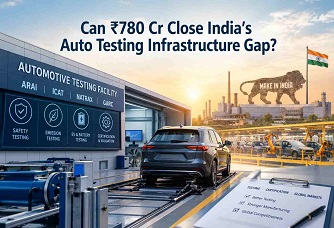
Against this backdrop, the Ministry of Heavy Industries has earmarked Rs 780 crore to upgrade automotive testing agencies, signaling a shift toward strengthening the infrastructure needed to validate newer vehicles, technologies and components.
Even as automotive manufacturing in India has scaled up, the country's testing and certification capacity hasn't always kept pace.
Union Minister for Heavy Industries and Steel H.D. Kumaraswamy announced that the Ministry of Heavy Industries will invest Rs 780 crore to upgrade automotive testing infrastructure across government testing agencies nationwide.
The Rs 780 crore allocation under PM E-DRIVE is intended to modernize four government testing agencies-ARAI, ICAT, NATRAX and GARC-and strengthen testing and certification capabilities for emerging automotive technologies.
The requirement is becoming more complex as India's automotive industry moves toward electric mobility, alternative fuels and intelligent mobility systems. Testing infrastructure now needs to support more than conventional vehicle validation, including advanced powertrains, battery systems and newer vehicle technologies.
For manufacturers, expanded testing capacity can affect the time required for validation and certification before products enter the market. That makes testing infrastructure an important part of the wider automotive manufacturing ecosystem rather than simply a regulatory requirement.
Also Read: Manufacturing in Maharashtra 2026: Industries, Hubs & Investments
The timing of the investment is significant because India's manufacturing base has expanded considerably since Make in India began in 2014.
Automobiles and auto components are among the sectors covered by the PLI framework. The automobile PLI scheme itself has an approved outlay of Rs 25,938 crore, with 82 approved applicants and an estimated investment commitment of Rs 42,500 crore.
As more companies develop advanced vehicles and components domestically, India needs adequate vehicle testing facilities, certification capacity and engineering infrastructure to validate those products at scale.
The gap is therefore shifting from simply having manufacturing capacity to having the infrastructure that can support increasingly sophisticated manufacturing.
Electrification is one reason testing requirements are changing. PM E-DRIVE includes Rs 780 crore specifically for upgrading testing agencies, alongside Rs 2,000 crore for public EV charging infrastructure.
Manufacturers developing electric vehicles and advanced automotive components require testing and certification facilities capable of handling evolving technical standards.
The challenge is also not limited to passenger vehicles. ICAT's new tractor and agricultural-machinery facilities indicate the broader requirement for specialized testing across vehicle categories.
For India's automotive sector, therefore, the expansion of testing capacity can help connect product development, certification and commercial manufacturing more closely.
The government's 12-year Make in India milestone points toward a manufacturing ecosystem increasingly focused on global production and supply chains.
Union Minister of Commerce and Industry Piyush Goyal said India's ambition has moved from manufacturing primarily for domestic consumption toward manufacturing for global markets.
Heavy Industries Minister H.D. Kumaraswamy has similarly said India's ambition needs to extend beyond being a large automotive market toward capabilities in design, engineering, manufacturing and intellectual property.
The Rs 780 crore allocation can therefore be viewed as one component of a broader manufacturing transition: from expanding factory output toward strengthening the infrastructure required to develop, test, certify and commercialize more advanced products in India.





We use cookies to ensure you get the best experience on our website. Read more...