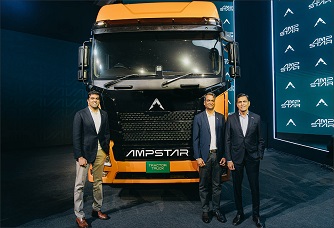
JSW Greentech has entered India’s electric commercial vehicle market with the launch of Ampstar, a new brand focused on electric trucks and buses.
The company plans to use in-house technology, flexible ownership models and a full-stack mobility approach to encourage businesses to shift from conventional diesel-powered commercial vehicles to electric alternatives.
The company is initially targeting B2B customers, particularly businesses operating vehicles on predictable routes.
JSW Greentech believes lower operating costs and a reduction in total cost of ownership (TCO) can help overcome the higher upfront price of electric commercial vehicles. The company expects TCO savings of around 15–20% as electric mobility scales.
Ampstar will initially enter the market with a 55-tonne electric tractor-trailer, while the company plans to add tippers and fixed-body dumpers in the future. Its electric bus portfolio will cover vehicles ranging from 7 metres to 18 metres, targeting applications such as staff transportation, city services, intercity travel and school transportation.
The company is positioning Ampstar as more than a vehicle brand. Its offering will combine vehicles with charging infrastructure, financing, operating solutions and after-sales support. Customers will have options including outright purchase, leasing and Battery as a Service (BaaS).
JSW Greentech is also developing its technology internally. The company has built the base logic, software and algorithms for its electric drivetrain, allowing it to customise vehicles for different operating requirements. The platform supports power configurations ranging from 150 kW to 500 kW.
The vehicles will feature a double-cooling battery system and high-strength monocoque chassis designed for Indian road and climate conditions. JSW said its first 100 hires included a large majority of R&D personnel, reflecting its focus on developing its technology in-house.
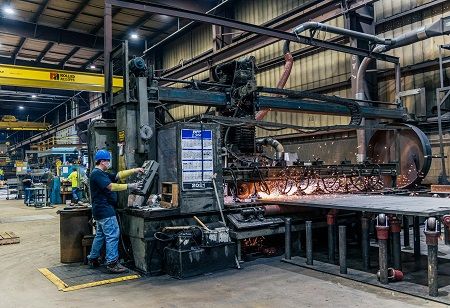
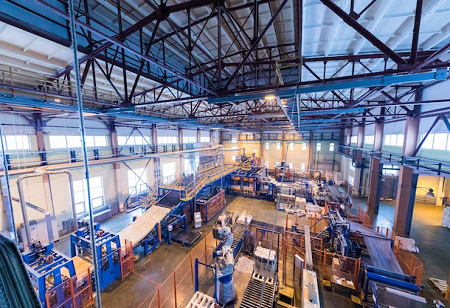
Production of Ampstar vehicles will take place at JSW Greentech’s 90-acre manufacturing facility at AURIC in Chhatrapati Sambhajinagar, Maharashtra. The facility has an annual capacity of 15,000 electric buses and trucks and is expected to begin commercial production within weeks.
The facility will include an integrated battery ecosystem, an automated truck-cabin production line and a pre-treatment and electro-deposition process for bus manufacturing. JSW is also targeting increased localisation as production scales.
The company is initially pursuing a B2B-led strategy instead of building a conventional retail dealership network. It plans to establish its own service and maintenance presence across multiple states to support commercial customers.
JSW Group also provides the company with a potential internal market. Its businesses operate around 17,000 trucks across steel, cement and port operations. JSW Greentech estimates that 40–50% of these vehicles could potentially be electrified immediately, particularly those running on closed-loop routes.
The group has invested about ₹2,500 crore in the electric commercial vehicle facility and has set ambitious plans for the business. JSW has said it wants to scale production significantly over the coming years as electric mobility expands in India.
Also Read: Explained: Why Chinese-Backed Auto Manufacturing Bids Stalled Over FDI
Beyond trucks and buses, the company is also exploring other applications for its electric technology, including locomotives. With Ampstar, JSW Greentech is seeking to build a broader electric mobility business while focusing initially on the economics and operational requirements of commercial transport.





We use cookies to ensure you get the best experience on our website. Read more...