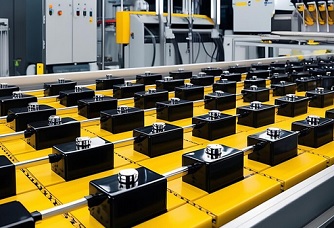
The battery ecosystem in India could soon get a major boost as the government prepares a new incentive scheme worth around Rs 12,000 crore to support local manufacturing of battery components.
The move is aimed at strengthening the country's battery ecosystem, reducing import dependence, and building a more complete supply chain for electric vehicles (EVs) and energy storage systems.
According to reports, the proposed scheme will focus on critical battery components that are currently imported in large quantities. While India has already introduced incentives for battery cell production, policymakers now want to address gaps in the broader supply chain that continue to limit domestic value addition.
India has taken several steps in recent years to boost local manufacturing through Production-Linked Incentive (PLI) schemes for sectors such as electronics, semiconductors, solar modules, and advanced chemistry cell (ACC) batteries.
However, industry stakeholders have pointed out that battery cell manufacturing alone is not enough to create a self-reliant industry. Many of the key materials and components used in battery production are still sourced from overseas markets, particularly China.
The proposed Rs 12,000 crore support package is expected to encourage investments in:
By expanding domestic production of these inputs, the government aims to create a stronger manufacturing base for the EV and energy storage sectors.
Also Read: Hydrogen Storage Innovations Are Driving India's Clean Energy Push
Battery components account for a significant share of the overall battery value chain. Despite growing demand for EVs in India, the country remains heavily dependent on imports for several critical battery materials.
A stronger domestic supply chain could help:
Industry experts believe that developing local component manufacturing is essential if India wants to emerge as a global battery manufacturing hub.
The latest proposal reflects a broader shift in India's industrial strategy. Instead of focusing only on end-product manufacturing, the government is increasingly looking to localize entire supply chains.
The battery sector has become a key priority due to its importance in electric mobility, renewable energy storage, and energy security. Demand for batteries is expected to rise sharply in the coming years as EV adoption increases and renewable power capacity expands.
The proposed incentive scheme is also expected to attract investments into battery materials, recycling, and related industries, helping create a more integrated ecosystem. If implemented, the initiative could complement existing battery manufacturing programs and strengthen India's position in the global clean energy supply chain.
The final contours of the scheme are still under discussion, but the government's intent is clear: build a stronger domestic battery industry and reduce reliance on imported components that currently dominate the market.
.jpg "Saksham Enterprises: Optimizing Mission- Critical HVAC Infrastructure For The High Precision Sector")

.jpg "JDS Group of Companies: Innovating Smart Solutions For Modern Power Transmission & Distribution Infrastructure")




We use cookies to ensure you get the best experience on our website. Read more...