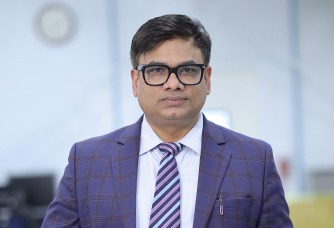
As India races ahead on renewable energy generation, having already crossed the halfway mark toward meeting its power needs from clean sources, the country's Battery Energy Storage System - BESS infrastructure remains at a nascent stage. In an interaction with Industry Outlook, Nikhil Bhuta, Director, Belding (EFC Limited), discusses the company's manufacturing philosophy, the gap between renewable generation and storage readiness, and what it will take for India to build a self-reliant BESS ecosystem. EFC Limited is a listed company on the Bombay Stock Exchange, operating as a holding company with subsidiaries including DCNT Global Private Limited, DCNT Defense Private Limited, Metafin Technology, BEST Limited and Evolve Technology. The group's primary focus areas are Battery Energy Storage Solutions (BESS) and Edge Data Centers (EDC), manufactured out of a large facility in Pune.
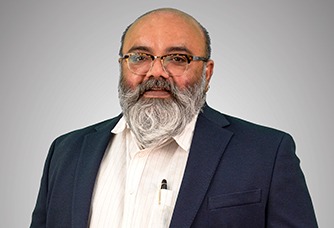
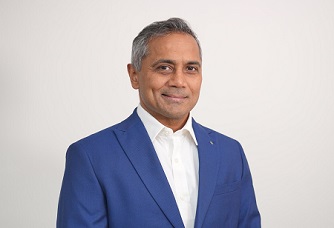
Nikhil Dilipbhai Bhuta is a qualified Chartered Accountant with more than 25 years of entrepreneurial experience. As a Director of the Company, he has been associated with the Group since its inception and oversees its enabling functions and strategic initiatives. His proactive leadership, strong work ethic and strategic vision have been instrumental in driving the Group’s growth and establishing it as a progressive, forward-looking organisation
Tell us about EFC Limited and the products you manufacture.
This is a listed company on the Bombay Stock Exchange. We have multiple subsidiaries under this company - DCNT Global Private Limited, DCNT Defense Private Limited, Metafin Technology, BEST Limited, and Evolve Technology - so it's more or less a holding company.
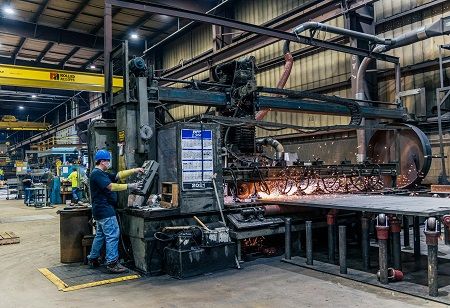
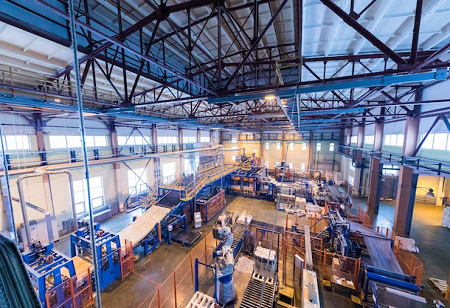
We have a three-gigawatt-hour BESS assembly line here in Pune, at a facility called Care Industrial City, on the outskirts towards the Bombay side. It's an MIDC location with nine acres of land and about 250,000 square feet of development area - 200,000 square feet is the factory shed, and 50,000 square feet is admin and display space.
Our second product is EDC - Edge Data Center, or Containerized/Modular Data Center. The idea is that data center infrastructure is miniaturized into a shipping-container format, and these containers can be joined vertically and horizontally to expand capacity. We call it "Edge" because, globally, a data center near the consumer is an Edge data center - like a hub-and-spoke model, where large hyperscaler data centers sit at central locations such as Mumbai and Pune, where undersea cables terminate, since power and internet connectivity are the two most important factors. Mumbai, Chennai and Vizag are strategically important for exactly this reason.
What is your philosophy around in-house manufacturing versus dependency on third parties?
Our philosophy is clear: we want integrated solution provider status, not dependency on third-party sourcing for critical components. For quality, timelines and margin profile, we believe critical components should be manufactured in-house - that's what we've done across all our lines.
That's also why we created Metafin Technology, where we brought in very senior executives and engineers from Schneider to do high-end fabrication and engineering innovation in-house.
Walk us through what goes into building a Battery Energy Storage Solution.
You take battery cells, make a pack, create a module, then do system integration in a containerized format. Unfortunately, nobody in India manufactures battery cells today - they come from abroad, mostly China. A few players have started developing cells here, but nobody is manufacturing at scale yet, particularly for energy-storage-specific batteries like 314 Ah and 280 Ah cells.
Barring the battery cell, everything else is manufactured in-house by us. Charging and discharging generates heat, and if a battery catches fire, it's extremely difficult to control for up to 24 hours — so we've developed our own cooling plates to keep cells at a stable temperature. We also build the power distribution infrastructure in-house, along with the fire suppression system.
Once cells are packed into modules, those modules go into racks, which are enclosed in steel fabrication, and the whole assembly is placed into a container along with the fire suppression and power distribution systems. Every component - containers, racks, enclosures, cooling plates - is manufactured in-house, then integrated and offered as a complete solution.
How is EFC positioning itself within the BESS industry in India?
We're positioning ourselves as an OEM to the industry - an original equipment manufacturer for BESS. I'm not competition to anybody in the market. Even players with their own baseline come to us because they lack components like cooling plates, containers or enclosures - capabilities we've built in-house through Metafin Technology. Most people only talk about having a BEST assembly line. Nobody talks about what goes inside it, who manufactures those components, or who controls the supply chain end-to-end. That's where we've positioned ourselves - as a complete OEM for the BESS market in India. We are positioning ourselves as an OEM to the industry. So, I am not a competition to anybody in the market.
Our customers include Pace Digitech, Lineage Powers, Amara Raja Batteries, Waaree, Reliance, Adani, Tata, and Vertiv. Executives from Tata and Adani have praised our infrastructure firsthand - and even Chinese battery representatives who visit us to market their own products have told us, "Sir, what you have created is something almost near to what we see in China." We take a lot of pride in that.
Beyond BESS and EDC, Metafin also manufactures products for defence and aviation - including DigiYatra kiosks and airport boarding-pass vending kiosks, fire-rated doors, LT and HT electrical panels, and security technologies like luggage, vehicle and cargo scanning systems for aviation, railways and metros.
Also Read: From Cost Reduction to Structural Cost Leadership in Manufacturing
Where is the biggest gap between renewable growth and storage readiness?
As of now, there's hardly any storage capacity available. Government and industry focus was on building renewable generation first, and that's gone beyond expectations - we're already at nearly 50% of our power generation from renewables, a target originally set for 2030.
Storage is only a three- to four-year-old sector in India, and it's only this year that people have really started setting up infrastructure. Earlier tenders and PLI incentives went largely unutilised because the pricing and economics weren't formed up yet. We recently represented EFC as a sponsored partner at India Energy Storage Week in New Delhi, and even there, across World Bank representatives, financial institutions, local players and the Renewable Energy Ministry, it was clear storage readiness is still forming.
The government's 2030 target is roughly 250-plus gigawatt-hours of storage capacity. Honestly, there's hardly any capacity built up yet. Very few players have both the infrastructure and the capability to operate it - battery assembly is not a skill India has traditionally had, and even companies bringing in Chinese personnel for months have struggled to train local teams.
Right now, combined capacity across players like Adani, us, JSW, Waaree, SMPL and Lineage is roughly around 20 gigawatt-hours - and much of that is imported in CKD (complete knockdown) format from China and simply assembled here, because manufacturing skills are still developing.
The reason storage is essential: solar generation follows the sun, peaking at noon, but consumption is linear throughout the day. Whatever generation exceeds demand gets wasted unless it's stored - that stored power then fills the gap when generation is low. It can also be used for power arbitrage - storing cheaper off-peak power (say Rs 5-7 a unit) and using it during peak hours instead of paying Rs 10 a unit, effectively lowering overall costs.
The government has recently cut GST on BESS to 5% to make domestic transactions more viable. I believe 2027 will be the year storage really starts picking up - from generation, storage and indigenous manufacturing perspectives - though dependency on China will remain for now.
What is still lacking in terms of industry collaboration and government support?
The major gap is in-house manufacturing capacity for battery cells. The BESS solution itself isn't complicated - it's fairly mechanical and simple. What matters is the cell itself, since everything depends on its quality, life and durability.
A few big players - Reliance, Adani, Amara Raja, Waaree - have announced plans around cell manufacturing, but we need many more such players to remove dependency on China. That requires significant investment, and government support in the form of cheaper land, cheaper power and infrastructure relaxations.
Lithium-ion cells also require rare-earth materials, and India currently has no domestic supply chain for that - we do have lithium resources, but exploration hasn't happened yet, and that exploration is expensive. Either the government takes the lead on this investment, or supports industry to do so. As a first step, even importing raw lithium and rare earths to set up cell manufacturing domestically would suffice; developing our own raw material sources can follow as a second step.
Which BESS applications make the strongest business case in India, and why?
I think power backup solutions will be the strongest. We recently launched a product called Hybrid BESS, which combines battery storage with DG sets - the diesel generators most industries already run on. Going forward, I believe power backup will become the standout use case for battery energy storage in India.
What could become the biggest constraint on India's BESS growth - technology, economics, regulation or execution?
Honestly, I don't see any of these becoming a constraint. In India, industries often grow specifically because there's no alternative left - and that's happening here. Technology, economics and regulation are all falling into place together.
The government is providing strong incentives. Economically, the business is close to viable since most components are manufactured in-house - the moment battery-cell dependency is resolved, the economics fall into place too. Technologically, the process itself isn't complex; it's the cell manufacturing that's the missing piece. The moment that's solved, technology stops being a constraint as well. From a regulatory standpoint, things are already fairly well established.
Also Read: India as a Global Manufacturing Hub in the New Mobility Era
What is your personal mantra that has guided your journey?
What matters to me is staying attached to whatever activity or project I'm working on, and doing full justice to it - without constantly filtering everything through "who benefits, how do I benefit, does my company benefit." If you focus purely on doing the work itself as well as you possibly can, everybody benefits automatically.
That's something I've always believed - keep learning, keep pushing yourself. I'd tell young professionals not to worry too much about work-life balance right now. It matters eventually, to unwind and rejuvenate, but early in your career, focus on the work.
.jpg "Manufacturing & Services Special")

We use cookies to ensure you get the best experience on our website. Read more...