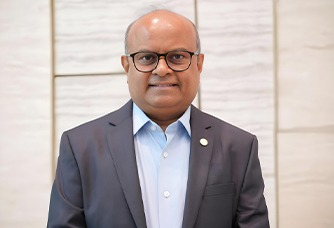
In an interaction with Thiruamuthan, Assistant Editor at Industry Outlook, Viswa Prathap Desu, Chief Operating Officer - Residential, Brigade Group, discusses the rise of mixed-use developments in India, focusing on the growing demand for integrated spaces. He also addresses challenges related to planning, approvals, and infrastructure, while highlighting the importance of sustainability and connectivity in shaping future urban projects. With 37 years of experience, Viswa Prathap Desu is a seasoned real estate expert, bringing expertise from Tata Housing and IDEB Construction. His proficiency includes sales operations, customer delight, product innovation, and strategic marketing within the real estate sector.
As mixed-use projects gain traction across Indian cities, what shifts in buyer and tenant behaviour are making this format increasingly viable today?
One of the primary reasons why mixed-use projects are becoming the preferred choice for many home buyers today is the ‘live-work-play’ ecosystem that such developments provide. These home buyers view a home as a functional hub where home, office, retail, wellness, sustainability, entertainment and high street dining seamlessly coexist at one location.
Mixed-use townships often embrace biophilic design, exhaustive greenery, and ESG compliance. Furthermore, these developments offer superior long-term investment value, with integrated projects historically demonstrating higher capital appreciation and rental yields due to their self-sustaining nature.
By blending high-end residential living with institutional, commercial, and recreational layers, mixed-use formats provide a holistic urban experience that fosters community, reduces the carbon footprint, and aligns perfectly with the aspirational, tech-enabled standards of today’s discerning homeowners.
Mixed-use formats provide a holistic urban experience that fosters community, reduces the carbon footprint, and aligns with today’s discerning homeowners
While mixed-use developments promise scale and integration, where do approvals, zoning, or infrastructure constraints still slow execution on the ground?
For large scale townships, managing water neutrality, waste-to-energy systems, and traffic impact across residential and commercial zones requires a level of coordination that the current single-window clearance systems have yet to cope with. One of the main bottlenecks is single-use zones, where zones are designed to keep the commercial or industry zone separate from the residential zone. Environmental clearances and approvals for the integrated floor space index are additional hindrances. While we can build a world-class township, it is often the infrastructure that surrounds it that dictates its success. Issues like delayed metro extensions, inadequate sewage and power grids, etc., can affect the project.
Also Read: Leveraging Modular Construction to Transform Housing in India
Given the complexity of blending residential, office, and retail uses, what planning missteps most often undermine the long-term success of mixed-use developments?
Management of conflict of interest between user groups is the most common misstep that developers often make. Traffic management is another area that must be addressed with care to ensure the smooth flow of vehicles. For example, if a visitor to the mall shares the same entry point as a resident returning home, it will lead to traffic congestion and the same goes for parking. To give an instance, we at Brigade prioritize independent access points and dedicated parking levels for residential, office, and retail segments to ensure smooth traffic flow. Finally, failing to give provision for future flexibility to easily incorporate any mandatory changes is another grey area that is often missed.
With connectivity emerging as a decisive factor, how critical are transit access and walkability in shaping occupier demand for mixed-use developments?
For mixed-use developments, the synergy between transit access and walkability can be considered as a dual engine that drives demand. A mixed-use development that is integrated with mass-transit hubs such as metro, railway and bus stations, will be much more attractive and will positively influence the buying decision as it provides easy inter and intra-city connectivity. From a work perspective, companies will benefit from higher employee retention as it eliminates extensive commute time. Walkability on the other hand, allows people to transition between living, working and social spaces without having to bother about transportation or traffic congestion. These two factors transform the development into a dynamic, sustainable urban node that prioritizes ease of living.
As GCCs and flexible offices move closer to residential clusters, how is this trend influencing design and space allocation in mixed-use developments?
Global Capability Centres (GCCs) have evolved from back-office hubs to strategic innovation centers, and their movement closer to residential clusters is fundamentally reshaping our design philosophy. GCCs now demand hybrid workspaces that offer world-class tech infrastructure. This trend has led to a significant shift in space allocation. We are seeing a move away from rigid, high-density floor plans toward open, collaborative layouts.
The rise of flexible offices within mixed-use developments allows GCCs to scale without committing to massive, fixed-term leases. This model means more square footage is dedicated to shared amenities such as high-end gyms, wellness centers, and meditation rooms, which serve both workspaces and residences. These are also typically in larger townships where segregation of different use spaces is possible while maintaining proximity.
Also Read: How Smart Elevators Are Transforming Vertical Mobility
Looking ahead, what structural changes will most clearly define the next generation of mixed-use developments in India’s evolving urban landscape?
Sustainability will play a massive role as we move forward with net-zero being the final goal. Future projects will be judged on their water neutrality, solar integration and effective waste management. From a technology perspective, smart developments will become mandatory, with AI and Machine Learning based management systems optimizing real time energy use.
The rise of REITs (Real Estate Investment Trusts) will force developers toward higher transparency and professional asset management, ensuring that these mixed-use properties are maintained to global standards for decades, not just years.
We will see "Institutional Integration" where schools, healthcare, and even university satellite campuses are woven into the master plan. Development will be a permanent, evolving part of the city’s social fabric rather than just a commercial project.
.jpg "Conveyor System Manufacturers")
.jpg "Oriental Rubber: Belt Solutions that Convey All the Way!")
.jpg "Creating a Center of Excellence in Cooling Solutions Deliverability")
We use cookies to ensure you get the best experience on our website. Read more...