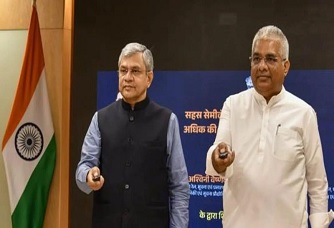
India’s first SME semiconductor plant has officially started operations in Bhiwadi, Rajasthan, marking a major step in the country’s growing semiconductor manufacturing ecosystem.
The SME semiconductor plant, inaugurated by Sahasra Semiconductors, is expected to strengthen India’s push toward self-reliance in chip packaging, testing, and electronics manufacturing.
The facility is the first semiconductor assembly and packaging unit in the country to be led by a micro, small, and medium enterprise (SME), highlighting the increasing role of smaller domestic players in India’s semiconductor mission.
Located inside the Electronics Manufacturing Cluster (EMC) developed by ELCINA in Bhiwadi, the new facility spans around 57,000 square feet and has been built with an investment of more than Rs 150 crore. The unit will focus on semiconductor assembly, testing, marking, and packaging operations, commonly known as ATMP and OSAT services. Industry experts believe the project could help reduce India’s dependence on imported semiconductor packaging services while boosting domestic electronics manufacturing.
Also Read: Localization Without Isolation: India’s Semiconductor Strategy
The facility currently has an annual production capacity of nearly 60 million semiconductor units. According to the company, this capacity is expected to rise significantly over the next two to three years, reaching between 400 million and 600 million units annually. The company plans to scale operations in phases as demand for locally packaged semiconductor products continues to increase across sectors such as consumer electronics, automotive electronics, industrial devices, and telecom infrastructure.
Sahasra Semiconductors stated that the plant will manufacture and package memory chips used in flash storage devices, including MicroSD cards and USB products. In addition, the unit will produce LED driver integrated circuits, RFID-based products, and eSIM solutions. These products are expected to serve both domestic and export markets.
The company has already established export relationships with several countries, including Germany, France, the United States, and Nepal. With global electronics brands increasingly looking to diversify supply chains beyond traditional manufacturing hubs, the Rajasthan-based semiconductor facility could position India as a competitive destination for semiconductor packaging and electronics manufacturing services.
Industry observers have pointed out that while India already has semiconductor-related facilities, including the Semiconductor Laboratory in Mohali, the Bhiwadi unit is different because it is the first commercially operational semiconductor packaging facility led by an SME. The development is seen as a significant milestone in India’s semiconductor journey, especially at a time when the government is aggressively promoting domestic chip manufacturing under various incentive schemes.
India’s semiconductor sector has witnessed rapid momentum over the past two years, with several large-scale investments announced across states such as Gujarat, Karnataka, Tamil Nadu, and Rajasthan. Companies including Tata Electronics, Micron Technology, and Kaynes Technology have either announced or initiated semiconductor and electronics manufacturing projects in the country.
The inauguration of the Sahasra facility comes amid the Indian government’s broader semiconductor mission aimed at creating a complete semiconductor value chain within the country. The government has introduced financial incentives and policy support to attract investments in chip fabrication, packaging, design, and electronics manufacturing.
The Electronics Manufacturing Cluster in Bhiwadi has also emerged as a growing electronics hub. According to industry estimates, the cluster has attracted planned investments worth more than Rs 1,200 crore from multiple electronics and semiconductor companies. The presence of a semiconductor packaging unit within the cluster is expected to encourage ancillary industries, supply chain companies, and component manufacturers to expand operations in the region.
Experts believe that ATMP and OSAT facilities are critical for building a robust semiconductor ecosystem because they bridge the gap between chip fabrication and final product integration. India’s increasing demand for semiconductors across smartphones, electric vehicles, data centers, and industrial automation systems has further accelerated the need for domestic semiconductor infrastructure.
The future outlook for India’s semiconductor manufacturing industry appears increasingly positive as both government and private sector investments continue to rise. Analysts believe semiconductor packaging and testing facilities like the one established by Sahasra Semiconductors will play a key role in helping India secure a larger share of the global electronics supply chain.
The Bhiwadi facility is expected to generate employment opportunities for skilled engineers, technicians, and electronics manufacturing professionals. It may also encourage more SMEs to enter high-technology manufacturing sectors that were previously dominated by large corporations and multinational companies.
With demand for semiconductors projected to grow rapidly worldwide, India is positioning itself not only as an electronics consumption market but also as a global manufacturing and packaging hub. The success of SME-led projects could strengthen investor confidence and accelerate the development of a self-sustaining semiconductor ecosystem in the country.
.jpg "Precise Fasteners: Committed To Fulfilling Client Expectations, Every Time!")


We use cookies to ensure you get the best experience on our website. Read more...