Why Legacy Equipment Still Dominates Many Factories
Walk through any heavy manufacturing plant in Pune, Stuttgart, or the American Midwest and you will quickly notice something that glossy “factory of the future” presentations rarely show: production lines built 15 to 30 years ago still run two shifts a day, delivering consistent output. The dominance of legacy equipment isn’t stubbornness—it’s economics and engineering pragmatism. A new CNC machining center or a high-speed packaging line can easily cost several million dollars, and the capital approval process alone can delay modernization for years. When the mechanical bones of a machine still hold tolerance and produce good parts, abandoning it makes little financial sense.
Industrial equipment lifecycles are built around iron, not silicon. A well-maintained press, conveyor, or winder can operate reliably for 20 to 30 years. The control architecture, however, ages at a completely different pace. Proprietary PLCs become discontinued, communication boards fail, and vendor support evaporates. This mismatch is what creates the modern retrofit challenge: the physical machine remains viable while its brain has already entered obsolescence.
“In many factories, the machine frame may still be mechanically reliable long after its original control architecture becomes obsolete.”
Full machine replacement also introduces significant production risk. Ripping out an entire line often means weeks of downtime, retraining operators, and debugging new processes. For plants running at 85% OEE or higher, that production gap is rarely acceptable. So the practical question shifts from “should we replace?” to “how do we extend the useful life of what we already have, while selectively capturing the benefits of Industry 4.0?”
The Biggest Challenges With Aging Automation Systems
Obsolete PLCs and Control Hardware
Many factories still rely on controllers like the Siemens S5, Allen‑Bradley PLC‑5, or GE Series Six. These platforms served reliably for decades, but today the modules are discontinued, firmware is frozen, and the pool of working spare parts shrinks every year. When a power supply or communication card fails, maintenance teams often scramble between ebay listings and specialized repair houses. Even when spares are found, the lack of vendor support means no one is testing new firmware patches or ensuring long‑term component availability.
This is not a theoretical problem. We have seen plants where a single failed analog input card held an entire packaging line hostage for three days, simply because the only replacement had to be sourced from a decommissioned machine on another continent. For many operations teams, sourcing industrial PLC replacement and retrofit components has become a critical pillar of maintenance planning rather than an occasional purchasing activity.
Communication Compatibility Problems
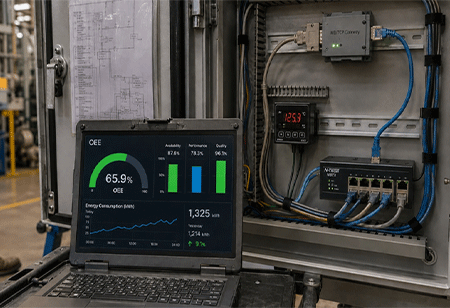
Older machines were rarely designed to share data. They speak serial protocols—RS‑232, RS‑485, Modbus RTU—or operate on proprietary industrial networks like Data Highway Plus, Profibus DP, or Interbus. Today’s plant networks, however, expect Ethernet/IP, PROFINET, or OPC UA. This leaves entire islands of production invisible to SCADA and MES layers. Engineers can stand next to a 20‑year‑old injection molding machine that runs perfectly while the plant’s digital dashboard shows zero data from that cell.
The result is a significant data visibility gap. Without communication, there is no automated production counting, no energy monitoring, and no condition‑based alerts. The machine becomes a black box in an otherwise connected factory.
 Cybersecurity and Reliability Concerns
When legacy controllers were designed, cybersecurity was rarely a consideration. These systems typically run unsupported firmware with no patch cadence, often relying on physical isolation for protection. The moment you connect them to a plant network—even for simple data extraction—you introduce network exposure risks that were never accounted for. Broadcast storms, unauthorized access, or even a misconfigured switch can cause unpredictable controller behavior.
Reliability also suffers from inconsistent diagnostics. Older PLCs may lack detailed fault registers, making root‑cause analysis a time‑consuming manual effort. This combination of hidden failure modes and limited cybersecurity makes retrofit planning as much about risk management as it is about technology.
What a Smart Retrofit Strategy Actually Looks Like Replacing Only Critical Control Layers
The most cost‑effective retrofit approaches we have seen leave the mechanical infrastructure completely untouched while surgically upgrading the control stack. Motors, gearboxes, and structural frames stay in place. The HMI, central PLC, and I/O modules get replaced with modern equivalents that can emulate the original I/O mapping and field wiring. A new controller might sit on the same DIN rail, using the same field terminations, but now supports Ethernet communication, onboard diagnostics, and remote access.
This approach preserves the machine’s proven mechanical dynamics while giving engineers a modern programming environment and full network capability. Downtime for the cutover can often be measured in hours instead of weeks.
Using Protocol Converters and Gateways
When a full controller swap is not feasible, industrial protocol gateways provide a practical bridge. A single DIN‑rail‑mounted gateway can translate a legacy serial protocol—say, Modbus RTU over RS‑485—into EtherNet/IP or OPC UA, making decades‑old variable‑frequency drives or temperature controllers visible to a SCADA system for the first time. This unlocks production visibility without touching the original machine logic.
We have used gateways to connect 1990s extruders to modern MES platforms, pulling live throughput and alarm data into centralized dashboards. The original machine continued running its proven control program with zero changes, while the gateway handled all protocol translation and data structuring.
Adding Sensors Without Full Machine Replacement
Industry 4.0 doesn’t require a new machine—it requires new data. Retrofittable sensors allow teams to capture vibration signatures, energy consumption, and thermal patterns without altering the machine’s mechanical design. Tri‑axial accelerometers mounted on bearing housings feed vibration data into predictive maintenance algorithms. Clamp‑on current transformers track motor energy usage. These sensors communicate wirelessly or via a local gateway, completely independent of the original control system.
This creates a parallel data layer that coexists with legacy automation, enabling condition‑based monitoring and early fault detection on machines that were never designed to report their own health.
When Full Replacement Makes More Sense
Retrofit strategies are powerful, but they have limits. When the mechanical platform itself is compromised—cracked frames, worn ways, or safety system obsolescence—adding new electronics is like repainting a rusted beam. Similarly, if production capacity needs to double, a retrofit cannot compensate for an undersized machine design. The table below summarizes the tipping points we typically evaluate.
|
Retrofit Scenario |
Full Replacement Scenario |
|---|---|
|
Mechanical platform is stable and within spec |
Structural wear, cracking, or safety system issues |
|
Limited capital budget available |
Capacity expansion is the primary objective |
|
Spare parts are still obtainable through secondary markets |
Control hardware is fully obsolete with no migration path |
|
Downtime must remain minimal |
A planned long shutdown is feasible |
These factors rarely produce a binary answer. Many plants phase their approach: a quick gateway project to gain visibility first, followed by a scheduled controller upgrade during a holiday shutdown, and only after several years evaluating whether the mechanical platform still justifies further investment.
How Industry 4.0 Is Changing Lifecycle Planning
One of the most significant shifts we see is the move from reactive lifecycle management to continuous, data‑driven planning. Digital twin models of legacy machines—built from retrofitted sensor data—allow engineering teams to simulate component wear and predict failure horizons. Asset lifecycle monitoring platforms aggregate runtime hours, vibration trends, and thermal histories to recommend precisely when a gearbox rebuild or bearing replacement will be needed, not based on a calendar but on actual condition.
Predictive maintenance platforms ingest this data alongside work order histories from centralized CMMS systems, creating a unified view of asset health. Spare parts inventory can then be optimized based on remaining useful life estimates rather than gut feeling. We are increasingly convinced that effective industrial automation lifecycle management strategies must treat legacy machines as first‑class citizens in the digital ecosystem, not as exceptions to be managed outside the system.
This shift transforms the conversation. A legacy machine is no longer just an aging asset to be nursed along—it becomes a source of continuous operational data that feeds into capital planning, uptime forecasting, and energy optimization. Modernization becomes a continuous process, not a one‑time project.
Conclusion
Legacy machines remain the economic backbone of manufacturing in countless sectors. A thoughtful retrofit strategy—one that preserves proven mechanical infrastructure while strategically inserting modern controls, gateways, and sensors—often delivers a better return on investment than a full replacement project. As Industry 4.0 adoption deepens, success will increasingly be measured not by how many new machines a plant buys, but by how intelligently it integrates the ones it already owns into a data‑driven operational framework.







We use cookies to ensure you get the best experience on our website. Read more...