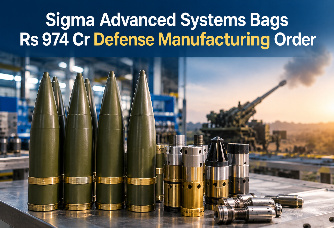
Defense manufacturing in India is gaining a new export milestone as Sigma Advanced Systems secures an order worth approximately Rs 974 crore from a NATO customer.
The Hyderabad-based company will manufacture and supply base bleed units for 155-mm artillery ammunition under a contract scheduled for execution over 12 months.
The order adds to its existing work on artillery shell bodies and fuses, widening its presence across the ammunition component chain.
Beyond the contract value, the development highlights how Indian suppliers are pursuing specialized manufacturing roles in international defense supply networks, while raising questions about production scale, integration and delivery capabilities.
The Rs 974 crore contract represents another step in Sigma Advanced Systems' efforts to expand its participation in ammunition manufacturing.
The company has previously secured orders for artillery shell bodies and fuses, and the latest award adds base bleed units to its portfolio of specialized components.
This progression provides a useful example of how defense component manufacturing can extend across multiple stages of a single ammunition supply chain.
Base bleed units are fitted to the rear of artillery projectiles, releasing gas during flight to reduce aerodynamic drag and extend range. Their production requires specialized engineering and quality controls appropriate to their role in ammunition systems.
For manufacturers, producing several components within one ecosystem can improve coordination between production stages and reduce dependence on external suppliers. Sigma's 12-month execution window makes manufacturing discipline an important part of the order's significance.
Also Read: India-EU Free Trade Deal: Which Sectors Are Set to Thrive in India
Defense manufacturing increasingly involves specialized suppliers supporting international customers with individual components, subsystems and engineering capabilities.
Sigma's expanding ammunition portfolio illustrates how an Indian manufacturer can seek a broader role without necessarily supplying a complete weapons platform.
For such companies, integration across component categories can create opportunities to coordinate manufacturing processes, strengthen supply-chain control and develop longer-term customer relationships.
The latest order indicates an expansion in Sigma's component offering, but the extent of in-house production, capacity additions and supplier localization would require further company disclosures to establish.
For India's wider defense manufacturing ecosystem, the opportunity lies in developing reliable suppliers capable of meeting international specifications consistently.
India's defense exports reached Rs 38,424 crore in financial year 2025–26, rising 62.66 percent from Rs 23,622 crore in the preceding year, according to the Ministry of Defense.
Private-sector firms accounted for Rs 17,353 crore of the total, highlighting their contribution alongside public-sector manufacturers.
This growth creates a relevant backdrop for examining whether Indian suppliers can capture more opportunities in specialized ammunition manufacturing and other defense components.
Manufacturers must demonstrate repeatable quality, competitive production economics, dependable deliveries and the ability to meet customer-specific requirements to attract further export contracts. Sigma's order offers a case study in this shift towards specialized participation in international defense supply chains.
More broadly, sustained investment in engineering, manufacturing capacity and supplier reliability will help determine how much value Indian companies can secure from rising global demand for defense equipment.







We use cookies to ensure you get the best experience on our website. Read more...