India is preparing the next phase of its 3D printing strategy to expand industrial use and strengthen domestic manufacturing.
Since February 2022, the National Strategy for Additive Manufacturing (NSAM) has trained over 1.54 lakh people, supported 56 start-ups, and helped develop 65 indigenous technologies.
The Ministry of Electronics and Information Technology (MeitY) is now conceptualizing NSAM 2.0 to accelerate innovation, boost commercial adoption, and improve India's position in the global additive manufacturing market. The proposed strategy builds on earlier efforts to develop local technologies, skilled workers, and manufacturing capabilities.
India's original strategy aimed to capture 5% of the global additive manufacturing market and contribute nearly USD 1 billion to the country's gross domestic product (GDP). Other targets included developing 50 India-specific technologies, supporting 100 start-ups, creating 500 products, training one lakh skilled workers, and building capabilities across 10 manufacturing sectors.
The reported training figure has already crossed the initial target. The program has also supported 65 indigenous technologies across materials, machines, design processes, and printed products. Seven specialized Development and Deployment Centres have been established to support research, industry collaboration, technology development, and skill building.
NSAM 2.0 remains at the conceptualization stage. Its proposed priorities include generating intellectual property, integrating digital technologies, developing globally competitive products, and making equipment and materials more affordable through manufacturing clusters. It also aims to strengthen the additive manufacturing electronics supply chain, support defense applications, expand start-up activity, and promote pilot projects linked to the Sustainable Development Goals.
Also Read: How India's Tyre Industry Is Responding to a Changing Mobility Market
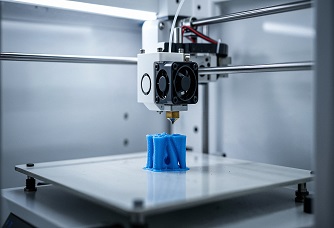
3D printing creates physical objects from digital designs by adding materials layer by layer. The process combines computer-aided design, electronics, and materials science, using materials such as metals, polymers, ceramics, composites, and biomaterials.
India has demonstrated applications across several sectors. In May 2024, Agnikul Cosmos, a start-up incubated at IIT Madras, launched its Agnibaan SOrTeD mission with a single-piece, 3D-printed semi-cryogenic rocket engine. The mission demonstrated the technology's role in developing indigenous space hardware.
The Indian Army has also used additive manufacturing for construction. A two-storey dwelling in Ahmedabad was completed in 12 weeks, while the technology has been extended to defense infrastructure in operational areas such as Ladakh. The armed forces are exploring its use in maintenance, repair, and overhaul operations.
MeitY held the second National Additive Manufacturing Symposium in March 2026 to discuss NSAM 2.0, defense uses, industrial adoption, and research. Atal Tinkering Labs are also introducing students in Classes VI to XII to tools such as 3D printers, robotics kits, and Internet of Things technologies.
The global additive manufacturing machines market is projected to reach USD 149 billion by 2035. The additive manufacturing electronics supply chain is expected to grow from USD 18 billion to USD 112 billion, according to figures cited by the government. These are projections, not current market valuations.




We use cookies to ensure you get the best experience on our website. Read more...