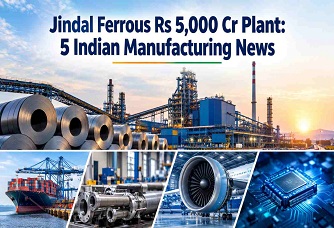
Indian manufacturing is seeing fresh momentum across steel production, industrial engineering, exports, aerospace technology and semiconductor development.
Recent developments include Jindal Ferrous commissioning an integrated steel complex worth more than Rs 5,000 crore in Odisha, DEE Development Engineers securing a Rs 46 crore international contract and India recording a 23.04 percent rise in merchandise exports in September 2026.
Raghu Vamsi Group has partnered with the University of Sheffield’s Advanced Manufacturing Research Centre to strengthen aerospace manufacturing capabilities.
Meanwhile, Tamil Nadu has introduced a semiconductor ecosystem policy to attract investments into the electronics sector.
Taken together, these developments show how capacity expansion, global tie-ups and policy support are defining the Indian manufacturing sector’s growth.
Jindal Ferrous has commissioned its first manufacturing complex in Jajpur, Odisha, following an investment of more than Rs 5,000 crore.
The facility includes a 2.2 million tons per annum (MTPA) steel melting shop, a blast furnace and a sinter plant, alongside supporting infrastructure.
The facility incorporates metallurgical waste recycling systems and process-gas utilization to improve resource efficiency.
The expansion strengthens Indian manufacturing by adding domestic steelmaking capacity and supporting downstream industries that depend on a reliable supply of steel.
Key developments include:
Odisha Chief Minister Mohan Charan Majhi said the commissioning would strengthen the state’s industrial ecosystem and reflect investor confidence in its infrastructure and investment environment.
Also Read: How to Build a Future-Ready Talent Pipeline for Electronics Component Manufacturing
DEE Development Engineers has secured an international contract worth approximately Rs 46 crore from a US-based engineering, procurement and construction (EPC) company.
The order covers module manufacturing and off-skid piping fabrication, with deliveries scheduled for completion by July 2027.
The contract gives the company greater exposure to overseas projects and custom engineering works. Similar deals can boost exports, deepen technical expertise and connect Indian manufacturers to the global supply chain.
DEE Development Engineers supplies high-pressure piping systems, piping spools, pipe bends, fittings, pressure vessels and modular skids, with manufacturing facilities in India and Thailand.
Chairman and Managing Director K L Bansal said the company is targeting core revenue of Rs 1,500 crore in FY27. Its strategy includes expanding into integrated modules and project-specific fabrication while improving manufacturing capacity utilization.
India's merchandise exports increased 23.04 percent year-on-year to USD 44.40 billion in September 2026, compared with USD 36.08 billion a year earlier. The merchandise trade deficit narrowed to USD 30.21 billion from USD 33 billion in September 2025.
Electronics, petroleum products, engineering goods, chemicals and agricultural products supported export growth. Overall exports, including goods and services, rose 10.99 percent to an estimated USD 80.75 billion.
Commerce Secretary Rajesh Agrawal highlighted the growth in export performance during the July–September quarter, when overall exports grew 15.84 percent.
Raghu Vamsi Group has signed a three-year memorandum of understanding with the University of Sheffield's Advanced Manufacturing Research Centre (AMRC) to strengthen aerospace and defense manufacturing capabilities in India and the United Kingdom.
The collaboration will focus on advanced manufacturing processes, digital technologies, superalloys and single-crystal castings.
It will also support technology development for the group's planned superalloys facility and research and development center in Telangana.
The partnership aims to improve supply-chain efficiency, develop specialized manufacturing capabilities and support relevant aerospace and defense industry accreditations.
Raghu Vamsi Group Managing Director Vamsi Vikas Ganesula said the collaboration would help build globally competitive manufacturing capabilities by bringing AMRC's expertise in single-crystal castings to India.
Tamil Nadu Chief Minister C Joseph Vijay has unveiled the state's Semiconductor Ecosystem Policy 2026 to attract semiconductor investments and strengthen advanced electronics manufacturing.
The policy aligns with the Union government's Semicon 2.0 program and builds on the state's planned semiconductor and electronics park at Maduramangalam in Kancheepuram district.
Key developments include:
The initiative is part of the state's broader ambition to develop its industrial and technology sectors. For Indian manufacturing, the policy could help expand the domestic electronics supply chain and attract investment into semiconductor-related activities.

.jpg "Industrial Manufacturing")




We use cookies to ensure you get the best experience on our website. Read more...