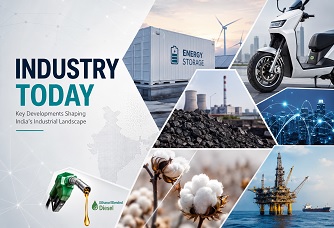
India’s industrial landscape continues to witness important developments across energy, manufacturing, technology, and automotive sectors.
Strategic partnerships, new project wins, and policy decisions are shaping business activity across key industries. Energy storage and electric mobility remain important areas for investment and localization.
At the same time, companies are strengthening domestic capabilities while exploring new opportunities across emerging and traditional industries.
Meanwhile, developments in coal imports, fuel blending, cotton prices, and energy exploration are influencing broader market trends. Here are the key industry developments to track today.
Jupiter Wagons has secured two Battery Energy Storage System projects from West Bengal State Electricity Distribution Company. The projects at Jeerat and Kharagpur have a combined capacity of 100 MW. The projects involve supply and commissioning worth approximately INR 400 crore under a 15-year Build, Own and Operate model.
“These projects add meaningful scale to our BESS order book, which now stands at approximately 500 MWh valued at over INR 500 crore, and reinforces our confidence in the long0term opportunity for energy storage in India,” said Vivek Lohia, Managing Director, Jupiter Wagon Ltd.
Bosch is increasing its focus on localization to strengthen its electric two-wheeler component business in India. The company has already localized key components, including electric motors and motor controllers. Bosch is also expanding its local manufacturing and engineering capabilities as electric two-wheeler adoption grows. Its portfolio includes electric drive systems and other technologies for two-wheelers.
Manohar Halahali, President, Bosch Two-Wheeler & Powersports, India said that the localisation has helped the company reduce costs, particularly in electric motors.
India’s thermal power sector has sharply reduced coal imports used for blending with domestic coal. Imports for blending declined from around 23.9 million tonnes in 2023–24 to 6.8 million tonnes in 2025–26. The decline reflects government efforts to increase domestic coal availability and reduce dependence on imported fuel.
Airtel Business and ITI Limited have entered into a strategic collaboration to accelerate enterprise digital transformation in India. The partnership combines Airtel Business’ connectivity and technology capabilities with ITI’s engineering expertise. The companies will support enterprises in modernizing legacy systems, improving operational efficiency, and strengthening digital security.
Rajesh Rai, Chairman and Managing Director, ITI Limited, said, "Extremely enthusiastic on this momentous occasion, wherein ITI Ltd. and Bharti Airtel Ltd. have come together with this MoU to offer state of the art services and solutions to our customers.
Sharat Sinha, CEO, Airtel Business, said, "As India accelerates into its next phase of digital growth, building a foundation that is resilient, sovereign, and regulatorily compliant is imperative.
Also Read: India's Electronics Component Boom: Opportunities & Road Ahead
Ethanol-blended diesel has failed required safety specifications due to a sharp reduction in its flash point. The government said the addition of ethanol significantly affects the fuel’s safety characteristics. Wider use of ethanol-blended diesel will remain on hold until the technical concerns are addressed.
Indian cotton prices have strengthened amid supportive global market conditions and firm domestic demand. International price movements have provided additional support to domestic cotton prices. The market is also being influenced by production expectations and changing demand conditions across the textile value chain.
ONGC and Shell Energy India have signed a non-binding memorandum of understanding to explore new energy opportunities. The agreement covers deepwater and ultra-deepwater oil and gas exploration in India. The companies will also explore potential LNG sourcing opportunities under the partnership.
The latest developments highlight continued activity across India’s industrial and energy ecosystem. Battery storage, electric mobility, and digital infrastructure are attracting greater strategic attention. At the same time, policy decisions are influencing coal imports and alternative fuel adoption. Partnerships across energy and technology sectors are also opening new opportunities for domestic growth and industrial expansion.






We use cookies to ensure you get the best experience on our website. Read more...