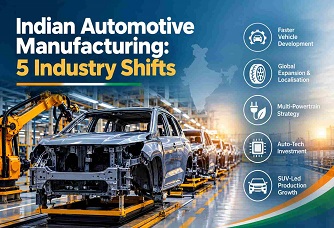
Indian automotive manufacturing is entering a crucial junction as production flexibility, localization, international expansion and changing vehicle demand are influencing industry strategies.
Vehicle and component manufacturers are changing their strategies across the value chain to accommodate changing customer preferences and to grow both at home and abroad.
Stellantis is targeting shorter vehicle development cycles, CEAT is pursuing a larger international revenue share, and automakers are expanding their multi-powertrain portfolios.
Meanwhile, auto-tech investment patterns highlight the importance of funding for industrial innovation, while utility vehicles continue to dominate India's passenger vehicle market.
Together, these developments offer insights into how manufacturers may need to approach supplier partnerships, production planning and manufacturing capabilities as the industry evolves.
Stellantis India is targeting a reduction in vehicle development time from 48 months to approximately 24 months, alongside efforts to strengthen localization.
For the development timeline to shorten, collaboration between the engineering team and component suppliers becomes crucial.
Faster prototype development, component testing and tooling readiness may become increasingly important as manufacturers seek to accelerate product launches.
For Indian automotive manufacturing, the development highlights the importance of building supplier capabilities that can support shorter engineering timelines without compromising on quality or reliability.
Also Read: Indian Commercial Vehicle Industry 2026: Trends and Opportunity
CEAT plans to raise its overseas sales to one-third of its total revenue over the next five years.
The company's strategy includes integrating CAMSO, expanding its overseas presence and benefiting from recovering demand in markets such as Africa and Latin America.
The development also highlights opportunities in specialized off-highway tyres used in construction, agriculture and mining equipment. These segments require product capabilities tailored to demanding operating conditions.
Manufacturers hoping to expand internationally must manage freight costs, delivery schedules, overseas distribution and product requirements across different markets.
Indian automakers are expanding their offerings across petrol, diesel, compressed natural gas (CNG), hybrid and electric powertrains as consumer preferences diversify.
The shift creates new considerations for manufacturing operations, including component sourcing, assembly-line flexibility and production scheduling.
Manufacturers must accommodate different powertrain configurations while managing capacity and maintaining consistent quality.
For automotive component manufacturing, this transition could create opportunities in batteries, power electronics, wiring systems and thermal management, alongside continued demand for conventional engine components.
India's auto-tech sector attracted USD 1.3 billion across 97 funding rounds between January 1 and October 15, 2026, compared with USD 2.1 billion across 195 rounds in 2025.
Late-stage investments accounted for approximately 60 percent of the 2026 funding total, while Bengaluru attracted nearly 70 percent of the capital raised.
The figures highlight continued investment activity, although the broader auto-tech sector includes mobility platforms and services as well as technology businesses.
Utility vehicles accounted for approximately 68 percent of India's passenger vehicle sales during the July-September quarter of FY2026-27, while utility vehicle volumes grew 34.2 percent year-on-year to 9.19 lakh units. Passenger car volumes increased 24.9 percent to 3.99 lakh units.
The sustained shift towards SUVs has implications for production planning, component sourcing and manufacturing capacity.
For Indian automotive manufacturing, the trend could create opportunities for suppliers of body panels, chassis systems, suspension components, seating and tyres, depending on individual vehicle programs and sourcing decisions.





We use cookies to ensure you get the best experience on our website. Read more...