India's electronics exports increased 44 percent year-on-year to USD 31.97 billion during April-September FY27, compared with USD 22.20 billion in the corresponding period last year, according to the Ministry of Commerce and Industry.
While smartphones remained the largest export category, non-smartphone electronics recorded faster growth, signaling a gradual shift in the country's export composition.
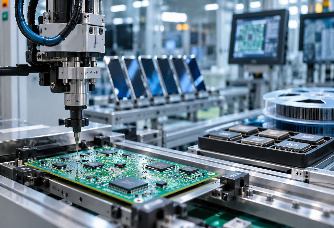
Printed circuit boards (PCBs), memory integrated circuits and networking equipment emerged as significant contributors.
However, the changing product mix also raises questions about export market concentration and India's ability to strengthen domestic component manufacturing and retain greater value within its electronics supply chain.
Also Read: How to Build a Future-Ready Talent Pipeline for Electronics Component Manufacturing
Smartphone exports increased 35.8 percent to USD 18.17 billion, while their share of total exports declined from 60.3 percent to 56.8 percent.
In comparison, non-smartphone electronics exports rose 56.5 percent to USD 13.79 billion, increasing their contribution from 39.7 percent to 43.2 percent.
The fastest growth came from mounted PCBs, whose exports increased from USD 63.3 million to USD 2.10 billion. Memory integrated circuit exports rose 2,333 Percent to USD 562.4 million, while networking equipment exports increased 98 percent to USD 1.45 billion.
Despite diversification in India's electronics exports, individual product categories remain concentrated in specific overseas markets.
Singapore accounted for USD 1.87 billion of mounted PCB exports, while China received USD 789.2 million worth of populated PCBs. Malaysia led memory IC exports at USD 390.8 million.
This concentration makes expanding the number of export destinations an important consideration for long-term trade resilience.
The increase in India's electronics exports highlights growing manufacturing activity, but export growth alone does not establish higher domestic value addition.
Dependence on imported components and intermediate goods remains an important factor to examine.
Strengthening domestic PCB, semiconductor and component manufacturing capabilities will be essential to deepen local supply chains and sustain export competitiveness.







We use cookies to ensure you get the best experience on our website. Read more...