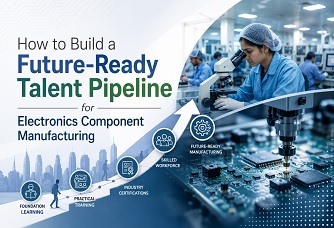
India's electronics component manufacturing sector is expanding faster than its workforce can keep pace with.
Production has jumped from Rs 1.90 lakh crore in 2014-15 to an estimated Rs 13.11 lakh crore in 2025-26. Yet industry reports point to a shortfall of nearly 10 million trained professionals by FY 2027-28.
The gap isn't just about headcount. It's about operators who can run SMT lines, technicians who understand cleanroom protocols, and engineers who can program PLCs for smart factories.
Electronics component manufacturing companies that solve this early will out-hire and out-produce those that wait for the labor market to catch up.
This article covers where the talent crisis stands today and which skills are missing on the shop floor. It also looks at how government schemes are shaping training mandates, and what a practical, in-house roadmap for building talent looks like.
The numbers tell a story of explosive growth colliding with a thin talent bench. India's electronics sector is growing at a compound annual rate of 25-30 percent. It is projected to create 12 million jobs by FY 2027-28, split between 3 million direct roles and 9 million indirect ones. Against this, TeamLease Degree Apprenticeship pegs the shortfall at 10 million trained professionals. An immediate deficit of roughly 8 million workers is already being felt on factory floors today.
A.R. Ramesh, Managing Director at Allegis Group and Former CEO of TeamLease, said "the industry faces a severe workforce shortage," even as production crossed USD 101 billion in FY2023. The mismatch is sharpest in the shift away from pure assembly. India spent a decade importing finished components and simply screwing them together.
The country is now trying to build printed circuit boards, passive capacitors, and display modules domestically. That shift demands operators and engineers who understand material science and precision processes. It calls for more than assembly-line repetition.
Electronics component manufacturing firms report that entry-level hires often need six to twelve months of on-the-job training before they turn production-ready. That delay is a cost only few companies can absorb at current growth rates, especially as competitors scale faster with better-prepared teams.
Skill shortages show up differently at each rung of the ladder. At the operator level, workers frequently struggle to read process charts or follow standard operating procedures precisely. Many can't troubleshoot basic machine stoppages without escalating to a supervisor. This slows throughput on lines designed to run near-continuously.
Higher up the chain, the deficit turns more technical:
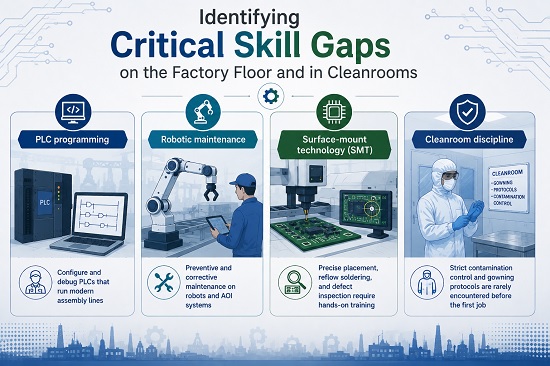 Few technicians can independently configure or debug the programmable logic controllers that run modern assembly lines.
Also Read: How Advanced Filtration Driving the Future of Sustainable Mobility
Most electronics graduates in India get little to no exposure to a working cleanroom during their education. That means the nerve center of component and chip manufacturing is often unfamiliar territory on day one. Quality control adds another layer of difficulty. Manufacturers need workers fluent in statistical process control and traceability documentation. These skills sit at the intersection of engineering know-how and regulatory compliance, and few fresh graduates arrive with both.
Policy has moved faster than the workforce it's meant to support. The Production-Linked Incentive (PLI) scheme for large-scale electronics manufacturing offers a starting point. The Scheme for Promotion of Manufacturing of Electronic Components and Semiconductors (SPECS) adds a 25 percent capital expenditure incentive. Modified Electronics Manufacturing Clusters (EMC 2.0) rounds out a policy scaffold aimed at pushing India from assembly toward high-value component production.
The Electronics Components Manufacturing Scheme (ECMS), launched in April 2025, sits at the center of this push. The Union Budget 2026-27 raised its outlay to Rs 40,000 crore. Already, 75 applications have been approved across 12 states. The Large-Scale Electronics Manufacturing scheme alone has generated over 1.71 lakh additional jobs as of December 2025. That shows how quickly incentive-linked hiring can scale once policy support is in place.
|
Scheme |
Focus Area |
Key Incentive |
|
PLI (LSEM) |
Mobile phones, specified components |
4-6% incentive on incremental sales |
|
SPECS |
Electronic components, semiconductors |
25% capex reimbursement |
|
ECMS |
Components, sub-assemblies, raw materials |
Rs 40,000 crore outlay (2026-27) |
|
EMC 2.0 |
Common infrastructure, clusters |
Grants for shared facilities |
What's still missing is a direct, enforceable link between these incentives and workforce training targets. Industry voices argue that future scheme renewals should tie disbursements to verified skilling outcomes. Right now, most schemes track production milestones but not training milestones. That leaves a gap where Electronics Component Manufacturing capacity can outpace workforce readiness instead of growing alongside it.
Also Read: India's Electronics Component Boom: Opportunities & Road Ahead
 Apprenticeship-embedded degree programs (AEDPs) are emerging as the most direct fix for the classroom-to-shop-floor gap. The Apprenticeship (Amendment) Rules, 2025 formally recognized degree apprenticeships. Students can now build skills in automation systems, industrial IoT, and cleanroom operations while still completing their academic coursework.
The scale of this shift is notable. Apprenticeship enrolment is growing at a 55 percent compound annual rate, with projections of 1 to 2 million apprentices by 2027. Sumit Kumar, Chief Strategy Officer at TeamLease Degree Apprenticeship, has called for stronger industry-academia collaboration. His goal: double the annual graduate pipeline from 2 million to 4 million by FY 2027-28.
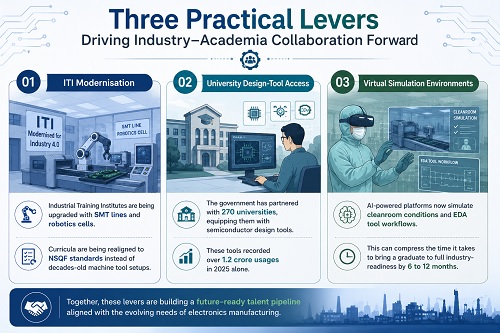
Three practical levers are driving this collaboration forward:
Electronics Component Manufacturing is no longer a purely mechanical trade. Smart factories run on data, and the workforce needs to catch up. IoT-enabled production lines generate continuous streams of machine data. That data is only useful if operators and technicians can read dashboards, flag anomalies, and act on predictive-maintenance alerts before a line goes down.
This requires a new baseline of data literacy on the factory floor. It isn't limited to engineers; line supervisors and quality inspectors need it too. Companies are increasingly building this through short, role-specific modules rather than long theoretical courses. A technician doesn't need a data science degree. But they do need to interpret a control chart and recognize when a machine's vibration pattern signals an imminent failure.
AI-driven predictive maintenance is proving to be the clearest return-on-investment case for this kind of training. Plants that pair sensor data with trained analysts catch component wear before it causes downtime. This protects output on lines that are increasingly automated but still need human judgment at the exception-handling layer. Building this capability early, rather than retrofitting it after a smart factory rollout, saves manufacturers both training cost and production disruption down the line.
Also Read: 8 Emerging Technologies Reshaping Electronic Component Manufacturing
Women already form the backbone of India's electronics workforce. Closing the talent gap depends heavily on deepening this participation further. Nearly 70 percent of the direct workforce in mobile phone manufacturing is female. Across electronics manufacturing services (EMS) more broadly, women make up 60-65 percent of production staff.
JS Gujral, Managing Director of Syrma SGS Technology, noted that late working hours remain a real deterrent for women. This holds true even as the company targets close to 90 percent female staffing at some newer plants. This points to a gap that isn't about capability but about workplace design. Safe transport, well-lit facilities, and shift structures that don't force women out of the workforce all matter here.
Two priorities can widen this pipeline further:
The semiconductor segment still lags behind. Women represent around 25 percent of that workforce as of 2025, with expectations to reach 35 percent by 2030. Closing that gap means deliberately recruiting women into process engineering and quality assurance roles, not just onto assembly lines.
Manufacturers waiting for the ecosystem to fix itself will lose ground to competitors building talent in-house today. A practical roadmap starts with three steps, each designed to be actionable within a single financial year.
1. Conduct a structured skills audit. Map every role on the floor against the skills it actually requires, not the qualifications listed on a job posting. This usually reveals that the real gap is narrower than assumed. It tends to concentrate in specific areas like SMT operation, PLC troubleshooting, and quality documentation, rather than being spread evenly across the workforce.
2. Build training dojos next to the production line. Rather than sending new hires to off-site centers, leading electronics component manufacturing plants are setting up small, dedicated training bays next to actual lines. New workers practice on retired or spare equipment before they ever touch live production, cutting both onboarding time and early-stage defect rates.
3. Adopt stackable, recognized credentials. Partnering with bodies like the Electronics Sector Skills Council of India (ESSCI) for NSQF-aligned certifications gives workers portable, verifiable proof of skill. This improves retention, because employees can see a clear ladder rather than a dead end at the end of every shift.
Manufacturers that combine these three elements consistently report shorter ramp-up times and lower attrition. Workers stay longer when they can see a defined growth path, rather than treating the factory floor as a temporary stop before something better comes along. A well-trained workforce also underpins the industry's next challenge: running plants that meet rising sustainability standards without sacrificing output.
India's electronics component manufacturing ambitions will eventually be determined not by investment alone, but by the power of its workforce. As the industry moves beyond assembly into advanced component and semiconductor production, building a skilled talent pipeline has become just as critical as intensifying manufacturing capacity.
The move toward smart factories, automation, cleanroom manufacturing, and AI-driven production requires a new generation of technicians, operators, and engineers equipped with industry-ready skills. Stronger collaboration between manufacturers, academic institutions, and policymakers will be essential to bridge the widening talent gap.
At the same time, greater participation from women, expanded apprenticeship programs, and constant upskilling can help create a resilient and future-ready workforce capable of supporting India's manufacturing goal.
As policy support, industry investment, and workforce development continue to align, companies that invest in talent today will be best positioned to drive innovation, improve productivity, and establish India as a globally competitive hub for electronics component manufacturing.
The government is tackling the talent gap through apprenticeship reforms, ITI modernization, and partnerships with universities for semiconductor and electronics training. Schemes such as ECMS, PLI, SPECS, and EMC 2.0 are also encouraging domestic manufacturing while strengthening the industry's long-term skilling ecosystem.
Women are a driving force in India's electronics manufacturing sector, accounting for nearly 70 percent of the direct workforce in mobile manufacturing and 60–65 percent of EMS production roles. Expanding STEM education, improving workplace safety, and strengthening career progression can further boost their participation.
Manufacturers can reduce skill shortages by conducting regular skills audits, establishing hands-on training dojos near production lines, and offering NSQF-aligned certifications. These initiatives shorten onboarding time, improve productivity, and increase employee retention by creating clear career pathways.
.jpg "Electrical & Electronics Companies")

.jpg "Chemical Companies")




We use cookies to ensure you get the best experience on our website. Read more...