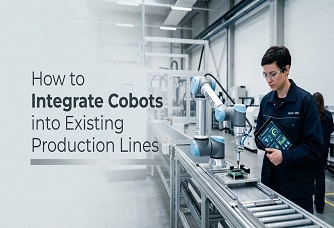
Manufacturers across the world are under pressure to raise output without adding floor space or headcount.
This is exactly why so many teams now integrate cobots into their existing production setup instead of rebuilding entire lines from scratch.
Collaborative robots, or cobots, are designed to work next to people, fit into tight spaces, and get installed in days rather than months.
Global cobot sales are projected to touch roughly 735,000 units in 2025, and industry surveys suggest around 70 percent of manufacturers plan to run cobots by 2030.
For an operations leader, the real question is not whether cobots work — it is how to bring them into a live, running line without breaking what already works.
Arvind Vasu, Managing Director, Scandinavian Robot Systems India says, “We are moving toward High-Throughput, High-Safety (HTHS) systems where the robot is predictive rather than just reactive. Future cobots will use AI to recognize human intent, anticipating which tool a worker needs next and handing it to them.”
“The robot will move from being a ‘tool’ to being an ‘intelligent teammate’, capable of self-correcting minor variations in part placement, thereby reducing downtime and maximizing the efficiency of the human-robot cell.”
This guide lays out eight practical steps, along with checklists, tables, and real deployment data, so you can move from idea to a working cobot cell with minimal disruption.
Start by mapping tasks that are dull, repetitive, or physically demanding for workers. Machine tending, palletizing, dispensing, inspection, and simple assembly are proven starting points for cobot integration. Poor task selection remains the single biggest cause of failed automation projects, according to integrators who work directly with SME manufacturers.
A good opportunity usually has three traits: consistent motion, tolerable cycle-time variation, and low changeover complexity. Tasks with constantly shifting part shapes or unpredictable timing are harder to automate well on a first attempt.
“Unlike industrial robots, cobots require no safety cages, can work alongside humans, and are easily reprogrammable for diverse tasks – key advantages in India’s labour-intensive manufacturing landscape,” says Sameer Gandhi, Managing Director, OMRON Automation India.
Also Read: How LiDAR, Thermal & UV Payloads Revolutionize Power Transmission
Cobots are typically far cheaper to deploy than caged industrial robots, and the payback period reflects that. A traditional palletizing cell can cost $150,000–$300,000 installed, while a cobot palletizer often runs $60,000–$100,000. Machine-tending cobots frequently cost $25,000–$45,000 and can run across three shifts, seven days a week.
|
Automation Type |
Typical Installed Cost |
Typical Payback Period |
|
Traditional caged robot cell |
$150,000–$300,000 |
12–36 months |
|
Cobot palletizing cell |
$60,000–$100,000 |
6–12 months |
|
Cobot machine tending |
$25,000–$45,000 |
6–12 months |
|
Cobot CNC tending (EU data) |
€35,000–€65,000 |
8–14 months |
When building the case, include savings beyond labor — reduced scrap, fewer ergonomic injuries, and higher machine utilization during unattended shifts. These often make the difference between a stalled proposal and an approved budget.
Match the cobot to the task, not the other way around. Four parameters decide most of the fit: payload, reach, repeatability, and software ecosystem compatibility.
|
Criteria |
Light Assembly |
Machine Tending |
Palletizing |
Welding |
|
Typical payload needed |
3–5 kg |
5–10 kg |
15–30 kg |
5–12 kg |
|
Repeatability required |
High (±0.03 mm) |
Medium |
Low |
Medium |
|
Common cobot class |
UR3e / UR5e class |
UR10e / CRX-10iA class |
UR20 / CRX-25iA class |
Cobot welding cells |
|
Integrator support needed |
Moderate |
Moderate |
High |
High |
Vinod Kumar, President of the India SME Forum, notes that affordability and support networks matter as much as specifications for smaller manufacturers: "Digital and software automation is becoming essential for competitiveness, while AI and affordable hardware automation will define the next phase of MSME growth and productivity."
Manufacturers already running one robot brand often add a compatible cobot line from the same vendor, since it reuses controllers, programming languages, and service contracts — a detail worth checking before comparing across brands.
A cobot cell must respect the rhythm of the line it joins. Existing lines have routines shaped by operators, upstream feeds, and downstream buffers, and ignoring that rhythm can create new bottlenecks instead of removing old ones.
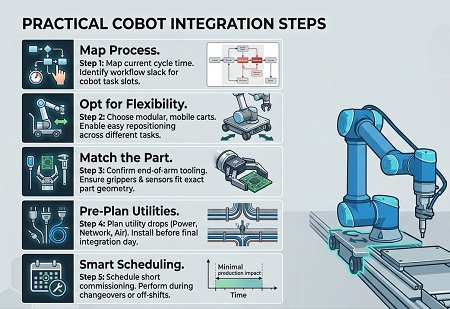 time and identify slack points for the cobot to slot into
Universal Robots' 2026 ElevateX leadership sessions described this shift plainly: manufacturers are moving past isolated pilot tests toward centrally managed cobot fleets that can be redeployed across lines in minutes rather than days. That kind of modularity reduces the risk baked into Step 4.
Cobots are built for close human interaction, but that does not remove the need for a formal risk assessment. International standards such as ISO/TS 15066 guide force, speed, and separation limits for collaborative applications, and most manufacturers now build assessments around AI-driven behavior and sensor-based awareness as systems get smarter.
Skipping this step is the most common regulatory and safety shortcut manufacturers regret. A proper assessment usually adds days, not weeks, to the timeline.
Nitin Mehra, President, Precision Engineering Technologies India Private Limited says, “We have seen a clear shift in Indian industry towards automation. Many customers are seeking a simple, accessible entry point, particularly those who aren’t operating at extremely high volumes. High-volume production often justifies the significant investment in fixed, moving, or gantry robots, which can connect multiple machines.”
Also Read: Designing Drone Success: Tech, Talent & Execution
Deployment should happen in a controlled window, ideally during a planned shift changeover or scheduled maintenance stop. A phased rollout — pilot cell first, then scale — protects output while the team learns.
|
Week |
Activity |
|
Week 1–2 |
Site survey, task confirmation, tooling order |
|
Week 3–4 |
Cobot delivery, mounting, and network setup |
|
Week 5 |
Programming and dry-run without live parts |
|
Week 6 |
Safety validation and operator walkthrough |
|
Week 7–8 |
Live pilot run with close monitoring |
|
Week 9+ |
Full handover and performance tracking |
Manufacturers report that force- and power-limited robots rarely fail because of the hardware itself — most disruption comes from skipping the dry-run and safety-validation steps to save time.
A cobot is only as good as the team running it. Operators need hands-on training on start/stop procedures, basic reprogramming, and recognizing fault codes. Maintenance teams need a clear schedule for calibration, gripper checks, and software updates.
Subrata Karmakar, President, Robotics & Discrete Automation Division, ABB India, “Cobots are popular due to their easy programming and typically need no additional safety measures, allowing seamless integration into existing production spaces without the need for fencing.”
Once live, track a small set of metrics weekly: cycle time, uptime, defect rate, and operator hours redirected to higher-value work. Compare against the baseline captured before deployment to prove real gains.
Cobot welding grew over 40 percent in 2025 and cobot palletizing grew over 50 percent year-over-year, largely because early adopters kept refining cycle times after go-live instead of treating deployment as a one-time project. Review performance monthly for the first two quarters, then quarterly once the line stabilizes.
|
Challenge |
Practical Solution |
|
Bottlenecks at handoff points |
Re-map cycle time and adjust cobot placement |
|
Operator resistance |
Involve operators early; frame cobot as support, not replacement |
|
Tooling mismatch |
Test end-of-arm tooling on real parts before full commissioning |
|
Underestimated integration hours |
Budget 30–80 hours of integration engineering upfront |
|
Safety sign-off delays |
Run risk assessment in parallel with tooling procurement |
Bringing a cobot into a running line is a planning exercise as much as a technical one. Manufacturers that succeed treat cobot integration as a structured, eight-step process rather than a single hardware purchase.
Careful task selection, a realistic business case, and a genuine safety review consistently separate smooth rollouts from stalled ones. As production line automation matures under Industry 4.0, the manufacturers who integrate cobots methodically — not just quickly — are the ones seeing lasting gains in throughput, safety, and cost control.
This article was researched and compiled using verified industry data, manufacturer disclosures, and named expert commentary current as of mid-2026. Figures such as cost ranges and payback periods vary by application, region, and vendor, and should be validated against current vendor quotes before final budgeting.
Yes. Cobots are designed to slot into existing stations, conveyors, and machines using compatible end-of-arm tooling, so most deployments avoid replacing existing equipment entirely.
They look for repetitive, rule-based tasks with stable cycle times and payloads within cobot range, such as machine tending, palletizing, dispensing, or inspection.
Downtime drops when deployment happens during a planned changeover, tooling is tested before commissioning, and operators are trained before the cobot goes live rather than after.
.jpg "Saksham Enterprises: Optimizing Mission- Critical HVAC Infrastructure For The High Precision Sector")

.jpg "JDS Group of Companies: Innovating Smart Solutions For Modern Power Transmission & Distribution Infrastructure")




We use cookies to ensure you get the best experience on our website. Read more...