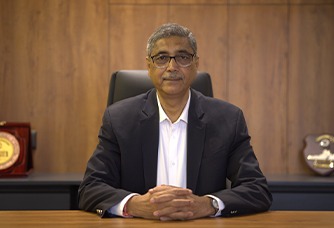
Rear Admiral VK Saxena, IN (Retd), is a distinguished maritime leader with over four decades of experience spanning naval operations, submarine construction, ship production, and large-scale shipyard management. He has held several critical leadership roles in the Indian Navy, including Project Director for Submarine Construction and Additional Director General for Project Seabird. Leveraging deep operational expertise and strategic acumen gained through his military service, he has successfully transitioned into leading complex, large-scale shipbuilding enterprises in the corporate sector.
Currently serving as the CEO of Swan Defence and Heavy Industries Ltd. (SDHI), he is leading the transformation of India’s largest shipyard, driving capacity expansion, technology adoption, and global competitiveness, while positioning India as a credible hub for next-generation and specialized shipbuilding.
In a conversation with Thiruamuthan, Assistant Editor at Industry Outlook, Rear Admiral V K Saxena, IN (Retd), CEO, Swan Defence and Heavy Industries Limited (SDHI), shares his perspectives on India’s evolving position in the global shipbuilding landscape. Drawing on decades of experience across naval operations, submarine programs, and shipyard leadership, he highlights the structural shifts, policy support, and ecosystem development driving India’s emergence as a credible maritime manufacturing hub.
Against the backdrop of global capacity constraints, supply chain realignments, and energy transition demands, he emphasizes the critical role of technology adoption, skilled workforce development, and long-term policy stability in enhancing competitiveness. He also outlines the strategic priorities required to translate India’s growing momentum into sustained global market share, positioning the country as a reliable destination for next-generation and specialized shipbuilding.
Q - In your assessment, has the global perception of India as a shipbuilding destination evolved in recent years, and what key factors are driving this shift?
A - The global perception of India's shipbuilding sector has evolved from a maritime market to an emerging shipbuilding and maritime manufacturing destination.
This shift is evident in the growing export order books of Indian shipyards, including SDHI and our peers, the plans of leading global shipbuilders such as Hyundai to establish shipbuilding capacities in India, and the increasing number of partnerships being forged between Indian and international maritime companies across technology, workforce development, and advanced shipbuilding.
Much of the credit belongs to policymakers who articulated a long-term vision through initiatives such as Maritime India Vision 2030 and Maritime Amrit Kaal Vision 2047. These frameworks have been complemented by supportive policies and incentives aimed at strengthening the entire maritime ecosystem.
At the same time, global capacity constraints, geopolitical realignments, and supply chain diversification have prompted shipowners to look beyond traditional shipbuilding hubs.
Equally important is the activation of existing capacities. At SDHI, the revival of India's largest shipyard has unlocked a quarter of the country's shipbuilding capacity and created a facility capable of delivering large, technologically advanced vessels. Our recent orders for chemical tankers and ammonia dual-fuel bulk carriers are strong indicators of the growing confidence that global customers are placing in Indian shipyards.
Q - What operational or structural challenges continue to limit scale and efficiency within the Indian shipbuilding ecosystem?
A - Shipbuilding is not just about having infrastructure; it depends on the strength of the entire ecosystem around it. India has made strong policy progress over the last few years, and the next phase is execution - scaling skilled talent, expanding the ancillary ecosystem, and investing in R&D, design, and digitization.
These will be critical to improving productivity, reducing costs, and competing at a global level.
India’s path to sustained global market share in shipbuilding will depend on execution excellence, ecosystem development, capacity expansion, and globally competitive cost structures.
Q - To what extent does policy continuity and long‑term financial support influence the ability of shipyards to plan capacity expansion and bid for international contracts?
A - Shipbuilding is a capital-intensive industry with long project cycles and equally long investment horizons. A shipyard cannot plan expansion, modernization, or technology upgrades on short-term visibility. Consistent and continued policy support gives the industry confidence to invest in infrastructure and advanced manufacturing capability.
Similarly, access to long-term financing and competitive working capital is essential while bidding for international contracts, where pricing, delivery assurance, and financial strength are evaluated together. In many ways, long-term policy stability is what enables shipyards to look beyond immediate project execution and build globally competitive capacity for the future.
Q - What role does technology adoption, automation, and digital design tools play in improving productivity and quality standards at Indian shipyards?
A - Technology adoption is central to improving productivity and quality in shipbuilding, especially as the industry moves toward more complex projects and competitive timelines. Digital design tools such as 3D modeling and simulation improve precision and streamline planning at the early stage. Automation on the shop floor enhances consistency in fabrication, welding, and assembly, while also improving throughput and safety.
At SDHI, we have one of the most advanced and modular fabrication facilities right from steel cutting to welding, assembly, blasting and painting – all of which gives us tremendous operational efficiency. This combined with our scale reduce turnaround time, improves throughput, and brings certainty in execution that ultimately benefits our customers.
Q - From an industry standpoint, how important is access to skilled and specialized manpower in sustaining India’s shipbuilding ambitions, and what gaps still need to be addressed?
A - A skilled workforce is the foundation of any industry, and in shipbuilding it becomes even more critical given the scale and complexity involved. India has a strong engineering talent base, but the larger requirement is industry-ready training aligned with real shipyard environments.
At SDHI, we are addressing it through a structured skilling approach. Our partnerships with 12 ITIs and polytechnics enable on-the-job training within live shipyard environments, while our collaboration with the Indian Maritime University strengthens advanced practical exposure. We have also signed an MoU with the Gujarat Maritime Board to develop a Centre of Maritime Excellence.
5 Key Takeaways from Rear Admiral VK Saxena on India’s Shipbuilding Growth
Q - How do you view India’s preparedness to cater to growing global demand for specialized and future‑ready vessels, including those linked to energy transition and strategic needs?
A - India is well positioned today than ever before to cater to the growing demand for specialized and future-ready vessels. The combination of policy support, expanding shipbuilding infrastructure, engineering expertise and private sector investment is strengthening the country's capabilities across advanced vessel segments.
Global demand is being driven by decarbonization, energy security and evolving strategic requirements, creating opportunities for alternative-fuel vessels, offshore assets, and other specialized platforms. India is increasingly well placed to participate in these markets.
At SDHI, our recent orders for dual-fuel Ice Class chemical tankers and ammonia dual-fuel bulk carriers reflect both the shift towards next-generation vessels and the growing confidence of global customers in Indian shipyards.
While continued investments in technology, skills and supply chains remain important, India today has a solid foundation to emerge as a credible global hub for specialized and future-ready shipbuilding.
LOOKING AHEAD: What are the most critical steps India must take over the next 5 to 10 years to translate intent into sustained global market share in shipbuilding?
India has made considerable progress in establishing itself as an emerging shipbuilding destination, but translating this momentum into sustained global market share will require a focus on execution and competitiveness.
Over the next decade, priorities should include expanding shipbuilding capacity, strengthening domestic supply chains, investing in workforce development, and accelerating technology adoption. Equally important is ensuring access to competitive financing and creating an ecosystem that enables Indian shipyards to compete effectively with established global players.
SDHI intends to play a catalytic role in India's shipbuilding journey over the next decade. As the country's largest shipyard, our focus is on converting scale into globally competitive output by building capabilities across commercial shipbuilding, specialized vessels, offshore assets, and heavy engineering. Beyond expanding capacity, we are investing in technology, workforce development and strategic partnerships that strengthen the broader maritime ecosystem.
Our objective is not only to deliver world-class vessels from India, but also to help establish the country as a reliable, high-quality shipbuilding destination capable of serving global markets. In many ways, SDHI's growth ambitions are closely aligned with India's aspiration to emerge as a leading global shipbuilder.



We use cookies to ensure you get the best experience on our website. Read more...