Heavy industry does not move without lifting equipment. In steel manufacturing, a single production cycle requires raw materials to be charged into furnaces, molten metal to be transferred between vessels, slabs to be repositioned across rolling lines, and finished products to be staged for dispatch — every one of these steps depends on a crane capable of operating continuously under extreme thermal, mechanical, and cycle-frequency demands. In large-scale infrastructure construction, the picture is no different: bridge girders weighing hundreds of tonnes must be launched into position over active waterways, precast concrete segments must be placed with millimeter-level precision on elevated structures, and heavy structural assemblies must be lifted to height in conditions that no other equipment class can handle.
Cranes are not peripheral equipment in these environments. They are the process. Understanding how different crane types are specified, selected, and operated in steel and infrastructure applications is essential knowledge for project engineers, plant managers, and procurement teams who carry responsibility for keeping these operations running safely and efficiently over a service life that commonly spans two to three decades.
Why Steel Production Places the Harshest Demands on Lifting Equipment
A steel plant is among the most demanding operating environments any lifting system will ever encounter. Ambient temperatures inside melt shops and casting bays regularly exceed 60°C. Radiant heat from molten metal and hot slabs can push localized temperatures near crane components to levels that accelerate structural fatigue and accelerate insulation degradation in electrical systems. Fine particulate from raw material handling settles continuously on mechanical components, infiltrating bearings, brakes, and control enclosures. And throughout all of this, the crane cannot stop. A melt shop overhead crane typically operates across three shifts, seven days a week, completing thousands of lift cycles per year.
This reality shapes every specification decision in steel crane selection.
Working duty class is the primary design parameter. Industrial cranes are classified under FEM (Fédération Européenne de la Manutention) or ISO standards into duty groups ranging from A1 (light intermittent use) through A8 (continuous heavy-duty service). Steel mill cranes serving ladle transfer, scrap charging, or slab yard operations are specified at A7 or A8 — the heaviest categories — meaning the crane structure, hoist machinery, and electrical systems are engineered for a full service life at high load factors and maximum cycle frequencies. Specifying anything below A7 in a continuous melt shop application is not a cost saving; it is a maintenance liability that compounds every year the equipment is in service.
Heat protection in steel mill cranes is not optional. Hoist drums, gearboxes, and wire ropes require heat-shielded enclosures in ladle crane applications. Cab designs for cranes in proximity to casting operations must provide thermal barriers and ventilation systems that protect operators during shifts that can extend to twelve hours. Electrical components — particularly variable frequency drives and control panels — require sealed, climate-controlled enclosures that prevent heat-induced failure.
Electromagnetic overhead cranes, used in scrap yards and billet handling, add a further design requirement: the structural integrity of the crane must be maintained under the dynamic loads created by engaging and releasing large electromagnetic attachments, and the electrical system must be rated to deliver the power cycling that electromagnets require without destabilizing the crane's control circuits.
The capacity range for steel mill overhead cranes spans from 5 tonnes for secondary handling operations up to 500 tonnes for ladle transfer cranes serving large-scale electric arc furnace installations. Bridge spans in wide melt shops commonly reach 30 to 50 metres, requiring double-girder configurations with box-section main girders engineered to limit deflection under full rated load.
Cranes in Infrastructure Construction: Bridges, Elevated Structures, and Energy Projects
Infrastructure construction presents a different set of challenges. Where steel plant cranes operate within a fixed facility over a long service life, construction cranes must often be deployed, repositioned, and sometimes demobilized across the duration of a project — and the lifting tasks they perform frequently have no margin for error.
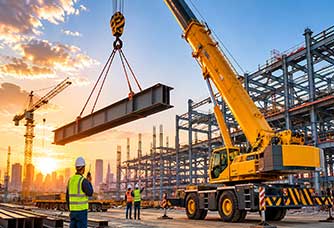
Bridge construction is the most technically demanding application. The sequential launching of prestressed concrete box girders or steel bridge segments across spans of 30 to 60 metres requires equipment that can precisely position multi-hundred-tonne loads at heights above terrain that may be inaccessible to conventional mobile cranes. Bridge girder launching cranes — also referred to as bridge construction cranes or beam launchers — are engineered for this specific task. They travel along the completed portion of the bridge structure, extend over the next pier, and lower girder sections into bearing with tolerances measured in millimetres. The hoisting and traversing systems must operate with exceptional control precision, and the structural frame of the launcher must resist the dynamic loads imposed by long-reach cantilever lifting without permanent deformation.
Precast concrete manufacturing uses overhead gantry cranes throughout the production and yard-storage process. Precast segments — wall panels, columns, beams, and tunnel linings — are cast horizontally, cured, lifted from moulds, and transferred to storage yards before final delivery to construction sites. Gantry cranes with spans up to 35 metres and lifting capacities from 20 to 200 tonnes handle this work. The critical specification here is not peak capacity but cycle consistency: a precast yard operating at volume may complete dozens of lifts per shift, and the crane's duty class rating must reflect the actual annual lift count rather than a nominal estimate.
Energy infrastructure — wind energy, hydroelectric, and thermal power — relies on heavy lifting equipment at multiple project phases. Wind turbine nacelles and tower sections require cranes capable of controlled lifts at heights exceeding 100 metres in conditions where wind loading on the suspended load is a live engineering parameter. Hydroelectric and thermal plant construction involves lifting of generator rotors, turbine casings, and large transformer assemblies — single-lift events where the load is irreplaceable and the consequence of equipment failure is a project-scale loss.
In all of these infrastructure contexts, the crane is not a generic tool that happens to be on site. It is a precision system whose performance characteristics — speed, control resolution, load stability, and reliability under the specific environmental conditions of that project — directly determine whether the construction programme can be maintained.
Key Crane Types and Their Role in Steel and Infrastructure Applications
Different lifting tasks require different machine architectures. The following are the primary crane types deployed in steel and infrastructure environments, with the technical characteristics that define their suitability for each application.
Double Girder Overhead Crane
The double girder overhead crane is the workhorse of heavy industrial facilities. Two parallel main girders support a crab unit — the combined hoist and cross-travel mechanism — that travels along the top flange of the girders. This configuration delivers lower hook height than single-girder designs of comparable span, while providing the structural stiffness needed to maintain load positioning accuracy at high capacities.
In steel plants, double girder overhead cranes serve coil storage, plate yard operations, and fabrication bay handling. In heavy manufacturing, they move large machined components, press dies, and fabricated assemblies that exceed the capacity of lighter crane systems. Lifting capacities range from 5 tonnes to upward of 800 tonnes in custom heavy-lift configurations. Spans extend to 50 metres and beyond for wide-bay applications.
Steel Mill Crane
The steel mill crane is a specialized variant of the double girder overhead crane, engineered specifically for the thermal, mechanical, and duty-cycle conditions of steelmaking. Structural steel grades, weld specifications, and surface treatments are selected for resistance to thermal cycling. Hoist systems are rated for the high load factors that characterize ladle transfer and slab handling. Electrical systems are specified with redundancy and environmental protection appropriate to melt shop conditions.
The distinction between a standard heavy-duty overhead crane and a true steel mill crane is not primarily one of lifting capacity — it is one of design standard, material specification, and engineering depth. A standard crane installed in a melt shop will meet its rated capacity on day one; a steel mill crane is designed to continue meeting that capacity on day 7,000 under the actual conditions of continuous steelmaking.
Bridge Construction Crane / Beam Launcher
Bridge construction cranes are purpose-built for sequential girder launching on elevated highway and railway structures. The machine is typically self-supporting, travelling on the completed deck structure or on temporary support frames positioned on bridge piers. Hoisting systems are designed for controlled lowering at full rated load, with variable-speed drives that allow fine positioning during bearing placement. Safety systems include load monitoring, anti-collision logic for multi-crane bridge sites, and wind-speed interlocks that halt operations when wind loads on suspended girders exceed safe limits.
Double Girder Gantry Crane
Where overhead runway structures are not available — outdoor fabrication yards, precast concrete facilities, port-adjacent storage areas — the double girder gantry crane provides equivalent capacity on freestanding legs that run on ground-level rails. Spans from 10 to 40 metres and capacities from 5 to 500 tonnes cover the majority of heavy outdoor lifting applications. In precast concrete plants, gantry cranes handle both the internal mould-stripping operations and the external yard storage and loading tasks, often using spreader beams or custom lifting fixtures to distribute loads across long or fragile precast elements.
EOT Crane (Electric Overhead Travelling Crane)
The EOT crane designation covers the broad category of electrically driven overhead travelling cranes. In the context of steel and infrastructure-related manufacturing — structural steel fabrication shops, heavy equipment manufacturers, railway rolling stock facilities — EOT cranes handling 20 to 200 tonnes are standard infrastructure. Variable frequency drives on hoisting and travel motions allow smooth acceleration and deceleration that reduces dynamic shock loading on both the crane structure and the lifted load — a significant operational benefit when moving precision-machined components or fragile fabricated assemblies.
Technical Specifications That Determine Performance in Heavy Environments
Crane selection in steel and infrastructure applications requires evaluation of several technical parameters beyond the headline lifting capacity figure.
Duty class has been noted above, but the practical implication deserves emphasis. A crane specified at A5 duty class and operated at A7 demand will exhaust its structural fatigue life in roughly one-third of its designed service life. Retrofitting a higher-specification crane into an existing facility is a capital project. Specifying correctly at the outset is not conservative engineering — it is economical engineering over any time horizon longer than three years.
Span and hook height define the working envelope of the crane. Span selection must account for future process layout changes, not just the current configuration. Hook height must provide clearance above the tallest load in its maximum lift configuration, including any lifting attachments. These dimensions are permanently fixed once the runway structure is built; under-specification at the design stage creates operational constraints that last the life of the facility.
Control systems in modern heavy-duty cranes have moved substantially beyond simple contactor-based on/off switching. Variable frequency drives (VFDs) on hoist and travel motions allow speed profiles to be programmed that match the process requirement: fast transit travel, slow approach, creep speed for final positioning. Anti-sway systems — either active electronic systems or passive pendulum-reduction software in the VFD — reduce load swing during travel, improving cycle times and reducing structural loading. Remote radio control eliminates the need for operators to follow loads in hazardous zones, a significant safety improvement in steel plant environments.
Structural design standards determine how the crane frame is calculated and fabricated. FEM 1.001, ISO 4301, and DIN standards provide the engineering basis for classifying crane structures by duty group and calculating allowable stress ranges for fatigue-critical components. CE-marked cranes are assessed against the European Machinery Directive, with third-party verification of design calculations and production quality. Buyers procuring cranes for installation in markets where local standards apply — OSHA in North America, EAC in Russia and CIS countries, BIS in certain contexts — should verify that supplier certifications cover the specific regulatory framework of the installation country, not simply a general CE declaration.
Safety and Compliance: What Certification Actually Means in Practice
Crane safety certification is a procurement filter that is widely cited and inconsistently understood. CE marking, ISO 9001 registration, and FEM compliance are frequently listed in supplier documentation as equivalent indicators of quality. They are not equivalent, and understanding the distinction matters for procurement teams responsible for commissioning cranes in regulated industrial facilities.
CE marking under the EU Machinery Directive (2006/42/EC) means that the manufacturer has assessed the crane against applicable harmonized standards — primarily EN 13001 for structural design and EN 14492 for hoisting machinery — and has issued a Declaration of Conformity. For complex machinery such as overhead cranes above a defined capacity threshold, CE marking requires involvement of a notified body for third-party design examination. CE marking is a legal requirement for placing machinery on the EU market, and it establishes the baseline of engineering accountability.
ISO 9001 is a quality management system standard. It confirms that the manufacturer has documented processes for design, production, inspection, and corrective action. It does not certify that any specific product meets any specific performance standard — it certifies that the manufacturer has a documented system for managing quality. ISO 9001 is a necessary but not sufficient indicator of product quality.
FEM compliance means the crane has been designed according to FEM 1.001 (or the applicable section for specific equipment types) — the European standard that defines duty classification, load combinations, and fatigue calculation methods for crane structures. A crane designed to FEM standards has been engineered with a defined structural service life corresponding to its duty class.
In practice, a crane supplied with CE marking, ISO 9001 certification, and documented FEM-based design calculations provides a substantially higher level of assurance than one supplied with only a general product specification sheet. When evaluating suppliers for steel or infrastructure project applications, requesting documentary evidence of all three — not just a statement of compliance — is standard procurement practice.
Maintenance compliance is equally important. A correctly specified and certified crane that is not maintained to schedule will fail at the point where an uncertified crane fails earlier. Published maintenance intervals for heavy-duty cranes typically specify daily pre-shift visual checks, monthly inspection of structural connections and mechanical wear components, and annual load testing. In steel plant applications operating at A7 or A8 duty, some OEM schedules require wire rope inspection and replacement intervals measured in months rather than years.
Evaluating a Crane Supplier for Large-Scale Industrial Projects
The selection of a crane supplier for a steel plant or major infrastructure project is not a commodity procurement decision. The technical risk is concentrated not in the equipment specification document but in the execution: whether the engineering calculations underlying the design reflect the actual operating conditions, whether fabrication quality controls are applied consistently across a production run, and whether post-delivery support is available at the scale and speed that a continuously operating facility requires.
Several evaluation criteria consistently differentiate suppliers capable of executing complex projects from those better suited to standard volume applications.
Custom engineering capability. Steel plant cranes and bridge construction equipment are engineered to project-specific parameters. A supplier that can only offer catalogue products within fixed capacity and span ranges will require the buyer to adapt the facility design to the crane — the reverse of correct engineering sequence. Suppliers with in-house structural engineering teams can calculate custom configurations, validate them against applicable standards, and provide design documentation that satisfies regulatory review.
Manufacturing quality controls. Welding of crane main girders is fatigue-critical work. Weld procedures, welder qualification records, and non-destructive testing of completed welds should be documentable on request. Load testing of completed cranes to 125% of rated capacity before dispatch — with load test certificates provided to the buyer — is standard practice for serious suppliers and should be a contract requirement.
Certification scope. As discussed above, CE marking, FEM compliance documentation, and ISO 9001 registration should all be verifiable, not simply asserted.
Global delivery and site support. For projects in markets distant from the manufacturer, delivery logistics, customs documentation, and on-site commissioning support are operational requirements, not afterthoughts. Suppliers with established export experience have resolved the procedural problems that create delays; those without it encounter them for the first time on the buyer's project.
After-sales parts availability. A crane that cannot be repaired because replacement parts are unavailable or have twelve-week lead times is a liability regardless of its initial specification. Suppliers who maintain spare parts stock for their standard components and can provide emergency parts supply for critical components offer a materially lower operational risk profile than those who manufacture to order.
Voitto Crane is a manufacturer of overhead cranes, gantry cranes, steel mill cranes, bridge construction cranes, and associated lifting equipment, supplying industrial facilities across more than 80 countries with CE and ISO-certified systems. With over three decades of manufacturing experience and a product range covering capacities from 1 tonne to 800 tonnes, Voitto Crane provides custom-engineered solutions for steel industry and infrastructure construction applications alongside standard configurations for general industrial use.
Conclusion
Heavy-duty cranes in steel and infrastructure environments carry a weight of responsibility that extends well beyond their rated lifting capacity. They are continuous-operation systems whose reliability determines whether production lines run or stand idle, whether construction schedules are maintained or overrun, and whether the people working around them go home safely at the end of each shift.
Getting the specification right — duty class, structural standard, environmental protection, control system, and certification — requires engagement with the technical requirements of the application rather than a comparison of price-per-tonne. Getting the supplier selection right requires evidence of engineering depth, manufacturing quality controls, and post-delivery support capacity, not simply a product brochure.
These decisions are made once, at the beginning of a project. Their consequences persist for the twenty or thirty years that the equipment operates. The time invested in making them correctly is the most efficient cost control measure available to any project team responsible for heavy lifting in demanding industrial environments.







We use cookies to ensure you get the best experience on our website. Read more...