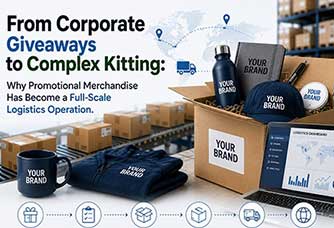
Corporate merchandise used to be simple. A business would order a few thousand plastic pens or basic cotton t-shirts, store them in an office closet, and hand them out at the next local trade show. Distribution was entirely manual, variations were rare, and expectations around the unboxing experience did not exist.
Today, the landscape looks entirely different. Branded items have transitioned from cheap giveaways into critical components of sophisticated marketing campaigns, employee onboarding programs, and high-impact influencer activations. High-quality outerwear, tech gadgets, custom-formulated wellness products, and curated gift boxes have replaced the disposable trinkets of the past. As the value and variety of these items have grown, so too has the operational complexity required to manage them. Sending out branded materials is no longer a minor administrative task. It is a sophisticated supply chain challenge that demands professional infrastructure, rigorous quality control, and advanced software integration.
The Shift Toward Bespoke Brand Experiences
When a company sends a welcome package to a new remote executive or a premium gift box to a high-value client, the presentation speaks volumes about the brand itself. Modern marketing strategies rely heavily on these physical touchpoints to build emotional connections in an increasingly digital marketplace. This shift has turned the first section of the supply chain into a critical operation, necessitating professional promotional products fulfillment to ensure that every package arrives exactly as intended.
Managing these advanced programs requires a complete overhaul of traditional fulfillment methods. Marketing teams often coordinate complex campaigns that require integrating variable components sourced from multiple global suppliers. A single influencer mailer might contain a custom-embroidered hoodie, a delicate glass water bottle, a printed lookbook, and a personalized, handwritten welcome note. Bringing these disparate elements together seamlessly demands robust infrastructure and specialized knowledge.
This is where traditional warehousing models fall short, and sophisticated promotional product fulfillment workflows become essential. Managing these workflows requires careful orchestration, starting from the moment individual components arrive at a facility. Logistics providers must inspect every incoming shipment for quality and accuracy, log structural specifications, and organize inventory to prevent damage or loss. When a campaign launches, assembly lines must follow strict build guidelines to ensure every item sits perfectly inside its custom packaging, turning a standard delivery into an unforgettable brand moment.
The Complexities of Multi-Item Kitting and Custom Assembly
Unlike standard ecommerce orders where an employee picks a single item from a shelf and drops it into a standard shipping box, promotional merchandise often requires extensive kitting and custom assembly. This process is highly labor-intensive and demands a level of precision that internal corporate teams simply cannot replicate at scale.
Professional kitting operations treat assembly as a disciplined manufacturing process rather than a casual packing task. The process relies on several critical steps to ensure absolute accuracy:
When businesses attempt to manage this level of assembly in-house or through a standard warehouse, errors quickly multiply. A missing insert or a poorly applied label can ruin an entire marketing campaign. Entrusting this process to specialized logistics providers guarantees a high level of quality assurance across thousands of complex configurations.
Navigating Multi-Channel Distribution Networks
Modern promotional campaigns rarely target a single type of recipient or utilize just one shipping method. On any given day, an organization might need to send five thousand individual welcome kits directly to consumer homes, ship fifty heavy pallets of event materials to a convention center, and distribute bulk inventory to dozens of regional franchise offices.
Managing these diverse distribution paths requires true multi-channel logistics capability. Direct-to-consumer shipping demands integration with standard parcel carriers and meticulous residential address validation. Conversely, shipping to major convention centers or corporate headquarters requires freight management, liftgate delivery coordination, and strict adherence to specific delivery windows.
If a shipment arrives at a convention center even an hour late, the entire event investment is compromised. Specialized logistics operations utilize advanced transportation management systems to select the ideal carrier, optimize shipping routes, and coordinate complex freight arrivals, ensuring that marketing materials always arrive on time, regardless of the destination channel.
The Imperative for Real-Time Inventory Visibility
One of the biggest challenges in managing promotional merchandise is maintaining an accurate understanding of available stock. Because marketing campaigns move rapidly and involve frequent pivots, businesses need constant access to clear, actionable data. Relying on manual spreadsheets or weekly inventory counts inevitably leads to stockouts, delayed launches, and wasted capital.
Modern promotional products fulfillment relies on advanced cloud-based platforms that integrate directly with enterprise resource planning systems, e-commerce stores, and corporate procurement portals. This software environment offers several distinct advantages for brand managers:
With real-time data, decision-makers can confidently adjust their marketing strategies on the fly. If a specific promotional kit performs exceptionally well among influencers, the brand can instantly view component availability and scale up production without delay.
Managing Shipping Precision and Delivery Exceptions
A promotional kit is only valuable if it actually reaches its intended recipient. While a standard online shopper will actively track their own package and reach out to customer service if a delay occurs, the recipients of corporate gifts and promotional items rarely do. If a VIP client's gift box gets lost in transit or sent to an old corporate address, they simply never receive it, and the brand misses a crucial opportunity.
Achieving high delivery success rates requires extensive pre-shipment data cleansing and proactive tracking management. Specialized logistics providers utilize automated software to scan recipient lists, flag incomplete addresses, and correct formatting errors before labels are ever printed.
Furthermore, professional operations actively monitor shipments while they are in transit. If a parcel carrier encounters a delivery exception, such as a gate code requirement or a closed business office, the logistics team can intervene immediately to resolve the issue. This proactive approach ensures high delivery success rates and protects the significant financial investment wrapped up in every custom package.
Scaling Operations Without Increasing Internal Headcount
As corporate merchandise programs grow, the physical burden of managing them internally becomes unsustainable. Office hallways fill with cardboard boxes, administrative staff spend hours packing kits instead of performing their core duties, and tracking down missing inventory becomes a constant source of stress.
Transitioning to a professional promotional products fulfillment model allows organizations to scale their marketing initiatives effortlessly. Businesses gain access to massive warehouse footprints, dedicated assembly lines, and specialized logistics experts without the financial burden of purchasing facilities or hiring seasonal staff. This operational flexibility allows companies to execute massive nationwide product launches or subtle, recurring internal gifting programs with equal ease, keeping internal teams focused entirely on strategic growth.
A Grounded Look at the Future of Corporate Logistics
The transformation of promotional merchandise from simple giveaways into a highly strategic marketing tool has fundamentally rewritten the rules of corporate logistics. Success in this modern landscape requires a shift in perspective. Organizations can no longer view branded items as mere marketing collateral. Instead, they must treat them as high-value inventory that requires specialized care, absolute precision, and advanced technological support.
By shifting the operational burden to dedicated logistics systems that specialize in complex kitting, multi-channel distribution, and real-time inventory management, businesses protect their brand reputation and maximize the return on their marketing investments. In an era where physical brand experiences carry immense weight, having a flawless, invisible logistics engine behind every campaign is no longer a luxury. It is an absolute operational necessity.







We use cookies to ensure you get the best experience on our website. Read more...