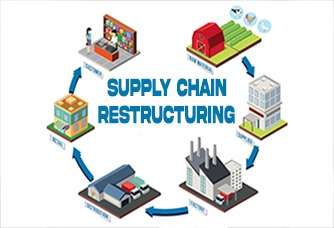
Supply chains have evolved steadily over the years, moving from a functional focus to vertical integration to eventually becoming more horizontally integrated. However, the changing behaviours and expectations of end customers and stakeholders over the last 18 months have challenged the established supply chain set-ups. Customers now research on their own and buy products across multiple channels and expect seamless experiences. They expect just-in-time order fulfilment at lowest prices along with complete transparency around order statuses. There is an increased willingness to be associated with only trustworthy supply chains that can continue to serve even during disruptions, and stakeholders are increasingly concerned about product origin and quality as well as overall supply chain sustainability.
To match these heightened expectations and adapt to the wider scope of responsibilities, organisations need to transform their supply chains and build certain advanced supply chain capabilities. These are:
• Closed loop and integrated planning
• Dynamic supply-chain segmentation
• Inbuilt supply-chain resilience
• Supply-chain sustainability
• Smart logistics flows
According to a recent PwC survey of more than 1,600 supply chain executives and decision makers in 33 countries across the Americas, Europe, the Middle East, Africa and Asia Pacific, organisations that have built these advanced supply chain capabilities were able to achieve operational savings of 6.8% annually in supply chain costs, 7.7% increase in revenue and higher levels of customer satisfaction and retention.
Cognitive automation in supply chain – the ability to use artificial intelligence (AI) and other advanced analytics techniques (machine learning [ML], deep learning, optimisation, simulation and natural language processing [NLP]) to predict or prescribe an optimal course of action and subsequently execute those actions with limited human intervention – can be a powerful accelerator of these advanced supply chain capabilities. Supply chains that take advantage of vast quantities of data, generated both internally and externally by leveraging cognitive automation techniques, can increase transparency and sustainability, improve planning, enhance logistics flows and be more resilient to future disruptions and uncertainties, ultimately enhancing customer centricity and trustworthiness.
Cognitive automation as an enabler of advanced supply chain capabilities
Closed loop and integrated planning: Demand planning and supply planning are at the core of supply chain management. To have high levels of accuracy and responsiveness in planning, it is important to cover the scope of end-to-end supply chain (integrated) and to link planning with execution (closed loop). It is critical to build in closed loop and integrated planning capabilities that autonomously respond to the changing macro environment. For example, the traditional demand forecasting approach that uses standard statistical techniques can be replaced with ML-based techniques that leverage not just a company’s internal data but also other external data that explains consumer behaviour. Consider a case of secondary demand forecasting for a CPG manufacturer. Internally available secondary sales and trade planning data can be combined with demographic, macroeconomic, social media, weather, and competitors’ data to generate a more accurate secondary demand forecast at the SKU and distributor levels.
Improved secondary forecast will lead to a high-fidelity primary demand forecast with high forecast accuracy which will clearly translate into a more effective supply plan. This will ultimately lead to reduced lost sales, increased revenue and improved service levels for the CPG manufacturer.
Dynamic supply chain segmentation: Supply chain segmentation isn’t new. However, the ‘one-size-fits-all’ approach no longer works and customers are demanding increased personalisation. Hence, we now need to move towards a more flexible and requirement-driven configuration in which each transaction can be dynamically allocated to one of the supply chain segments. A whole range of potential attributes such as customer value, product margin, product lifecycle stage, production processes and supply capabilities, to name a few, can define these segments. Profitably serving these segments means understanding the cost to serve and customer value proposition, and then configuring the supply chains accordingly. A supply chain’s digital twin can be useful to drive dynamic segmentation. By simulating different scenarios, a digital twin can help in striking the right balance between costs, margins, service levels and inventories, and in turn identifying the optimal way to dynamically respond to customer demand at a transactional level. For example, a large order of essential items from a retailer to a CPG manufacturer can be passed through a digital twin to find out the most efficient way to respond while maintaining the promised service levels, whereas other regular orders from the same retailer continue to get serviced according to the pre-defined periodic dispatch plans.
In-built supply chain resilience: While efficiency and responsiveness have been the focus of supply chains, the recent pandemic has showed that it is equally critical to build resilience within supply chains – the ability of a supply chain to both resist disruptions and recover operational capability post disruptive events. AI techniques such as NLP can help in identifying early warning signals by scanning a wide set of both publicly available and subscribed data sets to find out if there are any areas that need attention. For example, autonomous scanning of social media posts and local news articles from the region where a pharmaceutical manufacturer has a maximum supplier base can indicate possible legal and regulatory issues faced by one of its key suppliers, leading to a shutdown of that particular supplier’s services. Such proactive early warning signals help in putting contingency plans in place well in advance and minimise the value at risk. While supply chains are prepared to handle known-known or known-unknown risks, the real ability to continue serving customers and win their trust gets unlocked when supply chains can handle unknown-unknown disruptions. An unknown-unknown risk/disruption is one which you cannot anticipate in advance and the impact is unknown because the nature of the risk/disruption
is not known either. For example, one of your key suppliers just informed that there has been a fire incident at its location and it’ll be out of operation for a month. To navigate such an unknown-unknown disruption, we need to first accurately understand the impact and then decide on the actions to mitigate it. Such a disruption can be modelled in a supply chain digital twin to find out, for example, after how many days the customer orders will start getting stocked out and how much revenue is at risk. The digital twin also provides a risk-free environment to simulate multiple forward-looking scenarios and subsequently identify the optimal course of action to be taken. For example, scenarios to onboard alternative suppliers can be simulated to evaluate the trade-off between costs and service levels. A supply chain digital twin gives the ability to test decisions before implementing them on ground, thereby improving the supply chain’s agility to handle disruptions.
Supply chain sustainability: PwC’s 23rd Annual Global CEO Survey found that CEOs are far more likely to see the benefits of going green. For example, 30% of CEOs strongly agree that their response to climate change initiatives will provide a reputational advantage to their organisation among key stakeholders, including employees. Supply chain leaders can no longer ignore the idea of sustainable supply chains and need to take concrete actions to build the same. AI and other advanced analytics techniques present us with an opportunity to reduce the carbon footprint of supply chains, build circular business models and increase the contribution of supply chains to ensure fairness in society. Consider an example of building truck loads for delivery of items to customers. A planning system recommends the items to be delivered to different customers based on their requirements and the availability of inventory at the plants. The customer orders are fed to the optimisation engine along with details of the fleet available. The optimisation engine, which is configured to maximise the utilisation of vehicles, recommends the minimum number of vehicles needed to fulfil the customer orders. The recommendation is fed to the execution system through an automated data pipe and orders are placed for the delivery of items. Minimising the number of vehicles to be used reduces cost as well as the carbon footprint of the supply chain and automation of the end-to-end process flow brings in the required efficiency. Another example could be to use a digital twin to estimate the as-is carbon footprint of the supply chain and subsequently run simulations to evaluate multiple emission scenarios that can help move towards the journey of achieving net zero emissions.
 Smart logistics flows:
 As per the PwC survey of supply chain executives and decision makers mentioned above, smart logistics is a key savings driver and accounts for more than 50% of the overall supply chain cost savings. While logistics is managing and executing the physical flow of goods from the point of origin to the point of consumption, smart logistics connects the physical shipment and information flow between suppliers, manufacturers, logistics service providers and customers interactively and in near real time. For example, when using the GPS devices fitted in a fleet, geographical coordinates for incidents like overspeeding, harsh braking, harsh maneuvering and sudden acceleration are recorded and an automated alert is sent to drivers when they are approaching such hazard points. This not only saves money by reducing material damage but also reduces vehicle wear and tear, ultimately lowering overall supply chain costs. Another example would be AI helping in predicting the estimated time of arrival of shipments using real-time GPS signals and other weather and traffic information. This improves the accuracy of the estimated time of arrival (ETA) and allows, for example, the receiving warehouse to adjust its operations if materials are arriving sooner or later than planned.
Taking the next steps
Based on the examples discussed above, advanced supply chain capabilities enabled by cognitive automation techniques are essential to make the supply chains fit for future. Supply chain leaders should think about building these advanced capabilities along the four levers of cognitive automation, viz. visibility, insights, integration and execution. Each of these levers also has four levels of digital maturity. Organisations should find out their current level of digital maturity along these four levers as a first step.
Once the current level of maturity across the four levers is understood, organisations can identify the use cases that can help them move forward in their digital maturity journey. Use cases can be prioritised based on their impact and ease of implementation. The impact of use cases can be assessed across the potential to increase revenue, reduce costs, bring down the blocked working capital, improve asset utilisation and mitigate risks. Ease of implementation can be assessed by the degree of complexity, availability of data, internal change management and availability of existing tools and technologies. As supply chains move forward in their digital maturity journey along the four levers, they start becoming more connected with their ecosystem partners and operate with minimum human intervention, ultimately becoming self-orchestrating.
Let us look at an example of how a connected and self-orchestrated supply chain ecosystem operates. The AI-based demand sensing system for a CPG manufacturer predicts a decline in the demand for a finished good (FG) in a region in near future based on the macroeconomic information and other external factors. The demand planner is auto alerted of the decline in demand and subsequently approves the change in forecast through an automated workflow. The revised demand forecast is fed into the planning system that optimises and recommends revised dependent raw material (RM) and packaging material (PM) consumption forecast. Based on the revised RM and PM consumption forecast, the inventory projection dashboard confirms the build-up of relevant RMs and PMs at the warehouse. Slow moving and obsolete (SLOB) inventory is predicted by the SLOB prediction algorithm and the supply planner is alerted of the same. The supply planner also gets recommendation from the system on how to minimise the SLOB inventory. These include deferring some planned goods receipts to subsequent months and diverting some RM and PM stock to a neighbouring warehouse. Once the impact of these recommendations is evaluated through a what-if simulation, the supply planner initiates an automated workflow to execute these recommendations. The system recommends a low-cost and low-carbon logistics service provider for stock transfer to the neighbouring warehouse. The stock-transfer order is placed autonomously with the recommended logistics provider. Along with this, an automated notification is also triggered to the supplier of RM and PM to defer the dispatch of goods.
As we see, AI and other advanced analytics techniques have a significant potential to enhance supply chain performance. However, we also need to understand and assess the associated risks. How do we identify the aspects of data, model and human interaction that lead to unfairness of AI? How do we increase the understanding of AI systems and solve the black box problem? How can we build the quality assurance of the digital twin to ensure that the simulations can be relied upon? How can we understand the ethical implications of AI usage? It is important that we assess, mitigate and subsequently manage such risks. To address these risks, we can look at the following five key areas that make AI responsible – bias and fairness, governance, interpretability and explainability, robustness and security, and ethics and legal.
Leveraging cognitive automation and transforming supply chains through advanced capabilities will have to be people driven. Attracting digital talent as well as upskilling/reskilling existing teams will be critical in this transformation journey. A tech-enabled workforce will be able to drive the adoption of such advanced solutions much more smoothly. They will be able to focus on more value-added activities such as uncovering hidden insights or contributing to the firm’s strategy as opposed to carrying out day-to-day operational tasks. Building supply chain digital talent will help organisations not just meet future business needs but also handle uncertainties more effectively.
Next-level supply chain ecosystems will be far more sophisticated than the present ones. The evolution from a linear supply chain – where data flows from one stage to the next in silos – to a connected and self-orchestrated supply chain ecosystem is undoubtedly complex. However, it is worth the effort because that is how supply chains will be able to respond dynamically to ever-changing conditions and meet the rising expectations of end customers and stakeholders.


.jpg "AR Enterprises: Building The Supply Networks Behind India's Construction Growth")
.jpg "Industrial Packers: Engineering Industrial Packaging for India's Manufacturing Future")