
Manufacturers in defence electronics play a critical role in shaping national security infrastructure, particularly in an era defined by rapid advancements in communication technologies. As modern defence strategies increasingly rely on secure, resilient, and real-time connectivity, the importance of indigenous capabilities in satellite communication and ground systems has grown significantly.
India’s push toward self-reliance in defence and space technologies has further accelerated the need for domestic players who can design, build, and sustain complex communication ecosystems.
In this evolving landscape, Comsat Systems stands out as a key contributor, bridging critical gaps in satellite communication infrastructure. By focusing on indigenous development and system-level integration, the company has steadily strengthened India’s ground segment capabilities, supporting defence, space, and broadcasting sectors with reliable, high-performance solutions.
Evolution from Antenna Manufacturing to SATCOM Solutions
Founded in 1982 by an engineer with experience at ISRO and ECIL, Comsat Systems began its journey at a time, when India was heavily dependent on imported satellite communication equipment. The company initially focused on developing earth station antennas domestically, laying the groundwork for long-term technological capability.
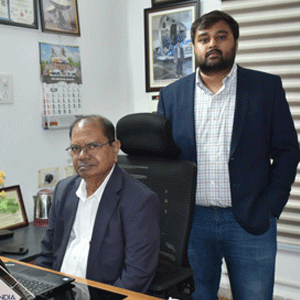
Under the leadership of Managing Director John Saripally, Comsat has evolved into a full-spectrum SATCOM solutions provider.
Its portfolio today spans from compact VSAT terminals to large 13.5-meter class earth station antennas, supporting operations across GEO, MEO, and emerging LEO constellations. This transition reflects not just scale, but a deep alignment with global shifts in satellite communication technologies.
End-to-End Engineering and System Integration
A defining strength of Comsat Systems lies in its ability to deliver fully integrated, end-to-end solutions. The company handles the complete lifecycle, from design and manufacturing to installation and maintenance, ensuring accountability and performance in mission-critical deployments.
Its engineering approach integrates RF systems, mechanical structures, and control technologies into cohesive solutions tailored for real-world conditions. This system-level ownership is particularly important in defence and space applications, where reliability cannot be compromised. With over 5,000 installations across India, Comsat has demonstrated consistent performance across diverse environments, including remote and high-demand operational settings.
Innovation, Partnerships, and Future Growth
Innovation at Comsat is driven by a focused in-house engineering team specializing in RF, mechanical design, and control systems. The company has developed capabilities in multi-band antenna systems across C, Extended C, Ku, and Ka bands, along with precision tracking technologies required for dynamic satellite environments.
Long-standing collaborations with organizations like ISRO have further strengthened its technical expertise, exposing the company to advanced design standards and mission-critical requirements. These learnings have been embedded into its processes, enabling it to deliver solutions that balance institutional-grade reliability with operational flexibility.
Innovation at Comsat is driven by a focused in-house engineering team specializing in RF, mechanical design, and control systems
Looking ahead, Comsat Systems is investing in expanding its manufacturing capacity and upgrading its facilities to meet increasing demand. The addition of new leadership, including Vice President Solomon Mudumala, reflects a strategic focus on scaling operations and expanding global reach. With strong demand from India’s defence and government sectors, alongside growing international interest, the company is well-positioned to play a larger role in the global SATCOM ecosystem.
As India continues to prioritize self-reliance in defence and space, Comsat Systems exemplifies how indigenous engineering and sustained innovation can build resilient, future-ready communication infrastructure.
.jpg "Textile Special")





We use cookies to ensure you get the best experience on our website. Read more...


