Electric vehicles are becoming an increasingly important part of India's automobile market. The increased customer interest, coupled with the launch of new models and advancements in battery technology, is contributing to the segment's growth across vehicle categories.
FADA data showed that EV sales have crossed 2,98,448 in August 2026 across two-wheelers, three-wheelers and passenger vehicles, a 52.9% rise from the same month in 2025.
Electric two-wheelers had the largest growth. Sales rose 67.05% year-on-year to 1,83,204 units. Their lower running costs and suitability for daily commuting have made electric scooters an attractive option for urban customers. Manufacturers such as TVS Motor Company, Bajaj Auto and Ather Energy are expanding their electric portfolios with new models offering improved battery performance, longer driving ranges and additional features.
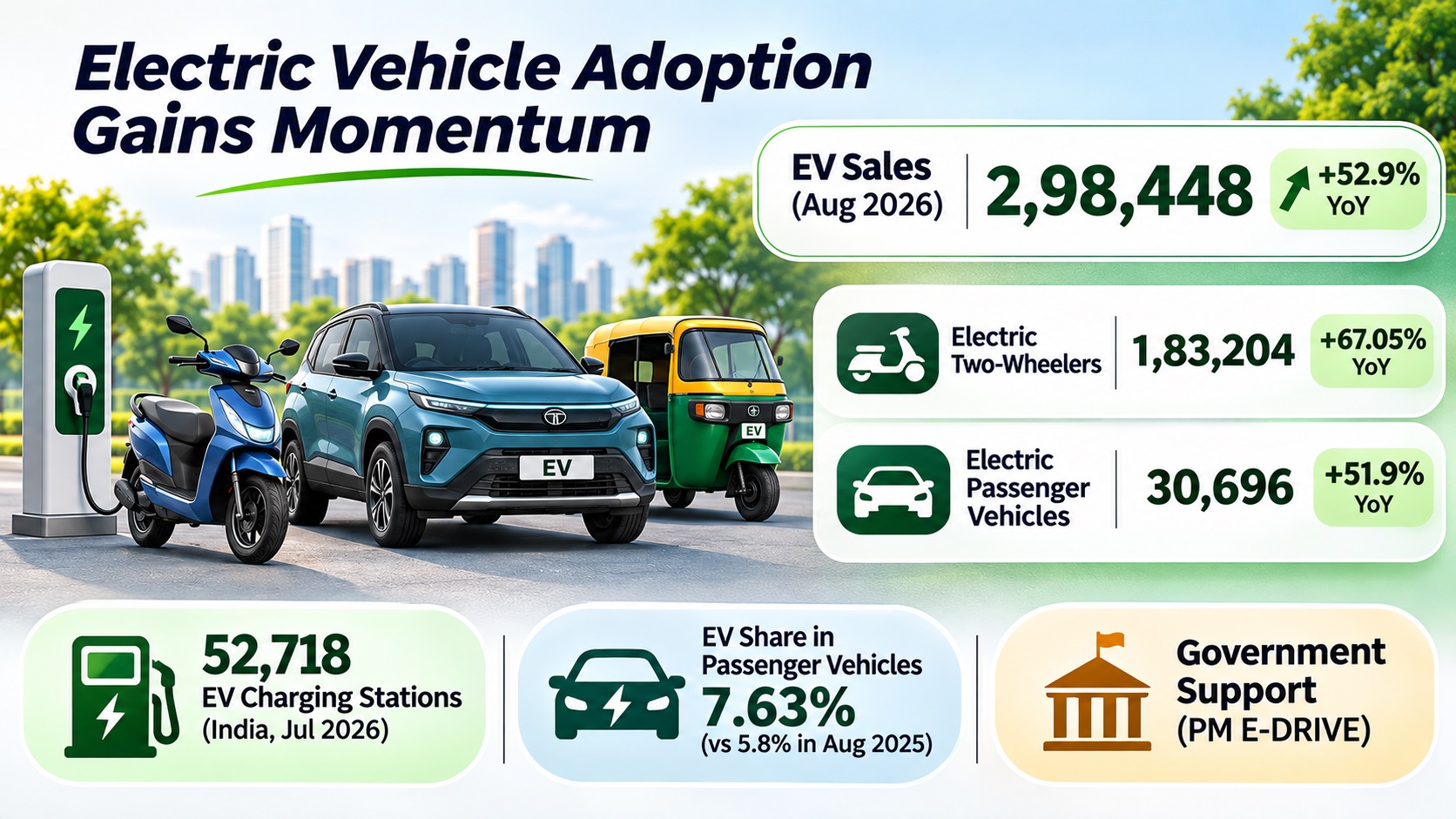
The electric passenger vehicle segment is also on the rise. In August 2026, the number of retail sales units rose 51.9% year-on-year to 30,696 units. EVs accounted for 7.63% of passenger vehicle sales, up from 5.8% in the same month last year.
Tata Motors is continuing to be a frontrunner in this segment with the Nexon EV, Punch EV, and Tiago EV. On the other hand, Mahindra and JSW MG Motor are launching additional electric variants to expand customer options in the price segment and vehicle class.
Despite this increase, charging station availability is still a serious concern. The Ministry of Heavy Industries reported 52,718 public EV charging stations in India as of July 2026. Among these, 16,561 provided quick charging stations for vehicles. But charging stations are still not evenly distributed throughout highways and neighborhoods.
The initial purchase price is another challenge. Although electric vehicles generally have lower running costs, their upfront prices can be higher than comparable petrol models. Buyers also consider battery replacement expenses, performance and resale value before making a decision.
Government programs like PM E-DRIVE are promoting electric mobility with incentives and charging infrastructure development. EVs are also being considered by delivery firms, fleet operators, and commercial transport companies due to their cost-saving benefits.
The demand for electric three-wheel vehicles is on the rise, especially in urban and semi-urban areas, for goods transportation and passenger carrying. With model variety, better technology, and government support, e-mobility has emerged as one of the winning propositions in India's automotive ecosystem, despite issues with affordability and charging infrastructure.
With the rising demand of CNG, hybrid and electric vehicles, the way people are purchasing cars in India is changing. Earlier, most buyers focused on the price of the vehicle, mileage, maintenance costs and brand reputation. These are still relevant, but fuel costs and long-term running costs have become more of a focus.
Fuel expenses can be a significant part of the monthly budget for individuals who have to commute long distances on a daily basis. This is encouraging them to consider CNG and hybrid vehicles. At the same time, people who have access to charging facilities are showing greater interest in electric cars.
Location also plays an important role in this decision. In big cities, there might be better infrastructure and access to CNG stations and EV charging stations. However, in smaller towns and rural areas, it is possible that people will opt for petrol cars due to the access to service centres and fuel stations.
FADA's August 2026 data also showed strong growth in rural passenger vehicle sales. The growth rate for rural registrations was 24.99% while that for urban registrations was 10.93% from the previous year. This indicates that demand is rising outside big cities.
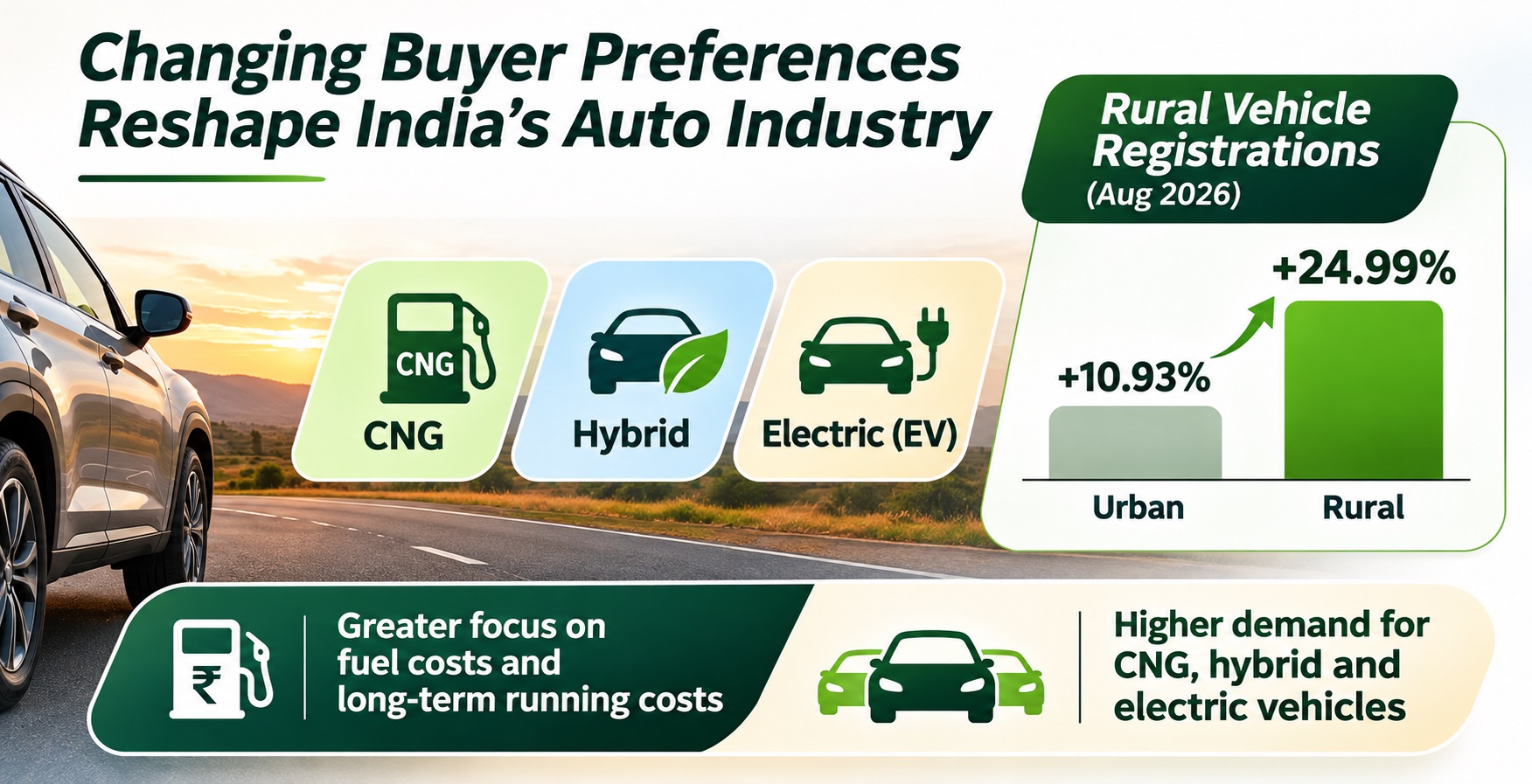
Car manufacturers are responding by offering more choices. Instead of focusing only on petrol and diesel vehicles, companies are investing in CNG, hybrid and electric models.
This is also creating new opportunities for businesses that supply automobile components. Demand for batteries, electric motors, charging equipment and other electronic parts is increasing. Companies that have traditionally supplied components for petrol and diesel vehicles are also looking to take a stab at electric mobility.
Government regulations are expected to play an important role in this transition. New regulations for fuel economy will encourage manufacturers to create vehicles that consume less fuel and emit less pollution. This would help bring in more investments in hybrid systems, electric vehicles and more.
Yet, there are some challenges remaining in the industry. Some people may not be able to afford an electric and hybrid vehicle because of its higher cost. Charging facilities are not available equitably throughout the country and CNG stations are also located in specific areas.
Battery life, resale value of vehicles, and availability of service facilities are also issues of concern. Manufacturers will have to overcome these challenges to gain customer confidence.
The affordability is another important aspect. Indian buyers tend to be conscious of car prices, and any hike can make a difference in their decision. Companies will need to offer alternative-fuel vehicles at competitive prices if they want to attract more customers.







We use cookies to ensure you get the best experience on our website. Read more...