The August 2026 sales figures show how much India's automobile market has changed over the past year. The CNG, hybrid and electric cars sold 41.95% of the total passenger vehicle sales while petrol and ethanol vehicles sold 40.85%.
The difference between the two categories was small, but the result highlights a change in buyer preferences. In August 2025, petrol/ethanol vehicles accounted for a significant proportion of the market around 46.37%. Alternative-fuel vehicles made up about 35.26%. The gap got smaller over the next 12 months as more customers became interested in cars with lower operating expenses.
Better technology and increased availability of models have contributed to the growth of CNG, hybrid, and electric vehicles. There are a variety of options at various price points that makes it easier to consider alternatives to petrol cars.
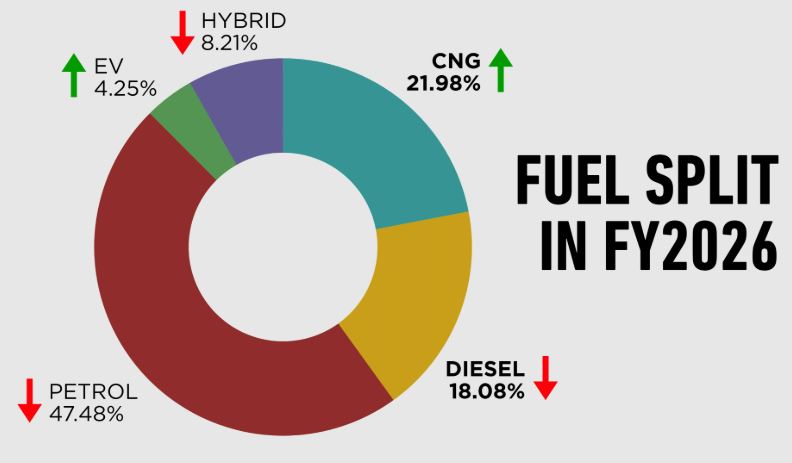
CNG has been the biggest contributor to this growth. It made up 25.28% of the total sales of passenger vehicles in August 2026. Hybrid vehicles had a 9.04% share, while electric cars accounted for 7.63%.
Figures also indicate that the significance of petrol vehicles has not decreased. They remain the largest individual fuel category in the market. But it is clear that buyers are not relying on petrol as their first choice as a significant number of vehicles now run on alternative fuels.
This is partly due to fuel costs. But as people get farther and farther from their jobs, they are thinking more and more about how much they pay for gas for their commute every month. Over time, a lower running car can have an impact on the household budget.
In India, the CNG and hybrid vehicles are gaining significant traction in the evolving auto industry landscape. Both provide alternatives to conventional petrol cars but in different ways.
CNG has become popular mainly because of its lower running costs. It can save on monthly fuel costs for individuals who drive their car on a daily basis. This makes CNG vehicles attractive to office commuters, families and people who travel long distances.
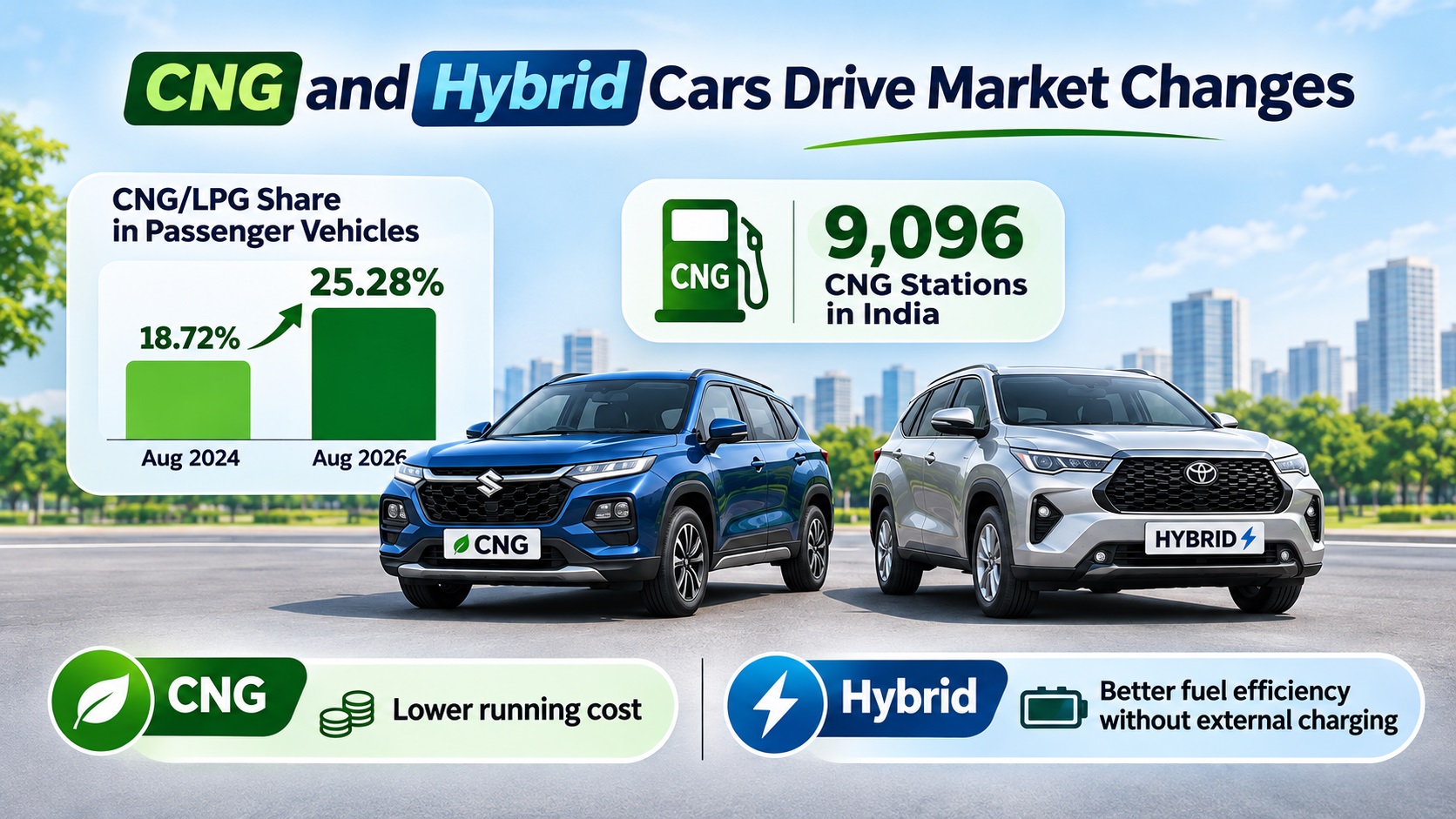
FADA data reveals that CNG/LPG for passenger vehicles share accounted for 25.28% in August 2026. This was a major increase from their 18.72% share in August 2024.
This growth has also been encouraged by the expansion of CNG stations throughout the country. As per the Ministry of Petroleum and Natural Gas, the number of CNG stations in India is 9,096 as of July 31, 2026. This has made CNG more accessible to customers, particularly in cities where the network is well developed.
Car manufacturers are also introducing more CNG variants. Maruti Suzuki has its strong presence in this segment with CNG variants of popular models. Tata Motors and Hyundai Motor India are also offering CNG vehicles to attract customers looking for lower fuel expenses.
The factory fitted CNG systems have made the cars more convenient for the customers. They are offered with the manufacturer's designed system, eliminating the need for customers to rely on separate aftermarket installations.
But there are also some drawbacks to using CNG. Not all areas are equipped with sufficient CNG stations and queuing up sometimes makes it difficult to refuel. In some vehicles, the gas cylinder can also take up space in the boot.
Hybrid cars are becoming another popular option. They are hybrid cars that run on a combination of petrol and electric power. The electric motor assists the engine to improve fuel efficiency, especially when operating in city conditions.
There are two typical types of hybrid systems: mild hybrids and strong hybrids. Mild hybrids run on electric power for short distances but with petrol engine assistance, while strong hybrids can do it for longer distances without the petrol engine.
One of the biggest benefits of hybrid cars is that they are not dependent on external charging. They get charged with the power of the engine and braking system. This is ideal for those who wish to save on fuel while not relying on charging stations.
Toyota and Maruti Suzuki have been instrumental in developing this market in India. Toyota's hybrid models like the Toyota Innova Hycross, Toyota Urban Cruiser Hyryder and Maruti Suzuki's Grand Vitara have introduced hybrid technology to a wider range of consumers.
However, hybrid cars are generally more expensive than regular petrol models. While they may provide fuel savings in the long term, customers might hesitate to consider them due to their higher purchase price.
Also Read: Indian Commercial Vehicle Industry 2026: Trends and Opportunity







We use cookies to ensure you get the best experience on our website. Read more...