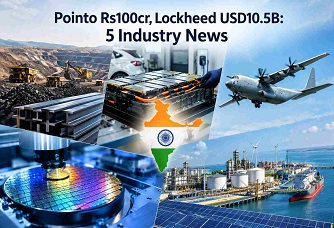
Indian manufacturing is increasingly moving beyond factory expansion to secure the raw materials, equipment, recycling networks, and industrial infrastructure needed to sustain production.
The Steel Ministry has asked SAIL and NMDC to explore overseas mineral assets, while Pointo is seeking Rs70-100 crore to expand its EV battery refurbishment network.
Lockheed Martin has proposed manufacturing 48 of 60 aircraft in India if it secures a USD 10.5 billion tender, Canon is planning semiconductor equipment service centers, and L&T is developing a 300,000-tonne-a-year green ammonia project at Kandla with Itochu.
The Steel Ministry's direction to SAIL and NMDC to explore overseas mineral assets points to a broader challenge for India's steel manufacturing expansion: securing competitive and reliable raw materials.
The move is aimed at supporting long-term requirements and controlling input costs, while reducing dependence on imported resources such as coking coal.
For manufacturers, overseas mining could provide greater supply visibility, but the larger issue is whether Indian steel companies can build a more resilient upstream resource network.
NMDC's potential diversification beyond iron ore could also become important as demand grows for minerals required across newer industrial sectors.
Also Read: Manufacturing Capability: The New Currency of India's Global Ambition
Pointo's planned Rs70–100 crore fundraise highlights an emerging requirement in India's EV ecosystem: service infrastructure for batteries after their first deployment.
The company plans to use the capital to build an automated, large-scale refurbishment facility and expand its distribution network. It currently operates more than 22 hubs across six states and serves about 25,000 customers.
The manufacturing opportunity lies beyond selling replacement batteries. Pointo plans to buy back, refurbish, and redirect batteries into second-life applications such as home inverters.
With 8,000–10,000 electric autos expected to require battery replacement from next year, a larger refurbishment and collection network could become an important part of India's battery circular economy.
Lockheed Martin's proposal for India's USD10.5 billion medium transport aircraft tender could have implications beyond aircraft procurement.
The company has proposed 12 aircraft in flyaway condition and 48 to be manufactured in India with Tata Advanced Systems. It also wants to expand its existing C-130J production relationship with Tata.
The manufacturing question is how much of this program can move into India's wider aerospace supply chain. Expanding aircraft structures, components, precision machining, maintenance and other capabilities could create opportunities for Indian Tier-1 and Tier-2 suppliers.
The proposed production expansion therefore provides a test of whether large defense programs can generate deeper domestic value addition rather than remaining primarily assembly-led.
Canon's semiconductor opportunity in India extends beyond supplying lithography machines. The company has discussed upcoming semiconductor projects and plans to establish service centers as manufacturing facilities become operational.
Canon says chip manufacturers will require 24x7 support for its equipment. That creates another potential localization layer for India's semiconductor industry.
As fabs and packaging facilities emerge, demand will also grow for equipment maintenance, technical expertise, spare parts, calibration and specialized engineering services.
Canon's proposed support infrastructure could therefore help establish a domestic ecosystem around semiconductor manufacturing equipment rather than focusing only on chip production itself.
L&T's proposed 300,000-tonne-per-year green ammonia facility at Kandla is being positioned as part of a broader export strategy for green hydrogen derivatives.
The company is also discussing equity participation in its clean-energy arm with Japan's Itochu, which has agreed to take green ammonia under a long-term arrangement.
The manufacturing opportunity spans renewable power, electrolysers, hydrogen production, ammonia synthesis, storage, and port logistics. Itochu's expected use of Kandla-produced ammonia for bunkering operations in Singapore and elsewhere also gives the project an international demand pathway.
Together, these developments show how India's manufacturing expansion is increasingly being shaped by upstream resource security, circular battery infrastructure, aerospace localization, semiconductor equipment support, and export-oriented clean-energy capacity.




We use cookies to ensure you get the best experience on our website. Read more...