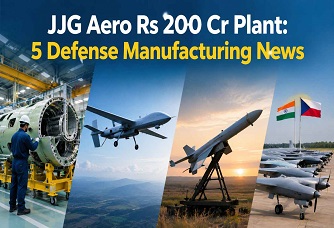
India’s defense manufacturing sector is seeing fresh activity across aerospace components, autonomous aircraft, loitering munitions and international industrial partnerships.
These five recent developments span the full production cycle, encompassing industrial capacity expansion, technological development, military deliveries and cross-border defense manufacturing cooperation.
Bengaluru-based JJG Aero plans to invest Rs 200 crore in a new aerospace facility, while Gopalan Aerospace India plans to raise its monthly drone output from 25 to 500 units within a year.
Meanwhile, government-backed funding for ideaForge’s YETI platform and the Indian Army’s receipt of 450 Nagastra-1R loitering munitions underline the importance of indigenous engineering and production execution.
India and the Czech Republic have also agreed to expand defense industrial cooperation, opening potential avenues for joint production, technology collaboration and stronger defense manufacturing partnerships.
Together, these developments offer a closer look at the capabilities shaping India’s defense industrial ecosystem.
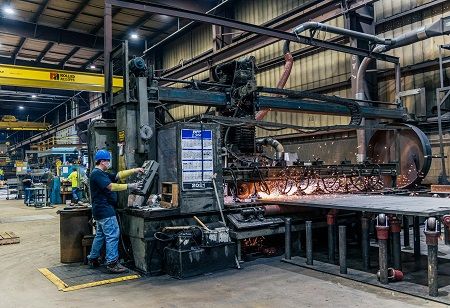
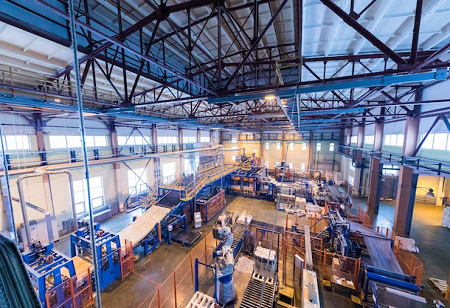
JJG Aero has begun work on its third manufacturing facility, aiming for Rs 1,000 Crore in annual revenue by FY31.
The first phase will cover 325,000 square feet and is expected to add Rs 600 crore in incremental revenue by FY31, alongside 1,500 direct jobs. The facility will initially house more than 325 machines.
The expansion will extend the company’s capabilities beyond precision machining into:
Founder Anuj Jhunjhunwala described the facility as a step towards taking on higher-value work for global aerospace customers.
The investment highlights how defense manufacturing also depends on specialized component suppliers and advanced production processes.
Also Read: Indian Air Force at 94: From Four Aircraft to Modern Air Power
India and the Czech Republic have agreed to expand defense industrial collaboration, including through the India-Czech Joint Defense Committee.
Defense Minister Rajnath Singh and Czech First Deputy Prime Minister Karel Havlíček reviewed existing cooperation and welcomed established joint ventures.
The partnership could create opportunities for joint production, engineering collaboration and technology development.
However, the announcement does not confirm new manufacturing contracts or specific technology-transfer commitments. Its significance for defense manufacturing will depend on how bilateral cooperation translates into projects involving Indian companies and domestic suppliers.
The Technology Development Board has signed an agreement to provide Rs 151 crore in financial support to ideaForge for developing YETI, a heavy-lift autonomous aerial logistics vehicle. The project has a total cost of Rs 302 crore.
The platform is designed to carry payloads of up to 200 kg over a targeted distance of 200 km. The program aims to advance the technology from Technology Readiness Level 4 to Level 9, subject to successful development and validation.
The funding supports the development of indigenous autonomous aerial vehicle systems, with engineering, testing and operational readiness remaining important milestones.
Solar Defence and Aerospace Limited has delivered 450 Nagastras-1R loitering munitions to the Indian Army, completing a Rs 158 Crore procurement contract and marking its biggest single-batch delivery of the weapon system.
The milestone demonstrates the importance of manufacturing consistency, technical validation and the ability to fulfill defense orders at scale. It also adds a delivery-based example to India's indigenous defense production efforts.
Gopalan Aerospace India plans to increase output from around 25 drones a month to 500 within a year. The company has spent Rs 75 crore of its planned Rs 100 crore investment and launched a new production line at its Hoskote facility.
The proposed increase would require a twentyfold rise in monthly output. Execution will depend on production-line efficiency, component availability, quality control and sustained demand.
For India's defense manufacturing ecosystem, the target illustrates the challenge of converting investment and installed capacity into consistent production volumes.
.jpg "Industrial Manufacturing")






We use cookies to ensure you get the best experience on our website. Read more...