When we hear about India’s defense and aerospace sectors today, the first and foremost question that comes to mind is: what drives this sector on a large scale—innovation, self-reliance, or the ability to transform challenges into opportunities? The answer is a blend of all these factors, as India strives to indigenize its defense manufacturing capabilities, drive technological advancements, and turn existing challenges into stepping stones for a stronger, more self-sufficient industry. It goes in a steep direction with an astounding pace owing to the government support. On that note, the evolving defense procurement policies and the increasing emphasis on technological innovation to reduce dependency on foreign suppliers provide strong support for businesses.
"Private sector involvement in defense manufacturing will not only strengthen India's national security but also create a significant impact on global defense markets, creating economic growth and job opportunities." – Piyush Goyal, Minister of Commerce & Industry, Government of India
For many years, India has been highly focused on foreign suppliers for purchasing a significant amount of their weapons, aircraft, and naval equipment for defense. India's approximately spent yearly on defense import expenditures were between $10-15 billion. These initiatives are directly influencing the transformation of this sector on different levels. With increasing homegrown innovation today, it has made it possible to manufacture products such as the Tejas fighter jet and BrahMos missile.
"Indigenization is the cornerstone of India’s future technological development. Empowering local manufacturers will ensure the nation becomes self-sufficient in cutting-edge innovations," says Sandeep Agarwal, Founder & CEO, IdeaForge Technology.
Due to the positive effect, ultimately, the focus is on manufacturing more local production and innovation, to totally reduce dependency on imports. Recognizing the need to build an independent defense infrastructure, India’s defense and aerospace sectors are now prioritizing more and more indigenization. The emphasis is on taking the local manufacturing capabilities to a global standard and reducing import reliance, and developing advanced technologies within the country.
"Through collaboration between private industry and government, we are laying the foundation for India to become a leading player in defense technology and manufacturing," – Baba Kalyani, CEO, Bharat Forge
The defense procurement policies of India are being altered to support domestic producers. Policies such as the Strategic Partnership Model and the Make in India initiative are pushing local businesses to work with international defense behemoths to jointly develop and manufacture significant technology in India. Such initiatives strive to build a robust military manufacturing system all while offering possibilities for employment, innovation, and the expansion of the domestic defense sector.
"AI integration in drones is not just desirable; it is inevitable," says Lakshya Chauhan, Project Head of Drone Manufacturing, Indian Army
This leads to a surge in innovations like the Tejas fighter jet, BrahMos missile, and indigenous UAVs, driven by the government’s push for self-reliance and technology transfer. The creation of dedicated defense manufacturing clusters and funding under schemes like Make-II has provided more opportunities for new players to thrive.
"India’s aerospace manufacturing is on the cusp of a revolution. A strong focus on indigenization, combined with private sector innovation, will help us become a global powerhouse," – Amit Jain, Chairman, L&T Defence
Developing all goods domestically serves as one of the main objectives of this shift, as it will provide a quicker turnaround time, more operational flexibility, and increased cost-effectiveness. The Tejas light combat aircraft is a classic example of effective local development, and the Indian military is likewise placing a high priority on indigenous aircraft production.
Also Read: How India's Drone PLI Scheme Is Fueling a New Aerospace Manufacturing Ecosystem
The aerospace production in India has recorded remarkable progress in the last ten years. Such industry giants as Hindustan Aeronautics Limited (HAL) and Bharat Electronics Limited (BEL) are working on the development and manufacturing of military planes, helicopters, and avionics. These organizations are collaborating with global defense firms to acquire the latest technologies and procedures that can be modified to meet the needs of the Indian defense ecosystem.
"India’s strength lies in its talent pool and the ability to execute large-scale technological projects that can reshape industries across the globe," said Anand Sri Ganesh, CEO, NSRCEL
The Aerospace Industry in India can also develop because of the interest of the country in technological innovation and research and development (R&D). Aerospace Innovation in India is an investment by the country in order to build a sustainable competitive advantage in the world market. An example is the Indian Space Research Organization (ISRO), which has played a major role in the initiation of satellite technologies and the increase in Indian space exploration. This innovation is also trickling into the manufacturing of the defense sector, whereby India is seeking to manufacture next-generation aircraft and defense systems.
"Innovation, coupled with the strategic push from the government, will make India a global leader in aerospace manufacturing. We must invest in homegrown solutions to secure the future of defense," – Sukaran Singh, CEO, Tata Advanced Systems
In line with India’s growing focus on indigenous drone manufacturing and aerospace innovation, new infrastructure-led initiatives are also emerging across states.
AVPL International is about to inaugurate Phase-1 of its proposed Rs 80 crore Drone City Haryana project on May 16 at Village Sisai, Hansi, marking a significant step towards building an integrated drone manufacturing, skilling, and innovation hub in India. The project has received incentive support worth Rs 58.51 crore under the Haryana Enterprise and Employment Policy-2020.
The ambitious Drone City Haryana project aims to establish a comprehensive platform for drone manufacturing, component production, testing, training, research, innovation, and deployment under one integrated campus. The initiative aligns with India’s broader push towards indigenous drone manufacturing, precision agriculture, defence technologies, and future-ready skill development.
The grand inauguration ceremony will be attended by Haryana Cabinet Minister Shri Krishan Kumar Bedi as the Chief Guest, along with former Finance Minister Captain Abhimanyu, senior government officials, industry leaders, and stakeholders from the drone and defence sectors.
On the same day, a special orientation and empowerment programme under the “500 Drone Udhami Scheme” for Scheduled Caste youth will also be organised in association with the Haryana Scheduled Castes Finance and Development Corporation. Under the initiative, 500 youth from the SC category will be trained and empowered as drone entrepreneurs, drone pilots, technicians, and agri-drone service providers.
The Rs 58.51 crore incentive-supported project associated with Drone City Haryana is aimed at developing a large-scale integrated drone manufacturing and skill ecosystem in the state. The project will focus on drone manufacturing, drone component production, research & development, drone testing infrastructure, advanced technology development, and large-scale skill training activities.
Under this project, nearly 800 youth in Haryana are expected to be connected with employment, entrepreneurship, drone operations, technical training, manufacturing, and allied drone ecosystem activities. The initiative is also expected to contribute towards strengthening Haryana’s position as an emerging hub for drone manufacturing, defence technologies, aerospace innovation, and advanced skill development in India.
Spread across nearly 11.5 acres, Drone City Haryana will feature 23 industrial sheds dedicated to drone and drone-component companies from across the country. The ecosystem will focus on agriculture drones, industrial drones, logistics drones, surveillance drones, and advanced UAV systems.
The integrated Drone City ecosystem will include:
• Drone Manufacturing Units
• Drone Component Production Facilities
• Drone Testing & Demonstration Zones
• Research & Development Labs
• Pilot & Technician Training Centres
• Agriculture Drone Operations
• Surveillance & Advanced UAV Technologies
• Battery, Sensor & Communication System Development
• Drone Assembly & Supply Chain Ecosystem
• Entrepreneurship & Skill Development Programmes
• Large Drone Flying & Deployment Infrastructure
Dr. Preet Sandhu, Founder and Managing Director, AVPL International, said, “Drone City Haryana is a dream come true project for us. We envisioned this as an integrated ecosystem focused on drone manufacturing, innovation, skilling and entrepreneurship. Through this initiative, we aim to bring together manufacturers, startups, technology innovators, training institutions and service providers under one platform focused on future technologies.”
“We sincerely thank the Government of Haryana and the Industries Department for their continuous support and encouragement in helping us develop this ecosystem. The initiative aims to contribute towards strengthening India’s indigenous drone and aerospace ecosystem while creating meaningful employment and entrepreneurship opportunities for youth,” she added.
The foundation stone of the project was laid by Haryana Chief Minister Nayab Singh Saini on September 8, 2025, reflecting the state government’s focus on futuristic industrial growth, innovation, and employment generation.
Although the indigenization of defense and aerospace technologies has made a big leap forward, there are a number of weaknesses. Indigenizing Defense Technology has challenges because required expertise is specialist, advanced production facilities, and ongoing investment in research and development. Most of the Indian manufacturers are yet to establish the abilities to keep pace with their international players in terms of technology.
There are also issues about intellectual property rights (IPR), technology transfer agreements, and the possibility of having skilled labor to manage the advanced defense systems. With India trying to ramp up its military production, it is essential to ensure that the local manufacturers are provided with state-of-the-art Aerospace Manufacturing Technology to get around these challenges.
The other problem is the ability to increase the production without affecting the quality. This is what has been worrying the Indian Defense Manufacturing since the country is trying to strike a balance between speed and accuracy and at the same time, meet world quality standards. The main way to overcome these hurdles will be to build a strong supply chain and establish a web of military manufacturing centers in India.
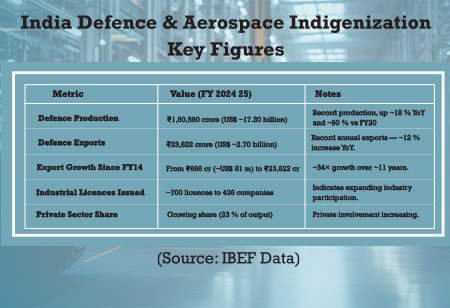
The vision of the Defense Modernization Program in India is aimed at improving capabilities of the Indian Armed Forces with regard to the indigenization of critical defense technologies. The government has established some specific goals of minimizing the reliance on imports and has a timetable of producing high-tech defense products, including military aircraft, unmanned aerial vehicles (UAVs), and defense missile systems. India is making sure that these capabilities are made in-country through the Self-Reliance Initiatives in the defense sector so that there is no dependency on external powers.
"2025 will be a pivotal year for India’s drone sector, just as 2026 holds the promise of groundbreaking advancements. Similarly, the fight against AMR requires a multi-year strategy with continuous investment and execution," - Agnishwar Jayaprakash, Founder & Director, Garuda Aerospace
The Defense Indigenization Government Policies also focus on attracting investment in defense manufacturing by the private sector since the sector has been dominated by government-owned enterprises. India is making efforts to establish a better competitive and efficient ecosystem in the development of defense technologies by opening the arena of defense manufacturing to the participation of private players.
The competitiveness of aerospace in India will be determined by how the government will promote innovation and cooperation. The strengthening of the private sector in defense manufacturing will be significant with an emphasis on boosting the level of R&D - showcasing the increase in the standards of manufacturing, and the decrease in the bureaucracy level.
India is on the brink of becoming a big player in the world, given its focus on indigenization of its defense. The government initiative to be self-reliant and the changing procurement policies will enhance defense capabilities. Nevertheless, let us wait for technological issues getting resolved backed up by a long-term and robust partnership between the government and the industry to enable the aerospace sector to expand.
.jpg "Saksham Enterprises: Optimizing Mission- Critical HVAC Infrastructure For The High Precision Sector")

.jpg "JDS Group of Companies: Innovating Smart Solutions For Modern Power Transmission & Distribution Infrastructure")



We use cookies to ensure you get the best experience on our website. Read more...