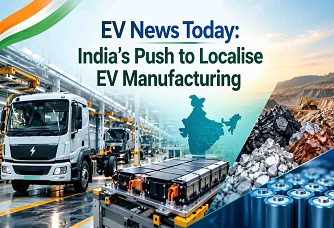
India’s electric vehicle manufacturing story is beginning to move beyond vehicle assembly, with recent developments spanning commercial EV production, battery manufacturing, auto components and critical minerals.
While the latest announcements highlight large investments and capacity plans, the more significant shift is taking place deeper in the value chain.
India’s EV ambitions depend not just on producing more vehicles, but on localizing the batteries, components and materials that power them.
JSW’s integrated commercial-EV facility, Ashok Leyland’s proposed battery project, auto-component investments linked to the PLI scheme and Lohum’s expansion into nickel and cathode materials each address different manufacturing gaps.
Together, these developments show companies targeting the technologies, materials and processing capabilities needed to increase localization and reduce dependence on imported inputs.
JSW Group’s entry into electric commercial mobility is more significant from a manufacturing perspective than its Rs 2,500 crore investment or initial 15,000 unit annual capacity suggests.
Its 90-acre facility at AURIC, Chhatrapati Sambhajinagar, is designed to combine bus body manufacturing, automated truck-cabin production and battery-pack operations. The plant will also feature a pre-treatment and electro-deposition process for buses.
The less emphasized development is the attempt to build capabilities across multiple layers of the vehicle. JSW Greentech CEO Sumit Mittal said the company was designing and engineering the vehicles in India, including its drivetrain and software.
While the plant will initially assemble battery packs from imported cells. The company is targeting around 50 percent localization initially.
This creates a clear localization gap: vehicle and pack manufacturing can be brought inside India, but battery cells remain an upstream dependency.
Union minister Nitin Gadkari has said Ashok Leyland is considering an EV battery project in Bhandara, Maharashtra, with potential investment of Rs 10,000–15,000 crore.
Importantly, the project remains under consideration and is not a confirmed investment commitment.
The larger manufacturing question is therefore not simply how much the proposed project could cost, but which part of the battery value chain it could localize.
The announcement does not specify whether the proposed facility would manufacture cells, battery packs or other battery components. That leaves several important execution questions:
Gadkari has highlighted Vidarbha’s logistics infrastructure, including Nagpur’s dry-port capabilities, as part of the region’s investment proposition.
For India’s commercial-EV industry, the significance will ultimately depend on whether the project moves the company further upstream from vehicle manufacturing to battery manufacturing.
The government is likely to consider existing auto PLI applications from companies with Chinese investment after the relevant FDI approvals, according to credible sources.
The development could affect JSW MG Motor India and Tata AutoComp ventures with Chinese partners.
The manufacturing gap here is less about the ownership structure and more about domestic value addition.
TACO Prestolite, a Tata AutoComp joint venture with Prestolite Electric Beijing, for instance, designs and manufactures electric drivetrains and traction motors for EVs, while TACO Air International manufactures automotive air-conditioning systems.
The auto PLI scheme was designed around incremental production, investment and domestic value-addition targets. Investments under the scheme have crossed Rs 45,000 crore.
That makes the next question increasingly important: whether PLI-supported production translates into deeper component localization, supplier development and technology capabilities rather than primarily increasing final vehicle output.
Lohum’s expansion illustrates another missing layer in India’s EV manufacturing story: the availability of battery materials.
The company currently produces about 1,000 tons of nickel annually from recycled materials in Gujarat and is targeting 10,000 tons within 18 months. It is also seeking nickel-mining assets in Indonesia and the Philippines.
Lohum is simultaneously developing a 5,000-ton-per-year cathode active material plant in Uttar Pradesh and plans to process lithium ore in Zimbabwe before sending lithium sulphate to India for further refining.
This creates a broader battery ecosystem strategy spanning mining, refining, cathode production and recycling. Lohum CEO Rajat Verma added that the company could create even larger nickel capacity if it gains access to suitable mines.
The development highlights a fundamental manufacturing challenge: scaling EV production requires more than cell and vehicle factories. India also needs reliable access to critical minerals, intermediate materials and processing capabilities.
Taken together, these developments show an EV manufacturing ecosystem being built across several layers - from vehicles and drivetrains to batteries, cathode materials and mineral supply. The next phase will depend less on announced capacity and more on how deeply these investments localize the value chain.
.jpg "Saksham Enterprises: Optimizing Mission- Critical HVAC Infrastructure For The High Precision Sector")
.jpg "JDS Group of Companies: Innovating Smart Solutions For Modern Power Transmission & Distribution Infrastructure")

We use cookies to ensure you get the best experience on our website. Read more...