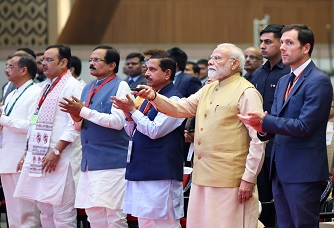
 BESS manufacturing emerged as a key opportunity after Prime Minister Narendra Modi inaugurated the Bharat Renewable Energy Summit and Expo (BRESE) 2026 at Bharat Mandapam in New Delhi on November 2.
Addressing industry leaders, investors and innovators, PM called for indigenous storage hardware and additional battery storage capacity, describing the requirement as an opportunity for India's youth, researchers and investors.
The appeal adds a manufacturing dimension to the country's renewable energy expansion: scaling solar and wind generation will also require systems to store electricity and supply it when production fluctuates.
This creates scope to strengthen India's battery energy storage ecosystem.
India's growing renewable energy capacity requires storage infrastructure that can address the intermittent nature of solar and wind power.
Electricity generated during periods of high renewable output needs to be stored and dispatched when generation falls; battery energy storage systems (BESS) can support this requirement.
According to the Ministry of Power, India could require approximately 47.24 GW or 236 GWh of installed BESS capacity by 2031-32, involving an estimated investment of Rs 3.49 lakh crore.
This projected investment highlights the potential demand for battery storage equipment, manufacturing facilities and associated industrial components. For manufacturers, this creates an opportunity to develop a domestic supply chain covering battery cells, modules, packs and integrated storage systems.
BESS manufacturing could also extend into battery management systems, power conversion systems, thermal management equipment and safety components.
PM's emphasis on indigenous storage hardware at BRESE 2026 therefore brings attention to the industrial capabilities needed alongside renewable power generation.
Also Read: Indian Solar Wafer Policy 2028: ALMM Rules, Deadline, Impact
The Production Linked Incentive (PLI) scheme for Advanced Chemistry Cell (ACC) battery storage carries an outlay of Rs 18,100 crore and targets 50 GWh of manufacturing capacity.
The program envisages approximately Rs 45,000 crore in direct investment in ACC battery manufacturing projects.
As of December 31, 2025, beneficiary companies had reported cumulative investments of Rs 3,237 crore under the scheme, with 40 GWh of manufacturing capacity awarded to four companies.
Private-sector investments are also expanding the ecosystem. Waaree Energy Storage Solutions has announced an Rs 8,175 crore investment in a 16 GWh lithium-ion battery gigafactory in Andhra Pradesh.
Gujarat-based Powertrac Group has also announced Rs 600 crore for a 1 GWh containerized BESS manufacturing facility, including battery management system development and integration.
More recently, India's Failte Energy and China's Sigenergy announced plans for a joint venture involving an initial investment of USD 250 million to establish inverter and battery energy storage manufacturing facilities in India.
Together, these investments illustrate how BESS manufacturing is attracting capital across battery cells, packs, containerized storage solutions and power conversion equipment.
PM's remarks connected the development of indigenous storage hardware with India's broader clean energy ambitions, highlighting the country's progress in domestic solar manufacturing, pointing out the fact that solar module manufacturing capacity had increased from around 2 GW a decade ago to over 200 GW.
A similar focus on domestic capabilities could help India's battery storage industry reduce dependence on imported equipment and components. The Prime Minister also identified storage technology development as an opportunity for startups, IITs, researchers and investors.
The opportunity also extends to suppliers of cathode and anode materials, battery foils, thermal management systems and power electronics.
The combination of government incentives, private-sector capital and rising storage requirements could provide a stronger foundation for India's indigenous battery manufacturing ecosystem.


.jpg "Building EV Bus Ecosystems for India's Clean Mobility Goals")
We use cookies to ensure you get the best experience on our website. Read more...