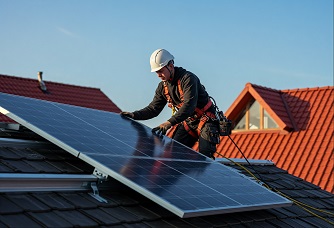
India's Solar Boom is no longer centered in metro cities. Smaller cities are now leading rooftop solar adoption across the country.
India's Solar Boom is gaining speed in tier-II and tier-III cities with strong government support.
Better awareness and attractive subsidies are encouraging more families to install rooftop solar systems. This trend is changing the country's clean energy landscape.
According to the latest government data, cities like Lucknow, Nagpur, Surat, Varanasi, and Ernakulam are among the top rooftop solar markets. Major metros, including Delhi, Mumbai, Bengaluru, Hyderabad, Chennai, and Kolkata, do not feature among the top 100 districts for rooftop solar adoption.
The biggest reason behind this growth is the PM Surya Ghar: Muft Bijli Yojana. The scheme was launched in 2024 to promote rooftop solar installations. It aims to cover one crore households across India.
The scheme offers financial support to reduce installation costs. Families installing rooftop solar systems of up to 3 kW can receive a central subsidy of up to Rs 78,000. Some state governments also provide additional incentives.
The scheme promises several benefits.
Government officials say awareness campaigns have also increased interest in rooftop solar. Electricity distribution companies have played a key role in reaching consumers.
Also Read: Hybrid Energy Systems: Shaping India's Industrial Power Landscape
The government has already installed rooftop solar systems in around 36.3 lakh households. More than 44.1 lakh families have benefited from the scheme.
The total budget for the scheme stands at Rs 75,021 crore. So far, the government has released over Rs 25,000 crore as subsidies.
Most homeowners are choosing systems between 3 kW and 4 kW. These systems account for more than 60 percent of total installations. They are suitable for the electricity needs of many Indian households.
States leading rooftop solar adoption include Gujarat, Maharashtra, Uttar Pradesh, Rajasthan, Kerala, and Assam. Officials credit strong local outreach and awareness drives for this progress.
The government is now expanding its rooftop solar efforts. It plans to increase installations in group housing societies. This will allow apartment residents to benefit from clean energy.
Another major step is the Utility-Led Aggregation (ULA) model. The program targets households that cannot install rooftop systems due to financial or structural challenges.
The ULA model aims to benefit around 30 lakh households across several states. It is expected to make solar energy more accessible to low-income families.
The latest trend shows India's clean energy transition is spreading beyond large cities. Smaller towns are becoming the new growth centers for rooftop solar. Lower costs, financial support, and rising awareness are driving this change. As more households adopt solar power, India's renewable energy goals are expected to receive a major boost.
.jpg "Precise Fasteners: Committed To Fulfilling Client Expectations, Every Time!")




We use cookies to ensure you get the best experience on our website. Read more...