For a business that rents generators, the machine is only one part of the proposition. A diesel generator can be technically sound and still fail the customer if maintenance is missed, a fault takes too long to resolve, or the service team cannot respond quickly.
In a business built around backup power, the real test begins when something goes wrong. How quickly a service provider can identify the problem, make a decision and mobilise the right response can matter as much as the generator itself.
That makes agility more than a service advantage; it becomes an operating requirement. Tara Genset Engineers has built its nearly three-decade journey around precisely that premise. Established by Dr. Sorav Narula's father, the company began as a Delhi-NCR generator rental business serving corporates and banks.
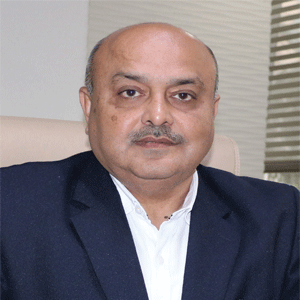
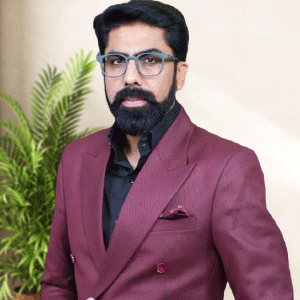
After studying at the University of East London, Dr. Sorav Narula returned to India in 2006 and took the second-generation business forward with stronger systems, processes and technology.
With a Doctorate in Scalable Systems & Process Excellence, his focus has been on creating the operational structure required to retain responsiveness as the business scales. Tara has since grown into a pan-India operation with more than 1000 deployed DG sets, ranging from 10 kVA to 750 kVA.
Today, its offering spans generator rentals and sales, AMC services, AMF panels and RECD solutions. But the proposition tying these capabilities together is agility: the ability to respond faster without compromising the processes, technical preparedness and visibility required to manage a distributed power-service network.
Making Agility an Operating Discipline
Tara's positioning starts with a distinction that is easy to miss in the generator rental market: customers are not really renting equipment. They are depending on a service to remain available when their primary power supply does not.
That changes the operating equation. A rental customer may have different expectations around fuel, maintenance, and deployment depending on the site and the nature of the operation. Some want the generator while managing fuel themselves; others require Tara to manage fuel as part of the service. The company therefore structures its offering around the customer's operating requirement rather than forcing every deployment into an identical model.
For Tara, this flexibility is closely tied to agility. Across a pan-India operation, quick service depends on the ability to make decisions without allowing scale or geographical spread to slow the response. Processes and systems provide the structure, while operational autonomy enables teams to act when a customer needs support. In that sense, agility extends beyond breakdown response to how the company manages its service operation itself.
“Gen-set renting business is not about renting a product. It is about renting a service also. So the most critical part is that if there should come a problem in a gen-set, it should be rectified. Agility and quick decision-making are important, and we are also a process-driven company. Customer experience is the most important thing for us; everything else comes after that”, shares Dr. Sorav Narula, CEO, Tara Genset Engineers (REGD).
Keeping the Fleet Ready
Tara treats preventive maintenance as a recurring operating discipline rather than an intervention triggered by failure. Every installed generator is visited at least once every three months, with more frequent maintenance at locations where operating hours or local power-cut patterns warrant it.
Maintenance schedules include checks tied to running hours, including filter and oil changes, while cleaning receives particular attention because India's dusty operating environments can accelerate wear and restrict radiator performance.
The company has formalised this work through a field survey report that technicians are required to complete during site visits. The report captures defined parameters and creates a consistent basis for monitoring equipment health across the fleet.
Remote monitoring adds another layer, allowing a central team to track generator statistics and parameters such as battery health and spot developing issues without waiting for the next physical inspection. That visibility supports quicker intervention across a widely distributed fleet.
Tara also builds technical capability through its relationships with equipment manufacturers. Its technicians include trained OEM personnel, ITI-qualified recruits and experienced professionals, while OEM partnerships are used to provide training on newer engines and technologies. The objective is to ensure technicians understand the underlying systems rather than relying on trial-and-error troubleshooting.
“We make sure that we get them trained by the OEMs. Since we are buying gen-sets from a lot of OEMs, we have key accounts with them and request that they train our technicians with the updated technology. They know the logic behind everything, rather than learning through hit and error, and that helps us stay abreast of the latest engines and machines”, adds Sorav.
Safety is built into the same process. Generator placement must account for waterlogging, ventilation, and sufficient working clearance for technicians, particularly in India's varied climatic conditions. These considerations may appear operationally basic, but they become significant when equipment is repeatedly deployed across different sites and environments. Tara's RECD offering addresses customers who have serviceable older generators but do not necessarily need or want to replace equipment that still has useful operating life
Retrofitting for a Lower-Cost Transition
RECD forms one part of Tara's wider portfolio, particularly for customers whose existing generators remain mechanically sound but need to meet changing emission requirements. Rather than replacing serviceable equipment immediately, eligible CPCB 2 generators can be retrofitted with an RECD system to reduce emissions to the required level.
Tara is now looking at what comes after conventional diesel generation, with hybrid systems that combine diesel with PNG or other gas-based fuels emerging as a potential next step. The attraction is practical: diesel prices are rising, while customers need backup systems that can deliver comparable performance without carrying the same operating burden.
“We are looking forward to the hybrid model, where gas and diesel can be used together. The solutions are available, but I don't think the technology has reached the pinnacle it should have. We want it to mature so that we can serve more people in a more economical and more environmentally friendly manner”, he concludes.
For Sorav, the opportunity is not limited to changing the fuel mix. Tara is also moving towards deeper digital control of the business itself. Remote monitoring already provides visibility into generator health, while the next layer is using software to track the processes surrounding a growing pan-India operation. As the fleet and service network expand, that visibility is intended to preserve what Tara considers fundamental to its model: the ability to make decisions and respond quickly without losing process control.
Tara's trajectory reflects a broader shift in generator rentals from equipment availability towards service-led power support. For the company, the defining capability within that shift is agility backed by structured processes, preventive maintenance, remote visibility and technical expertise. As its footprint expands, the objective is to ensure that scale strengthens the service network without slowing the response customers depend on when power fails.
Tara's Operating Footprint
Tara brings nearly three decades of experience in generator rentals, having grown from a Delhi-NCR operation serving corporates and banks into a pan-India business.
The company has built a 300-plus record of performance certificates and client testimonials, making customer validation one of its strongest measures of credibility.
A centralised remote monitoring system allows Tara's head office team to track generator health and operating statistics across its deployed fleet.

We use cookies to ensure you get the best experience on our website. Read more...