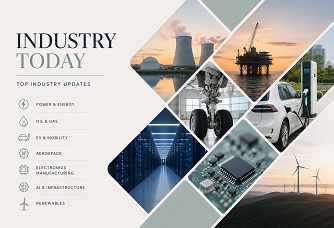
India's industrial landscape continues to evolve with significant developments across energy, electronics manufacturing, artificial intelligence, mobility, and aerospace.
From major infrastructure investments and global partnerships to policy-backed manufacturing initiatives, businesses are positioning themselves for long-term growth and competitiveness.
Today's industry roundup highlights seven key developments that are expected to influence India's manufacturing ecosystem, clean energy transition, technology adoption, and export ambitions while strengthening the country's position in global industrial value chains.
India's largest power producer, NTPC, has announced an ambitious capital expenditure plan of INR 16.7 lakh crore over the next 11 years to expand its installed power generation capacity to 250 GW by 2037. The investment will primarily focus on nuclear energy, renewable power, and battery energy storage systems as the company accelerates its clean energy transition while meeting India's growing electricity demand.
Oil and Natural Gas Corporation (ONGC) has approved a corporate guarantee to support Mangalore Refinery and Petrochemicals Limited (MRPL) in importing crude oil from Saudi Aramco. The move is expected to strengthen crude supply security, improve operational stability, and reinforce strategic energy partnerships between Indian refiners and global oil suppliers.
Despite rising electric vehicle adoption, Delhi continues to face significant challenges in expanding its charging infrastructure. Industry experts believe that inadequate charging networks could slow EV adoption unless public and private stakeholders accelerate investments in charging stations and supporting infrastructure.
Safran Landing Systems and Lufthansa Technik have entered a 10-year agreement to provide maintenance, repair, and overhaul (MRO) support for Airbus landing gear systems. The partnership is expected to enhance maintenance capabilities, improve fleet reliability, and strengthen long-term aerospace service support for airline operators.
Berit Plewinsky, Vice President Aircraft Component Services at Lufthansa Technik, said the agreement reflects the strength of the relationship between the two companies and demonstrates how close cooperation between a leading maintenance provider and an original equipment manufacturer benefits airline customers. She noted that combining the expertise of Lufthansa Technik’s landing gear network with Safran’s engineering knowledge will help meet growing market demand while maintaining the highest maintenance standards.
Darren Waite, Executive Vice President, Customer Support and Services at Safran Landing Systems, said the agreement is built on years of successful collaboration and mutual trust. He added that Safran will continue providing Lufthansa Technik with certified spare parts, technical expertise and engineering support to help maintain and improve the performance of Airbus fleets around the world.
Also Read: Zero-Emission Mobility: India's Path to Cleaner Urban Transport
India is witnessing a surge in investments in AI-ready data centers as demand for artificial intelligence, cloud computing, and digital services continues to grow. The expansion is driving investments across power infrastructure, real estate, cooling technologies, fibre connectivity, and advanced computing facilities, creating new opportunities for industrial development and technology-led growth.
The Government of India has approved two Electronics Manufacturing Clusters (EMCs) in Tamil Nadu under the EMC 2.0 Scheme. Located in Manallur and Pillapakkam, the clusters are expected to attract fresh investments, strengthen domestic electronics manufacturing, generate employment, and support India's ambition of becoming a global electronics production hub.
Suzlon Energy is expanding its international footprint by targeting export opportunities across Europe, Australia, and Southeast Asia. The renewable energy company aims to leverage its manufacturing capabilities and growing global demand for wind energy solutions to increase exports while strengthening its presence in overseas markets.
Today's developments reflect India's continued momentum across strategic sectors including energy, electronics manufacturing, artificial intelligence, renewable energy, mobility, and aerospace. Large-scale investments, government-backed manufacturing initiatives, and expanding global partnerships are strengthening industrial capabilities while supporting innovation, infrastructure development, and export growth. As businesses continue to invest in next-generation technologies and sustainable solutions, these initiatives are expected to play a vital role in shaping India's long-term industrial and economic competitiveness.
.jpg "AR Enterprises: Building The Supply Networks Behind India's Construction Growth")
.jpg "Industrial Packers: Engineering Industrial Packaging for India's Manufacturing Future")



We use cookies to ensure you get the best experience on our website. Read more...