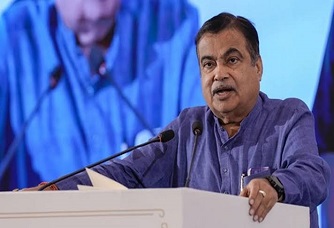
India’s EV market will reach Rs 20 lakh crore by 2030 and create five crore jobs, Union Minister for Road Transport and Highways Nitin Gadkari announced on wednesday.
Speaking at a summit organized by the CII-ITC Centre of Excellence for Sustainable Development, Gadkari revealed that India’s EV market currently holds 57 lakh registered electric vehicles with seven per cent market penetration.
He stated that demand stands at one lakh electric buses every year while manufacturers produce only 50,000 to 60,000 units annually.
India’s EV market growth will support the government’s target to make the automobile industry the world’s number one within five years.
Gadkari highlighted that Bajaj Auto and Hero MotoCorp already export more than half their production, underlining the sector’s export strength and trained manpower advantage.
Gadkari declared that India’s EV market forms a core pillar of the plan to rank the national automobile industry first globally within five years. He noted that the industry size stood at Rs 14 lakh crore when he assumed charge and now stands at Rs 22–23 lakh crore.
In comparison, the United States automobile industry measures Rs 78 lakh crore and China’s Rs 47 lakh crore. Gadkari emphasized that Indian vehicles offer high quality at lower cost, which attracts every major global automobile company to operate in the country. He added that India’s EV market benefits from abundant trained manpower that positions the sector for rapid scale-up.
Also Read: From Cost Reduction to Structural Cost Leadership in Manufacturing
Gadkari pointed out a clear production shortfall in the electric bus segment. India needs one lakh electric buses each year, yet current manufacturing covers only 50,000 to 60,000 units. At the same time, two-wheeler leaders Bajaj Auto and Hero MotoCorp export over 50 per cent of their output, demonstrating strong international competitiveness that India’s EV market can further leverage.
India currently spends Rs 22 lakh crore on fossil fuel imports, which fuels pollution challenges. Gadkari stated that good highways, alternative fuels and bio-fuel represent the future of transport. A joint report by IIT Chennai, IIT Kanpur and IIM Bangalore shows that expressways and economic corridors have already cut logistics costs from 16 per cent to 10 per cent.
The government now aims to lower this figure to eight per cent so Indian manufacturers can compete more effectively in global markets. India’s EV market expansion will reduce dependence on imported fossil fuels and support cleaner mobility while reinforcing these logistics improvements.
Gadkari concluded that the future of the Indian automobile industry remains bright and that India’s EV market will play a decisive role in achieving both employment and global leadership targets by 2030.





We use cookies to ensure you get the best experience on our website. Read more...