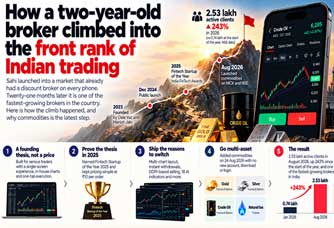
Sahi launched into a market that already had a discount broker on every phone. Twenty-one months later it is one of the fastest-growing brokers in the country. Here is how the climb happened, and why commodities is the latest step.
India's broking industry did not look short of options in December 2024. The discount brokers of the previous decade had already put a demat account on tens of millions of phones and driven the price of a trade close to zero. That is the market a Bengaluru startup called Sahi launched into that month. By August 2026, according to NSE data reported by The Economic Times, its active client base had grown 243% in the year to 2.53 lakh in a period when most of India's largest brokerages struggled to add active users at all.
The climb is worth tracing step by step, because none of it came from the playbook that built the incumbents.
Sahi began in 2023 with two founders who had watched the retail-trading boom from different seats. Dale Vaz had run engineering at Swiggy as its chief technology officer and had traded for 17 years himself. Manish Jain had built trading products at Kotak Securities as a senior vice president. Their shared observation was that everyone around them had a broking app, and almost nobody had the tools professionals use. So the company was built around the trading screen rather than the fee. Charts, option chains, positions and order execution sit in one view. Orders fill in a single tap. The charting engine was written in-house rather than licensed. Seed funding came from Accel and Elevation Capital, and the platform went live to the public in December 2024.
The first full year brought the external validation a young broker needs. Sahi was named Fintech Startup of the Year 2025 at the India FinTech Awards. Just as important was what it did not do: it did not chase users with acquisition offers. It priced at a flat ₹10 per executed order, with the first 30 days free, and left the price there.
"The last decade was really about accessibility and low cost, which we believe is now a solved problem," Vaz told The Economic Times in September 2026. "As users become more familiar with the markets, they are looking for products and tools that help them make more informed decisions rather than just a buy-sell button."
What turned a thesis into growth was a steady run of releases, each removing a specific reason an experienced trader might keep a second account elsewhere. A multi-chart layout for options traders. Instant withdrawals. DDPI-based selling that removes repeated OTP friction. A refreshed brand identity. A library of 18 machine-learning chart indicators, free, including a support-and-resistance mapper called Key Levels that the company developed itself. These tools are for analysis; they do not recommend trades or promise outcomes, and the decision stays with the trader.
ET's summary of the pattern was blunt: Sahi's growth has been driven by traders switching from larger brokerages to its single-screen platform. By the end of August 2026 the company had moved from 20th to 17th among Indian brokers by active clients, the fastest-growing of the 20 largest for a second month running.
The most consequential release landed on 24 August 2026, when Sahi added commodities. For a large group of its own users, MCX was the one thing still living on a rival app: equities and options on Sahi, crude oil and gold somewhere else. Sahi's commodities launch closed that gap inside the existing app, with no new download, account or login and a single ledger across segments.
The launch covers bullion, energy and base metals on MCX and NSE's commodity segment, with smaller contracts that let a trader size a position sensibly: Crude Oil Mini, Gold Mini, Gold Guinea, Gold Petal, Silver Mini and Silver Micro. A full gold lot is a kilogram. A Gold Petal lot is one gram. Crude Oil and Gold options trade from a customisable option chain with full Greeks.
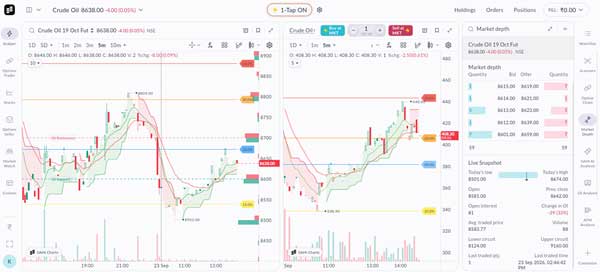
AI trend indicators and OI-based support and resistance on a Crude Oil futures chart on NSE's commodity segment, with a Crude Oil option chart and market depth alongside.
The tools that won the F&O trader carried over intact: one-tap execution, automatic stop-loss and target, trailing stops, a loss cap across the whole commodities portfolio, and a Kill Switch that blocks trading for a period the trader sets in advance. So did the company's habit of publishing its numbers. Its execution dashboard reports a 95th-percentile latency of 6.61 milliseconds from Sahi's execution management system to the exchange across 9,089,472 orders in March 2026, a platform-wide figure rather than a commodity-specific one.
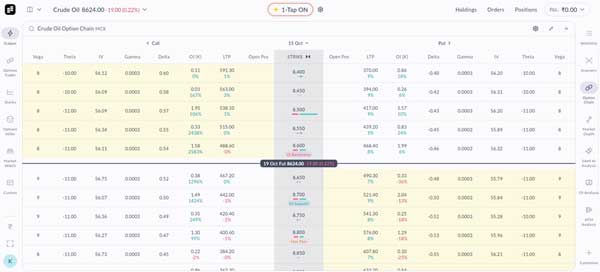
Crude Oil options with full Greeks in Sahi's customisable option chain, with OI resistance, OI support and Max Pain marked on the strikes.
Sahi's rise sits inside a wider shift. NSE data this year shows the giant discount brokers of the last cycle adding users slowly while a handful of smaller, product-focused platforms grow fast. The traders driving that shift are experienced, run real volume, and switch for a better screen rather than a lower fee. A broker that gives them every market in one place is harder to leave than one that merely undercuts on price.
Twenty-one months after launch, the company that was not supposed to be needed has become one of the clearest examples of that pattern. Its commodities page shows what the multi-asset version of the app now covers.
Commodity derivatives trading involves substantial risk and is not suitable for every investor. This article is for information only and is not investment advice.
About Sahi. Sahi is a trading platform built in Bengaluru by two people who spent years wishing one existed. Dale Vaz, who ran engineering at Swiggy as its CTO and has traded for 17 years, and Manish Jain, who built trading products at Kotak Securities as a senior vice president, founded the company in 2023 with backing from Accel and Elevation Capital. The app launched publicly in December 2024 and has since grown into one of India's fastest-growing brokers, with 2.53 lakh active clients in August 2026, up 243% since the start of the year according to NSE data reported by The Economic Times.
Sahi puts charts, option chains, positions and order execution on one screen, runs its own charting engine rather than a licensed one, and charges a flat ₹10 per executed order with the first 30 days free. It supports equities, F&O, IPOs, ETFs and, since 24 August 2026, commodities on MCX and NSE. Sahi is operated by Aaritya Broking Private Limited, a SEBI-registered stock broker (INZ000317632) and research analyst (INH000022172), a member of NSE, BSE and MCX, and a depository participant with CDSL. It was named Fintech Startup of the Year 2025 at the India FinTech Awards. More at sahi.com.

.jpg "AR Enterprises: Building The Supply Networks Behind India's Construction Growth")
.jpg "Industrial Packers: Engineering Industrial Packaging for India's Manufacturing Future")


We use cookies to ensure you get the best experience on our website. Read more...