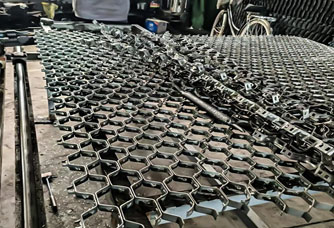
 Equipments in heavy manufacturing and process industries are usually subjected to extreme heat, abrasion and chemicals exposure. Refractory linings are common in order to safeguard structural shells and prolong the life of equipment. Nevertheless, two main elements, hexmesh and refractory anchors, are very important to the long-term performance of these linings. These reinforcement systems are very critical when it comes to stability in lining, failure prevention, and safety of operations in the cement, steel, petrochemical, and power generation industries.
Hexmesh is a metallic reinforcement system that is produced in an hexagonal pattern. It is attached or welded to the surface of steel to give a robust structure that supports refractory material.
The honeycomb structure is unique and refractory castables will interlock with each other to reduce the number of cracks due to shrinkage and minimize the number of lining displacement due to thermal cycling.
How Hexmesh Enhances Refractory Performance
Refractory hex mesh is an improved refractory lining through the formation of mechanical bonding between the lining and the steel substrate. This reinforcement helps in:
• Evenly distributing thermal stress in the lining.
• Stopping refractory fall on overhead and vertical surfaces.
• Growing vibration and abrasion resistance.
• Improving lining life areas in hot environments.
Due to these advantages, hexmesh is widely applied in the fields that are subjected to adverse operating environments where the conventional refractory application can break down too soon.
Industrial Applications of Hexmesh
Hexmesh finds a lot of application in production and processing equipment like:
• Kilns and rotary furnaces
• Cyclones and reactors
• Boilers and incinerators Duke, chimneys, and ducting systems.
It is a necessary element in high temperature industrial systems because of its capacity to hold refractory material even during repetitive heating and cooling processes.
What Are Refractory Anchors?
Stainless steel refractory anchors are metallic fasteners, which are employed to fix refractory linings to metal shells. They serve as load bearing connectors which take up mechanical and thermal loads on the refractory layer to the supporting structure.
Anchors are produced of different shapes and alloys in order to resist oxidation, corrosion, and creep deformation depending on operation temperature and lining thickness.
Use of Refractory Anchors in equipment with high temperature.
Refractory anchors are used as the supporting framework in lining systems to provide the stability of refractory materials in the course of operation. Their key functions include:
• Helping the weight of refractory linings.
• Thermal expansion and contraction accommodating.
• Eliminating lining detachment or collapse.
• Constant lining thickness.
The choice of anchor is important and improper selection of anchor material or spacing will cause untimely failure and result in expensive shutdown.
Types of Refractory Anchors Used in Manufacturing
There are anchor designs needed in different manufacturing processes such as:
• General lining support anchors that are V shaped.
• Y shaped anchors to enhance load distribution.
• U shaped stable anchors to move flexibly.
• Circular anchors in full refractory use.
Depending on the furnace design, operating temperature and the refractory material, the type of anchor selected varies.
Combinations of Hex mesh and Refractory Anchors.
Hexa mesh and refractory anchors are employed in combination in most industrial installations to make the lining as stable as possible. Hexmesh offers surface support and crack management where refractory anchors help the lining to have a structural integrity to the equipment shell.
Combined system has better resistance to:
• Thermal shock
• Mechanical vibration
• Chemical erosion
• Stress due to long term operationality.
This gives manufacturers longer maintenance periods and better uptime of equipment.
Significance of Quality Materials in Refractory Systems.
As both hex mesh and refractory anchors are used in rough conditions the quality of materials is vital. High grade alloys and accurate fabrication guarantee:
• Alkaline resistance to oxidation and scaling.
• Constant working at high temperatures.
• Longer service life of refractory linings
• Increased safety in uninterrupted operation.
The choice of trustworthy manufacturing grade parts has a direct effect on the efficiency of the plant and its operational reliability.
Conclusion
The reinforcement and anchoring systems of refractory linings in high temperature manufacturing environments determine their durability. Hexmesh offers the necessary structural assistance to refractory materials whereas refractory anchors allow the guaranteed attachment of metal shells under severe conditions.
Collectively, the elements constitute the basis of sound refractory systems that secure the equipment, minimize downtimes, and improve safety in the industrial manufacturing processes.






We use cookies to ensure you get the best experience on our website. Read more...