
The growing emphasis on hygiene, contamination control, temperature stability, energy efficiency, and regulatory compliance is reshaping the demand for specialised controlled environments across industries.
Clean rooms, cold rooms, controlled atmosphere chambers, and insulated systems have become integral to sectors such as pharmaceuticals, healthcare, food processing, biotechnology, and cold-chain infrastructure.
As these applications become more sophisticated, manufacturers are expected to deliver more than standard equipment; they must combine precision engineering, reliable materials, customisation, and long-term operating efficiency.
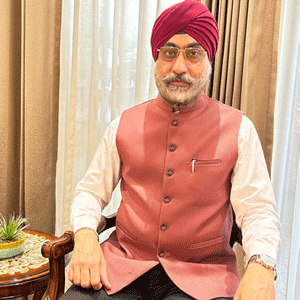
Against this backdrop, Ozla Plastocraft has established a distinctive position as an engineering-led manufacturer focused on developing indigenous solutions for controlled environments. Founded under the leadership of Dr. Manjeet Singh Ozla, an IIT Delhi alumnus with more than 35 years of experience in research, design, development, and manufacturing, the company has built its capabilities around product innovation and in-house engineering.
From Manufacturing to Indigenous Engineering
Ozla Plastocraft has evolved from a specialised product manufacturer into an R&D-driven organisation serving applications that demand controlled temperature, hygiene, insulation, and environmental integrity. Its portfolio encompasses clean room and cold room doors, controlled atmosphere doors and chambers, medical facility rooms and doors, PUF/PIR insulated systems, and specialised hardware.
“What distinguishes the company is its focus on indigenous technology development. Instead of relying extensively on imported technologies and critical components, Ozla Plastocraft has invested in developing its own products, manufacturing processes, and engineering capabilities.
The company estimates that these efforts have contributed to foreign-exchange savings of approximately US$5 million for India since its inception”, says Dr. Manjeet Singh Ozla, Founder.
This approach reflects a broader commitment to technological self-reliance, while also enabling the company to develop solutions around the specific operating requirements of Indian industries. Its expertise now extends across pharmaceuticals, healthcare, food processing, cold storage, controlled atmosphere storage, and other temperature- and hygiene-sensitive applications.
Engineering Performance into Every Solution
For controlled environments, performance is determined by much more than the primary equipment. Door sealing, insulation, air-tightness, hardware quality, operating frequency, and the ability to maintain prescribed environmental conditions can directly influence facility performance and energy consumption.
Ozla Plastocraft addresses these requirements through an application-oriented engineering approach. “The company considers parameters such as temperature, humidity, insulation, air-tightness, hygiene, traffic frequency, sealing requirements, and operating conditions before developing a solution. This enables it to customise dimensions, materials, hardware, insulation, and operating configurations according to individual project requirements”, mentions Dr. Manjeet Singh Ozla.
A significant part of this capability comes from its control over critical components. The company designs and manufactures key elements such as sealing gaskets and door latches in-house. This provides greater control over material selection, dimensional accuracy, consistency, and product performance while reducing dependence on external suppliers.
Energy efficiency is similarly embedded into the design philosophy. In refrigerated or temperature-controlled facilities, heat infiltration through poorly sealed doors, joints, or inadequate insulation can increase refrigeration loads and operating expenditure. By strengthening insulation and sealing performance, Ozla Plastocraft seeks to contribute not only to environmental control but also to the long-term efficiency of the facilities in which its solutions operate.
R&D Shaping the Next Generation of Controlled Environments
Innovation remains central to Ozla Plastocraft's growth strategy. The company continues to explore technologies that can address emerging requirements in hygiene, automation, monitoring, and energy efficiency. One notable area of R&D is the development of antimicrobial coatings for applications where microbial control is critical, including healthcare, pharmaceuticals, food processing, and other hygiene-sensitive environments.
The company is also examining greater integration of automation, sensors, access control, and intelligent monitoring. Such capabilities can potentially improve operational reliability, traceability, hygiene management, and energy performance while supporting the increasingly technology-driven nature of modern controlled facilities. Rather than treating innovation as a standalone function, Ozla Plastocraft integrates it into its broader product-engineering and manufacturing philosophy
This R&D orientation is reinforced by a culture of technical learning and collaboration. Customer feedback, engineering insights, manufacturing experience, and installation-site observations are brought together to improve existing products and inform future development. Rather than treating innovation as a standalone function, Ozla Plastocraft integrates it into its broader product-engineering and manufacturing philosophy.
Building a Globally Competitive Indian Technology Brand
Going forward, Ozla Plastocraft plans to deepen investments in R&D, antimicrobial technologies, energy-efficient systems, automation, advanced manufacturing, and indigenous product development. Strengthening technical capabilities, standardising manufacturing processes, and expanding its presence in Indian and international markets will form important elements of this roadmap.
Ultimately, Ozla Plastocraft's journey is defined by a clear engineering proposition: develop world-class technologies in India, reduce dependence on imported solutions, and deliver reliable products capable of meeting demanding industrial requirements. As controlled environments become increasingly critical to modern manufacturing, healthcare, food systems, and cold-chain infrastructure, the company's combination of indigenous R&D, manufacturing control, customisation, and application-focused engineering positions it to play a meaningful role in shaping the next phase of the industry.



We use cookies to ensure you get the best experience on our website. Read more...


