
As manufacturers across automotive, medical, consumer products, electronics, and industrial sectors pursue lighter, more complex, and higher-performing products, the role of an injection mould manufacturer has become increasingly strategic. Injection moulds are no longer viewed simply as production tools; their design and engineering directly influence component quality, cycle time, material efficiency, repeatability, and overall manufacturing economics.
As product development cycles become shorter and tolerance requirements more demanding, manufacturers increasingly need tooling partners capable of contributing from the earliest stages of design through production.
This is where Kamal Tools & Dies India Pvt Ltd has established its position. Founded in 2020 in Pune, Maharashtra, the company specialises in high-precision plastic injection moulds, moulded components, and advanced tooling solutions. Built around the technical expertise of its promoters, the company has developed an integrated approach that brings product design, mould development, precision machining, sampling, and component manufacturing into a connected workflow. Its ability to combine engineering depth with modern machining and quality-control practices has enabled it to serve industries where accuracy, reliability, and timely delivery are critical.
Building a Strong Foundation in Precision Tooling
Kamal Tools & Dies was established by Lalit Bafana, Badal Bhandari, and Lokesh Lalwani, bringing together complementary strengths in strategic growth, procurement, vendor management, and technical engineering. Among them, Lokesh Lalwani brings more than 15 years of experience in precision mould engineering and plastic injection mould manufacturing, playing a central role in the company's technical and operational development.
Since its incorporation in May 2020, Kamal Tools & Dies has steadily developed its capabilities despite entering the market during a challenging period for global manufacturing. Its Pune location provides access to one of India's strongest automotive and industrial ecosystems while placing the company close to a broad base of engineering, manufacturing, and component businesses.
The company's proposition extends beyond conventional mould manufacturing. It works across the tooling lifecycle, beginning with product design and manufacturability considerations and progressing through mould development, machining, sampling, and production of engineered polymer components. This integrated model allows customers to work with a single technical partner while reducing the disconnects that can arise when design, tooling, and production are handled independently.
Its focus on precision, customised development, delivery discipline, and technical support has helped Kamal Tools & Dies build a growing presence within India's competitive tooling ecosystem. Rather than competing purely on manufacturing capacity, the company is positioning itself around engineering capability and the ability to solve complex tooling requirements.
Engineering the Tool Before Manufacturing the Part
One of Kamal Tools & Dies' strongest differentiators is its end-to-end approach. The company involves its engineering and tooling expertise at the product design stage, enabling potential manufacturing challenges to be identified before tooling investment begins. Weak points, design bottlenecks, material-flow concerns, and other manufacturability issues can therefore be addressed before steel is cut.
“This approach has a direct impact on development efficiency. Product design and mould development are considered together to optimise material flow, cooling efficiency, cycle times, and dimensional consistency. Instead of treating mould manufacturing as a downstream activity, Kamal Tools & Dies integrates it into the product-development process”, says Lalit Bafana, Director.
The company's in-house mould manufacturing and sampling capabilities further strengthen this model. Design modifications and manufacturing iterations can be undertaken within a connected environment, helping reduce development cycles and accelerate product launches. Precision machining using high-end VMC and EDM technologies supports the execution of tight tolerances established during design.
The company's capabilities also extend from prototype tooling to series tooling. Proto-tools enable customers to validate form, fit, function, geometry, material behaviour, and other performance parameters before committing to high-volume production tooling. The learning generated during this stage can then be incorporated into series-tool design, creating continuity between development and commercial production.
For customers, this creates more than a faster tooling cycle. It reduces development risk, supports early validation, and provides a more controlled transition from prototype quantities to repeatable, high-volume manufacturing.
Advanced Infrastructure for Complex Moulds
Precision mould manufacturing depends heavily on the quality of the engineering infrastructure supporting it. Kamal Tools & Dies has developed a machining environment equipped to handle complex geometries and demanding tooling requirements. Its capabilities include high-speed Vertical Machining Centres with Automatic Tool Changers and spindle speeds of up to 15,000 RPM, supporting accurate and efficient cutting and profiling operations.
EDM technology is used for intricate cavity details, deep ribs, and geometries that may be difficult to achieve through conventional milling. The company's infrastructure also includes injection moulding machines extending up to 1,000-ton capacity, enabling it to address requirements ranging from smaller components to larger automotive applications.
Technology, however, forms only one part of precision engineering. Kamal Tools & Dies combines its machining infrastructure with CAD/CAM/CAE capabilities and experienced tooling engineers. Siemens NX is used for mould design and NC programming, while Design for Manufacturing and mould-flow considerations help assess plastic flow, cooling, warpage, sink marks, gate positioning, and cycle-time optimisation before manufacturing.
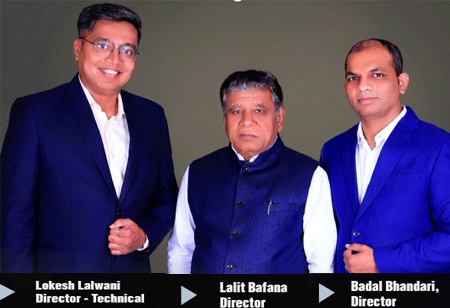
“This engineering-led approach is particularly valuable for complex moulds involving multi-cavity systems, hot runners, sliders, lifters, intricate parting lines, and demanding dimensional tolerances. By integrating simulation and manufacturing knowledge into the design stage, the company works toward achieving first-time-right tooling and minimising costly trial-and-error iterations”, shares Badal Bhandari, Director.
Quality Designed into Every Stage
For an injection mould manufacturer, quality cannot be confined to final inspection. Tool performance depends on decisions made throughout the manufacturing lifecycle, from material selection and machining to assembly, trials, and validation. Kamal Tools & Dies therefore follows a structured quality framework designed to maintain dimensional accuracy, durability, and repeatability.
Incoming material inspection verifies steel grades and hardness against project requirements. During manufacturing, dimensional checks are performed at critical stages following machining, EDM, and other precision processes. Coordinate Measuring Machines, optical inspection systems, and laser scanning capabilities support detailed dimensional verification.
The validation process continues through mould trials and sampling. T1 and subsequent trials allow mould performance and component characteristics to be assessed against drawings and 3D CAD data. Inspection reports, dimensional measurements, wall-thickness checks, and functional assessments provide a basis for customer approval and further refinement where required.
Durability is addressed through appropriate heat treatment, surface engineering, standardised components, and cooling design. Controlled heat treatment and processes such as nitriding and stress relieving help improve hardness, wear resistance, and toughness. The use of recognised standard components also supports maintainability and long-term serviceability.
Kamal Tools & Dies follows a structured quality framework designed to maintain dimensional accuracy, durability, and repeatability
Project management complements these technical controls. Detailed schedules, milestone tracking, progress updates, and contingency planning help the company maintain visibility across tooling programmes. This combination of engineering discipline and structured execution enables Kamal Tools & Dies to approach delivery as an integrated responsibility rather than simply a production deadline.
Expanding Capability, Technology and Market Reach
The company's next phase is centred on expanding both technology and engineering capability. “Investments in high-speed VMCs, precision EDM systems, and advanced metrology are expected to strengthen its ability to execute increasingly complex moulds while improving lead times and tolerance control. The company also intends to deepen its expertise in specialised moulding technologies, including gas-assisted injection moulding, long-fibre injection moulding, and injection-compression moulding”, highlights Lokesh Lalwani, Director - Technical.
At the engineering level, Kamal Tools & Dies plans to strengthen its product-design, research, and proto-tool capabilities so that it can participate more closely in customer development programmes from the conceptual stage. Greater use of CAE and mould-flow analysis will support simulation-driven optimisation and help identify potential defects before tooling reaches the manufacturing floor.
The company also sees opportunities beyond its established automotive, consumer-appliance, and industrial markets, with medical devices and specialised electronics emerging as areas for future expansion. Alongside diversification, sustainable manufacturing is expected to become increasingly relevant, with attention to energy efficiency, reduced polymer waste, optimised runner systems, and the use of suitable sustainable engineering materials.
With these priorities, Kamal Tools & Dies is moving from being a precision tooling manufacturer toward becoming a more comprehensive engineering partner for product development and production. Its combination of technical expertise, integrated tooling capabilities, modern manufacturing infrastructure, and a clear focus on quality provides a strong foundation for the next stage of growth.
As Indian manufacturing continues to demand greater precision, shorter development cycles, and more sophisticated polymer applications, the company's engineering-led approach positions it to contribute meaningfully to the evolving future of injection mould manufacturing.



We use cookies to ensure you get the best experience on our website. Read more...


