The global textile industry is undergoing a profound transformation as sustainability shifts from a niche preference to a business imperative. According to Textile Exchange, the global demand for preferred and sustainable fibres has grown steadily over the last decade, driven by increasing consumer awareness, regulatory pressure, and the fashion industry’s push toward responsible sourcing.
Organic cotton, low-impact fibres, transparent supply chains, and ethical manufacturing practices are no longer optional differentiators; they are becoming essential pillars of the modern textile ecosystem.
Within this evolving landscape, manufacturers capable of combining sustainability with scalability are emerging as key industry contributors. Among them, Herbal Fab has carved a distinctive position by building an ecosystem centred around organic fabrics, transparent sourcing, and ethical production practices.
What began as a conscious shift away from conventional textile manufacturing has evolved into a comprehensive sustainable textile platform catering to global brands, emerging designers, and environmentally conscious businesses. By integrating certified supply chains, diversified sustainable fibres, and responsible garment manufacturing, Herbal Fab has steadily positioned itself as a trusted name in India’s growing sustainable textiles segment.
From Conventional Textiles to Conscious Manufacturing
Herbal Fab’s journey is rooted in transformation. Coming from a family with over four decades of experience in the textile business, the founders witnessed firsthand the environmental impact of conventional textile manufacturing. A broader lifestyle shift towards Ayurveda, organic living, and chemical-free consumption eventually prompted the family to re-evaluate its own business practices.
The company was established in 2008 with a clear vision: to create textiles that aligned with environmental responsibility and human well-being. In its earliest phase, Herbal Fab focused on hand-spun, handwoven fabrics and natural dyeing processes. However, sustainable textiles were still relatively unfamiliar to the market at the time, making the initial years largely educational rather than commercial.
Rather than compromising on its principles, the company adapted strategically. Recognising the growing importance of globally accepted standards, Herbal Fab transitioned toward GOTS-certified manufacturing while continuing to maintain its sustainability-first philosophy. Over time, this helped the company bridge the gap between traditional eco-conscious practices and the scalability required by international markets.
Building a Transparent Sustainable Supply Chain
Herbal Fab’s defining strength lies in its supply chain approach. Instead of limiting sustainability to the finished product, the company focuses on creating accountability across every stage of production. This included working closely with mills, dyeing units, and manufacturers to encourage adoption of organic and environmentally responsible practices.
During the early years, the company actively guided conventional textile mills through the process of obtaining GOTS certification, long before sustainability became an industry-wide priority. This collaborative approach enabled Herbal Fab to build a reliable network spanning yarn production, weaving, dyeing, printing, and garment manufacturing.
Today, the company offers an extensive portfolio of sustainable fabrics, including organic cotton, linen, hemp, lyocell, modal, EcoVero, cupro, and handwoven textiles. However, what differentiates Herbal Fab is its emphasis on supply chain transparency. The company evaluates not just the fibre itself but also the extraction methods, chemical processes, and manufacturing systems behind every material before introducing it into its portfolio.
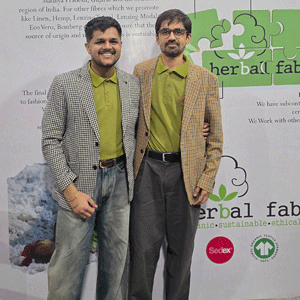
“This selective approach reflects a deeper understanding of sustainability. In an industry where many materials are marketed as eco-friendly despite chemically intensive production methods, Herbal Fab prioritises authenticity over trend-driven marketing”, says Aniket
Enabling Sustainable Fashion for Emerging Brands
While large global brands increasingly have access to sustainable sourcing networks, smaller fashion labels and emerging designers often struggle with minimum order quantities and limited supply chain access. Herbal Fab noted the gaps and has developed a model specifically designed to support smaller businesses entering the sustainable fashion space.
By maintaining ready stock of sustainable fabrics in smaller quantities, the company enables startups and independent brands to source responsibly without facing the operational barriers typically associated with organic textiles. Over the years, several clients who initially approached Herbal Fab for sampling quantities have grown into established brands with larger production requirements.
This ability to support businesses across different scales has strengthened Herbal Fab’s role within the broader sustainable fashion ecosystem. The company has effectively positioned itself not just as a supplier, but as a long-term growth partner for sustainability-focused brands. Herbal Fab expanded beyond fabrics into garment manufacturing, allowing the company to offer end-to-end sustainable solutions
Expanding Sustainable Manufacturing
In recent years, Herbal Fab has expanded beyond fabrics into garment manufacturing, allowing the company to offer end-to-end sustainable solutions. Its manufacturing unit now caters to a wide range of product categories, including babywear, dresses, jerseys, jackets, and woven garments for export markets.
The company’s operational philosophy extends beyond environmental sustainability into workforce development and ethical culture. Herbal Fab places a strong emphasis on employee growth, skill development, and creating a collaborative work environment. Several team members who joined in entry-level roles have progressed into supervisory and managerial positions, reflecting the company’s commitment to long-term people development.
Simultaneously, the company is working toward achieving net-zero operations by 2027 through initiatives such as solar energy integration, rainwater harvesting, and waste management systems. These efforts underline Herbal Fab’s broader vision of building a textile business that balances commercial growth with environmental responsibility.
As sustainability continues to reshape global textile manufacturing, companies that combine transparency, ethical production, and long-term vision will increasingly define the industry’s future. Herbal Fab’s journey demonstrates how purpose-driven manufacturing can evolve into a scalable and credible business model while contributing meaningfully to the global movement toward sustainable textiles.
.jpg "TSi Power: Building Smarter Power Protection For Modern Industry")
.jpg "Aditya Energy Services: Powering India’s Industrial Transition to a Sustainable Future")



We use cookies to ensure you get the best experience on our website. Read more...


