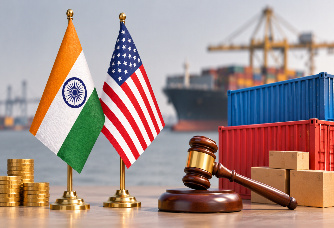
The latest US tariff proposal has added a new dimension to the growing trade tensions between India and the United States.
The Trump administration has proposed duties of up to 25 percent on Indian goods, citing concerns over structural excess capacity in India's manufacturing sector.
In response, the Chamber of Trade and Industry (CTI) has urged Prime Minister Narendra Modi to consider a 25 percent retaliatory tariff on American imports.
The trade body estimates that the proposed US duties could put USD 48 billion worth of Indian exports and around five lakh jobs at risk.
Any retaliatory move could also affect American exporters, manufacturers and businesses, raising questions about the wider economic consequences for both countries.
The India-US tariff dispute gained momentum in April 2025, when US President Donald Trump announced a 26 percent reciprocal tariff on Indian imports as part of his broader trade policy.
Although the additional duties were temporarily paused for 90 days, the US retained a 10 percent baseline tariff, keeping pressure on Indian exporters.
Tensions escalated in July 2025, when Washington announced a separate 25 percent tariff on Indian goods, followed by another 25 percent penalty linked to India's continued purchases of Russian oil.
By August 27, the combined additional tariff burden on several Indian exports had reached 50 percent, making India one of the countries facing the highest US tariff rates.
A possible breakthrough emerged in February 2026, when both countries announced a framework for an interim trade agreement. Under the framework, the US agreed to cut reciprocal tariffs from 25 percent to 18 percent and remove the additional 25 percent duty linked to Russian oil purchases, subject to further negotiations and formalization.
The situation changed again following the US Supreme Court's February 2026 ruling against the legal basis of Trump's reciprocal tariff framework, prompting Washington to pursue alternative tariff measures.
On November 25, 2026, the United States Trade Representative (USTR) proposed tariffs of up to 25 percent on Indian goods under a separate Section 301 investigation into alleged structural excess capacity in manufacturing.
The proposed rate could be reduced to 17 percent if India reaches a qualifying trade agreement with Washington. The latest proposal has added another layer of uncertainty to the bilateral trade relationship.
Also Read: India's Industrial Power Takes Shape Ahead of This Independence Day
The US tariff measures have increased pressure on Indian exporters with significant exposure to the American market.
According to the Government of India's response to a Rajya Sabha question in January 2026, approximately USD 47.2 billion of India's merchandise exports to the US, out of total exports worth around USD 86.4 billion in 2024, fell under categories subject to additional tariffs. The government also acknowledged that the measures had affected select Indian exports.
The exposure is particularly relevant for sectors such as textiles, gems and jewellery, marine products, engineering goods and chemicals, where access to the US market is commercially important.
However, the impact has not translated into an across-the-board decline in trade. India's exports to the US reached USD 59.04 billion during April-November 2025, registering 13 percent growth over the corresponding period a year earlier, according to the Ministry of External Affairs. This suggests that export performance remained resilient despite tariff-related pressure.
American businesses also have substantial trade exposure to India. According to the US Trade Representative, US goods imports from India increased 18.9 percent to USD 103.8 billion in 2025, while American goods exports to India rose 9.1 percent to USD 45.4 billion. The US goods trade deficit with India consequently widened to USD 58.4 billion.
For American importers, tariffs can increase the landed cost of Indian products, as the importer of record is generally responsible for paying customs duties.
The latest USTR tariff proposal has drawn criticism from Democratic lawmakers in the US, while the Indian government and industry representatives have called for negotiations to address the dispute.
US Senator Ron Wyden, incoming Chairman of the Senate Finance Committee, criticized the November 25 announcement, arguing that the proposed duties would increase costs for American families, workers and small businesses. He pledged to use his position to challenge the tariffs and restore Congress's authority over trade.
House Democratic Leader Hakeem Jeffries has also opposed Trump's tariff policy, pledging to stop what he described as the “ill-advised Trump tariffs”.
On the Indian side, the Ministry of Commerce and Industry rejected the USTR's structural excess capacity allegations and said trade concerns should be addressed through ongoing bilateral negotiations.
Meanwhile, S.C. Ralhan, President of FIEO, called for a fair and predictable India-US trade agreement, supporting the government's efforts to resolve the issue through dialogue.
Also Read: 5 Small-Scale Manufacturing Business Backed by India's Policy Push
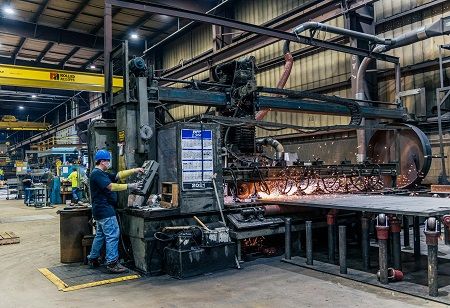
The US allegation centers on a concern that India is expanding its manufacturing capacity faster than market demand can absorb. This is what Washington calls “structural excess capacity” - when production remains higher than demand, partly because of government support and industrial policies.
In its November 2026 report, the Office of the US Trade Representative (USTR) pointed to initiatives such as Make in India, the Production Linked Incentive (PLI) scheme and Atmanirbhar Bharat. It argued that these programs encourage production and exports through financial incentives.
The report also highlighted sectors such as steel, solar energy, pharmaceuticals and information technology. For instance, it cited India's solar module manufacturing capacity of 154 GW, against domestic demand of 53 GW.
The Indian government has rejected the allegation, stating that the country does not have structural excess capacity in any sector. It says trade concerns should be addressed through ongoing bilateral negotiations.
The Chamber of Trade and Industry (CTI) has urged Prime Minister Narendra Modi to consider a 25 percent retaliatory tariff on US goods if Washington goes ahead with its proposed duties on Indian products. CTI Chairman Brijesh Goyal said the move could put pressure on American businesses while protecting the interests of Indian traders.
Goyal estimates that the proposed US tariffs could affect USD 48 billion worth of Indian exports and put around five lakh jobs at risk. He said sectors such as pharmaceuticals, electronics, seafood, textiles, leather, gems and jewellery, metals and auto components could face difficulties if higher duties make Indian products more expensive for American buyers.
If India imposes a matching 25 percent duty, US exporters could also face higher costs when selling goods in the Indian market. This could affect American suppliers of products such as petroleum, machinery, electronic goods, chemicals and agricultural products. Goyal believes the added costs could encourage US traders to press their government to resolve the dispute.
However, CTI's proposal is a recommendation to the government. India has not announced any such retaliatory duties.
Also Read: 5 Indian Renewable Energy Leaders Shaping the Energy Transition
India and the US are still negotiating a Bilateral Trade Agreement (BTA), following the interim trade framework announced in February 2026. The framework was intended to reduce trade barriers and improve market access for businesses in both countries. However, the latest US tariff proposal has added another challenge to these negotiations.
The USTR has proposed tariffs of up to 25 percent on Indian goods, with the possibility of reducing the rate to 17 percent if both countries reach a qualifying trade agreement. This gives India an incentive to continue negotiations, but the terms still need to be worked out.
India has said that trade-related concerns should be addressed through bilateral talks and has reiterated its commitment to an early agreement. However, if the government considers CTI's proposed retaliatory tariffs, it could create another point of disagreement. Both countries will need to find common ground if they want to avoid further trade tensions and secure a stable agreement.







We use cookies to ensure you get the best experience on our website. Read more...